Species · Flowering plants
Mohave Yucca Yucca schidigera
The scientific name of the Mohave Yucca is Yucca schidigera. It is a species of flowering plant in the family Asparagaceae (asparagus family), order Asparagales.
- Scientific name
- Yucca schidigera Roezl ex Ortgies
- Common name
- Mohave Yucca
- Genus
- Yucca
- Family
- Asparagaceae (Asparagus Family)
- Order
- Asparagales
- Class
- Liliopsida
- Red List category
- LC Least Concern
- Recorded in
- 2 countries
- Name status
- accepted in the Catalogue of Life

Overview
The Mohave yucca (Yucca schidigera Roezl ex Ortgies) is an evergreen shrub or small tree in the family Asparagaceae, order Asparagales, and class Liliopsida. It occurs in Arizona, Baja California, California, Nevada, and Utah, most commonly in the Mojave Desert and extensively in the Sonoran Desert. It is distinguished by stiff leaves with stringy marginal fibers and spiny tips.
Written 26 November 2026 from the sources listed below. Each statement was checked against the passage it cites; statements that could not be supported were removed.
Appearance
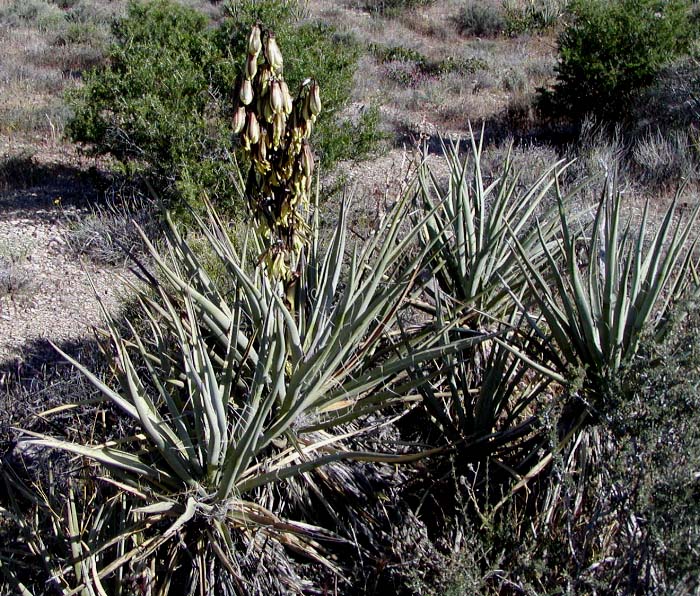
The Mohave yucca is an evergreen shrub or small tree with several stems and a variable growth form. Its stems are generally unbranched or have only a few branches, and its leaves grow in rosettes at the ends of branches.[1][2][3]
Its round to bell-shaped flowers grow in dense panicles on sturdy stalks. Its fruit is a fleshy, indehiscent capsule, and its seeds are thick, rough, dull black, and sometimes have scattered shiny spots.[4][5][6]
Mature stems commonly reach heights of 0.5–5 m, and the trunk diameter typically ranges from 15 to 50 cm. Flower stalks typically measure approximately 0.5–1.3 m tall.[7][8][9]
Its fruit capsules measure approximately 5–11 cm long and 4 cm wide. Its seeds measure approximately 6–9 mm in diameter.[10][11]
Its rhizomes can reach 1.5–2 cm in diameter and 20 cm in length.[12]
Habitat
The Mohave yucca typically grows on dry rocky slopes, flats, and washes in hot and arid habitats. Its habitats commonly have gravelly and calcareous soils.[13][14][15]
It is most commonly found in the Mojave Desert and also occurs extensively in the Sonoran Desert. It occurs in desert hardpan soils in Mercury Valley, Nevada.[16][17][18]
Its native range includes Arizona, Baja California, California, Nevada, and Utah. Its northern distribution in California reaches San Bernardino County, its southern distribution limit reaches northern Baja California, it is restricted to the northwestern part of Arizona, and it occurs in Washington County, Utah.[19][20][21][22][23]
It typically occurs at elevations between sea level and approximately 1,800 m. In coastal parts of its range, it commonly grows alongside chamise (Adenostoma fasciculatum).[24][25]
Behaviour
The Mohave yucca can survive without watering for more than one month without wilting or showing other adverse effects. It produces new sprouts readily after fires.[26][27]
Reproduction and life cycle
Its flower stalks produce flowers only once. Plants generally do not flower at five or six years of age, and it may take approximately 35 years for a plant to reach maturity.[28][29][30]
The Mohave yucca maintains a mutualistic pollination relationship with the yucca moth Tegeticula yuccasella. Yucca moths transfer pollen by carrying pollen balls between flowers and pushing them down the stigma tube.[31][32]
Yucca moths lay their eggs in the ovaries of fertilized flowers, and their larvae feed on developing seeds.[33][34]
Conservation
The species has no special federal legal status. Increased fire frequency associated with introduced nonnative grasses has reduced its survival rate.[35][36]
Uses
Native Americans use its leaf fibers to manufacture rope, cloth, thread, and sandals. Its flowers and fruits are eaten raw or roasted, and its black seeds have traditionally been ground into flour.[37][38][39]
Its roots are used to make soap. Extracts from the plant are used in animal feed and herbal medications.[40][41]
Its mature flower stalks are used as substitutes for eucalyptus stems or logs in making didgeridoos. Commercial steroid saponins are produced from the species for use as naturally derived food-grade surfactants.[42][43]
The plant is included in some dog foods to reduce pet waste odor.[44]
Classification of the Mohave Yucca
| Kingdom | Plantae |
|---|---|
| Subkingdom | Pteridobiotina |
| Phylum | Tracheophyta |
| Class | Liliopsida |
| Order | Asparagales |
| Family | Asparagaceae (Asparagus Family) |
| Genus | Yucca (Spanish-bayonet) |
| Species | Yucca schidigera Roezl ex Ortgies |
Where the Mohave Yucca is found
Checklists and occurrence records place Yucca schidigera in 2 countries across North America. GBIF holds 19,917 georeferenced records of it.
Countries
Regions and cities with the most records
- California, United States 11,405
- Nevada, United States 6,119
- Encinitas, United States 1,953
- Twentynine Palms, United States 1,932
- Summerlin South, United States 1,777
- Spring Valley, United States 1,662
- Enterprise, United States 1,516
- Baja California, Mexico 1,384
- Rancho Mirage, United States 979
- Palm Desert, United States 969
- Yucca Valley, United States 900
- National City, United States 883
- San Diego, United States 878
- Coronado, United States 873
- La Quinta, United States 835
- Chula Vista, United States 748
- Paradise, United States 710
- Desert Hot Springs, United States 691
- Imperial Beach, United States 672
- La Presa, United States 618
- Lemon Grove, United States 602
- La Mesa, United States 576
- Spring Valley, United States 569
- Arizona, United States 559
- Casa de Oro-Mount Helix, United States 524
- Rancho San Diego, United States 517
- Poway, United States 514
- Cathedral City, United States 506
- El Cajon, United States 502
- San Marcos, United States 462
- Escondido, United States 410
- Santee, United States 403
- Vista, United States 378
- Carlsbad, United States 373
- Bostonia, United States 366
- Tijuana, Mexico 336
A number beside a place is its count of GBIF occurrence records. A place without a number comes from a checklist alone. Records show where a species has been observed or collected, which can include escapes and vagrants.
Common names
English
- Mohave Yucca
- Mojave Yucca
- Spanish Bayonet
Names in 4 other languages
- Chinese
- 莫哈維絲蘭, 西地格丝兰
- Russian
- Юкка Шидигера
- Spanish
- Yuca de Mojave
- chl
- hunuvat
Synonyms
3 other scientific names have been used for this species and are now treated as synonyms of Yucca schidigera.
- Sarcoyucca mohavensis (Sarg.) Linding.
- Yucca mohavensis Sarg.
- Yucca californica Nutt. ex Baker ambiguous synonym
Related species
-
 Joshua TreeYucca brevifolia
-
 Adam's-needleYucca filamentosa
-
 Adam's NeedleYucca gloriosa
-
 Spineless YuccaYucca gigantea
-
 Big Bend YuccaYucca rostrata
-
 Spanish BayonetYucca aloifolia
-
 Banana YuccaYucca baccata
-
 Small SoapweedYucca glauca
Compare
Questions and answers
What is the scientific name of the Mohave Yucca?
The scientific name of the Mohave Yucca is Yucca schidigera. Written with its author, the full name is Yucca schidigera Roezl ex Ortgies.
Which family does the Mohave Yucca belong to?
Yucca schidigera belongs to the family Asparagaceae, in the order Asparagales and the class Liliopsida.
Where is the Mohave Yucca found?
Checklists and occurrence records place Yucca schidigera in 2 countries: United States and Mexico.
What is the conservation status of the Mohave Yucca?
The IUCN Red List category recorded for Yucca schidigera is Least Concern (LC).
What other names does the Mohave Yucca have?
Yucca schidigera is also known in English as Mojave Yucca and Spanish Bayonet.
Sources
Passages the profile rests on
- Yucca schidigera is an evergreen shrub or small tree with several stems and a variable growth form. Source passage: “Mojave yucca is an evergreen shrub or small tree with a variable growth habit. Typically there are several stems” — fs.usda.gov
- Its stems are generally unbranched or have only a few branches. Source passage: “Stems are without branches or sparingly branched” — fs.usda.gov
- Its leaves grow in rosettes at the ends of branches. Source passage: “Leaves occur in rosettes at the ends of branches.” — fs.usda.gov
- Its flowers are round to bell-shaped and grow in dense panicles on sturdy stalks. Source passage: “Round to bell-shaped flowers in a dense panicle occur at or above the longest leaves on a sturdy” — fs.usda.gov
- Its fruit is a fleshy, indehiscent capsule. Source passage: “Mojave yucca produces an indehiscent, fleshy fruit (capsule).” — fs.usda.gov
- Its seeds are thick, rough, dull black, and sometimes have scattered shiny spots. Source passage: “Seeds are thick, rough, and dull black with scattered shiny spots.” — fs.usda.gov
- Mature stems commonly reach heights of 0.5–5 m. Source passage: “Mature stem height commonly ranges from 2 to 20 feet (0.5-5 m)” — fs.usda.gov
- Its trunk diameter typically ranges from 15 to 50 cm. Source passage: “Trunk diameter ranges from 5.9 to 20 inches (15-50 cm)” — fs.usda.gov
- Its flower stalks typically measure approximately 0.5–1.3 m tall. Source passage: “on a sturdy, 1.6- to 4.3-foot-tall (0.5-1.3 m) stalk” — fs.usda.gov
- Its fruit capsules measure approximately 5–11 cm long and 4 cm wide. Source passage: “Capsules are cylindrical and measure 2 to 4.3 inches (5-11 cm) long and approximately 1.6 inches (4 cm) wide” — fs.usda.gov
- Its seeds measure approximately 6–9 mm in diameter. Source passage: “Seed diameter is 0.2 to 0.4 inch (6-9 mm)” — fs.usda.gov
- Its rhizomes can reach 1.5–2 cm in diameter and 20 cm in length. Source passage: “Rhizomes may reach 0.6 to 0.8 inch (1.5-2 cm) in diameter and 8 inches (20 cm) in length” — fs.usda.gov
- It typically grows on dry rocky slopes, flats, and washes. Source passage: “Mojave yucca is most often described on dry rocky slopes, flats, or washes throughout its range” — research.fs.usda.gov
- It occupies hot and arid habitats. Source passage: “Habitats occupied by Mojave yucca are hot and arid.” — research.fs.usda.gov
- Its habitats commonly have gravelly and calcareous soils. Source passage: “The soils in Mojave yucca habitats are often described as gravelly and calcareous” — research.fs.usda.gov
- It occurs in desert hardpan soils in Mercury Valley, Nevada. Source passage: “In Nevada's Mercury Valley, Mojave yucca occurs in desert hard pan soils” — research.fs.usda.gov
- It is most commonly found in the Mojave Desert. Source passage: “It is most common in the Mojave Desert” — English Wikipedia
- It also occurs extensively in the Sonoran Desert. Source passage: “but also occurs extensively in the Sonoran Desert” — English Wikipedia
- Its native range includes Arizona, Baja California, California, Nevada, and Utah. Source passage: “Yucca schidigera is native to Arizona, Baja California, California, Nevada, and Utah.” — English Wikipedia
- Its northern distribution in California reaches San Bernardino County. Source passage: “The northern limit of Mojave yucca in California is San Bernardino County” — research.fs.usda.gov
- Its southern distribution limit reaches northern Baja California. Source passage: “Mojave yucca's southern limit is reached in Baja California Norte” — research.fs.usda.gov
- In Arizona, it is restricted to the northwestern part of the state. Source passage: “In Arizona, Mojave yucca is restricted to the northwestern part of the state” — research.fs.usda.gov
- In Utah, it occurs in Washington County. Source passage: “It occurs in the southernmost part of Nevada, Clark County, and in southwestern Utah's Washington County” — research.fs.usda.gov
- In coastal parts of its range, it commonly grows alongside chamise (Adenostoma fasciculatum). Source passage: “In the coastal part of its range, Y. schidigera usually associates with Adenostoma fasciculatum (chamise).” — English Wikipedia
- It typically occurs at elevations between sea level and approximately 1,800 m. Source passage: “Mojave yucca is most typical from 0 to 5,900 feet (1,800 m) elevations” — research.fs.usda.gov
- It can survive without watering for more than one month without wilting or showing other adverse effects. Source passage: “Potted Mojave yucca plants without water for over 1 month did not wilt or show any other adverse effects” — research.fs.usda.gov
- It produces new sprouts readily after fires. Source passage: “Post fire, the Mojave yucca produces sprouts eagerly” — English Wikipedia
- Its flower stalks produce flowers only once. Source passage: “Stalks produce flowers only once” — fs.usda.gov
- Plants generally do not flower at five or six years of age. Source passage: “Webber [91] reports that 5- and 6-year-old Mojave yucca seedlings did not produce flowers.” — fs.usda.gov
- It may take approximately 35 years for the plant to reach maturity. Source passage: “Rowlands [76] reports that Mojave yucca takes 35 years to reach maturity.” — fs.usda.gov
- It maintains a mutualistic pollination relationship with the yucca moth Tegeticula yuccasella. Source passage: “Mojave yucca maintains a mutualistic relationship with its pollinator, a yucca moth (Tegeticula yuccasella).” — fs.usda.gov
- Yucca moths transfer pollen by carrying pollen balls between flowers and pushing them down the stigma tube. Source passage: “Yucca moths collect pollen from several flowers, form it into a ball, carry it to other flowers, and force it down the stigma tube.” — fs.usda.gov
- Yucca moths lay their eggs in the ovaries of fertilized flowers. Source passage: “Moths lay their eggs in the ovary after fertilizing flowers.” — fs.usda.gov
- Yucca moth larvae feed on developing seeds. Source passage: “Moth larvae feed on the developing seeds.” — fs.usda.gov
- The species has no special federal legal status. Source passage: “FEDERAL LEGAL STATUS: No special status” — fs.usda.gov
- Increased fire frequency associated with introduced nonnative grasses has reduced its survival rate. Source passage: “However, the introduction of nonnative grasses led to a higher frequency of fire, which decreased the survival rate of Y. schidigera.” — English Wikipedia
- Its leaf fibers are used by Native Americans to manufacture rope, cloth, thread, and sandals. Source passage: “The fibers of the Yucca schidigera leaves are used by Native Americans to make rope, cloth, thread, and sandals.” — English Wikipedia
- Its flowers and fruits are eaten raw or roasted. Source passage: “The flowers and fruit are eaten either raw or roasted” — English Wikipedia
- Its black seeds have traditionally been ground into flour. Source passage: “and the black seeds were ground into a flour.” — English Wikipedia
- Its roots are used to make soap. Source passage: “The roots are used to make soap.” — English Wikipedia
- Extracts from the plant are used in animal feed and herbal medications. Source passage: “Currently, extracts from this plant are in animal feed and various herbal medications.” — English Wikipedia
- Its mature flower stalks are used as substitutes for eucalyptus stems or logs in making didgeridoos. Source passage: “The rigid flower stalk of the yucca, after maturation, is used as a substitute for eucalyptus stems or logs to make didgeridoos.” — English Wikipedia
- Commercial steroid saponins are produced from this species for use as naturally derived food-grade surfactants. Source passage: “Steroid saponins are produced commercially from Y. schidigera that can be used as naturally derived food-grade surfactant.” — English Wikipedia
- The plant is included in some dog foods to reduce pet waste odor. Source passage: “It is mainly included in their food to reduce the waste odor of most pets.” — English Wikipedia
Data
- Catalogue of Life, 2026-10-16 XR cc by
- Global Biodiversity Information Facility CC BY 4.0
- Wikidata CC0
- GeoNames CC BY 4.0
- Wikimedia Commons per image; credit shown with each image
- Within the Catalogue of Life, this name comes from The World Checklist of Vascular Plants (WCVP) cc by
References
- Gartenflora 20: 110 (1871) where the name was published
This species in other databases
- Catalogue of Life 5CT9V
- Wikidata Q1518712
- iNaturalist 68400
- World Flora Online wfo-0000771250
- GRIN 405146
Page built on 26 November 2026. See how the catalog is made and all sources and licences.
Cite this page
ScientificNames.org. (2026). Yucca schidigera (Mohave Yucca). Retrieved November 26, 2026, from https://scientificnames.org/species/yucca-schidigera
“Yucca schidigera (Mohave Yucca).” ScientificNames.org, 2026, scientificnames.org/species/yucca-schidigera. Accessed 26 Nov. 2026.
ScientificNames.org. “Yucca schidigera (Mohave Yucca).” Accessed November 26, 2026. https://scientificnames.org/species/yucca-schidigera.
@misc{scientificnames_yucca_schidigera_mohave_yucca,
  author = {{ScientificNames.org}},
  title = {Yucca schidigera (Mohave Yucca)},
  year = {2026},
  url = {https://scientificnames.org/species/yucca-schidigera},
  note = {Accessed 2026-11-26}
}