Species · Flowering plants
Ginger Zingiber officinale
The scientific name of the Ginger is Zingiber officinale. It is a species of flowering plant in the family Zingiberaceae (ginger family), order Zingiberales.
- Scientific name
- Zingiber officinale Roscoe
- Common name
- Ginger
- Genus
- Zingiber
- Family
- Zingiberaceae (Ginger Family)
- Order
- Zingiberales
- Class
- Liliopsida
- Red List category
- DD Data Deficient
- Recorded in
- 31 countries
- Name status
- accepted in the Catalogue of Life

Overview
Ginger (Zingiber officinale Roscoe) is a flowering plant in the family Zingiberaceae, order Zingiberales, and class Liliopsida. The species is native to humid, partly shaded habitats in moist tropical and subtropical forests of Southeast Asia. Ginger is distinguished by its thick, branched rhizomes with a corky brown to golden outer skin and pale yellow interior.
Written 26 November 2026 from the sources listed below. Each statement was checked against the passage it cites; statements that could not be supported were removed.
Appearance
Ginger produces annual pseudostems with narrow leaf blades. The annual pseudostems grow to approximately one meter tall.[1][2]
The leaves are medium green, alternate, long, and narrow. The shoots consist of tightly wrapped leaf sheaths that form pseudostems.[3][4]
The rhizomes are thick, branched, and warty, with a corky brown to golden outer skin. Their interior is pale yellow and has a spicy, almost lemon-like scent.[5][6]
The flower spikes are dense and cone-shaped, with greenish or yellowish bracts. The flowers are cream to yellowish green and have mauve or deep purple lips.[7][8]
The inflorescences emerge directly from the rhizome on separate shoots. They develop on separate, leafless stems.[9][10]
Young ginger rhizomes are juicy, fleshy, and mildly flavored. Mature rhizomes become hotter, more fibrous, and drier.[11][12]
Habitat
Ginger is native to humid, partly shaded habitats in moist tropical and subtropical forests of Southeast Asia. The species originated in Maritime Southeast Asia.[13][14]
The plant grows best in hot, humid conditions and fertile soil. Ginger grows best in soil temperatures around 77 degrees Fahrenheit.[15][16]
Ginger is cultivated commercially in South and Southeast Asia, tropical Africa, parts of Central America and the Caribbean, and Australia. It is cultivated in India, China, and Nepal.[17][18]
The plant was transported throughout the Indo-Pacific during the Austronesian expansion. Austronesian voyagers introduced ginger to the Pacific Islands in prehistoric times.[19][20]
Ginger was carried to Madagascar and the Comoros during the first millennium CE. It was introduced to the Caribbean islands from Asia during the sixteenth century.[21][22]
Behaviour
Unharvested ginger plants gradually spread outward and form dense clumps. During short winter days and cool temperatures, the plants become dormant and lose their stems.[23][24]
Reproduction and life cycle
Flowering generally begins when ginger clumps are at least two years old. Culinary ginger flowers are usually sterile and rarely produce seeds.[25][26]
Uses
Ginger rhizomes are widely used as a culinary spice and in traditional folk medicine. The rhizome can be used fresh, dried, ground, or preserved in brine, vinegar, or sugar syrup.[27][28]
Ginger is used in vegetables, candy, soda, pickles, and alcoholic beverages. Young rhizomes are commonly pickled in vinegar or sherry or cooked in various dishes.[29][30]
Ginger can be steeped in boiling water to prepare herbal tea. It is commonly used as a spice in Chinese, Korean, Japanese, Vietnamese, and South Asian cuisines.[31][32]
Ginger is used medicinally for ailments including headaches, colds, nausea, and vomiting. It has been used in traditional medicine in China, India, and Japan for centuries.[33][34]
Ginger rhizomes and leaves were historically used by Austronesian peoples to flavor food or were eaten directly. Ginger leaves were also used to weave mats.[35][36]
Ginger was used in Austronesian rituals for healing and protection from spirits.[37]
Similar species
Plants in the distantly related genus Asarum are commonly called wild ginger because of their similar taste.[38]
Classification of the Ginger
| Kingdom | Plantae |
|---|---|
| Subkingdom | Pteridobiotina |
| Phylum | Tracheophyta |
| Class | Liliopsida |
| Order | Zingiberales |
| Family | Zingiberaceae (Ginger Family) |
| Genus | Zingiber (Ginger) |
| Species | Zingiber officinale Roscoe |
Where the Ginger is found
Checklists and occurrence records place Zingiber officinale in 31 countries across Africa, Asia, North America and Oceania. GBIF holds 792 georeferenced records of it.
Countries where it is native or its origin is not stated
Countries where it has been introduced
- Australia 18
- Bangladesh
- Cambodia 2
- China 62
- Comoros 1
- Costa Rica 25
- Cuba 12
- Dominican Republic 1
- Haiti 3
- Honduras 5
- India 131
- Madagascar 5
- Mauritius
- Mexico 85
- Myanmar
- Philippines 168
- Puerto Rico 6
- Reunion 15
- Sri Lanka 18
- Taiwan 18
- Thailand 22
- Trinidad and Tobago 12
- Vanuatu 5
- Vietnam 44
Regions and cities with the most records
- Veracruz, Mexico 23
- Passi, Philippines 12
- Puebla, Mexico 12
- Taiwan, Taiwan 12
- Kerala, India 11
- Molave, Philippines 11
- Muricay, Philippines 11
- Le Tampon, Reunion 10
- Queensland, Australia 8
- Chiapas, Mexico 7
- Limón Province, Costa Rica 7
- Misantla, Mexico 7
- Saint-Louis, Reunion 7
- Saint-Pierre, Reunion 7
- Abucay, Philippines 6
- Alajuela Province, Costa Rica 6
- Amadeo, Philippines 6
- Bah-Bah, Philippines 6
- Dinalupihan, Philippines 6
- Fujian, China 6
- Guangxi, China 6
- Hermosa, Philippines 6
- Himachal Pradesh, India 6
- Iloilo, Philippines 6
- Indang, Philippines 6
- Jiangxi, China 6
- Mendez-Nuñez, Philippines 6
- Miaoli, Taiwan 6
- Orani, Philippines 6
- Patuto, Philippines 6
- Prosperidad, Philippines 6
- Puntarenas Province, Costa Rica 6
- Querétaro, Mexico 6
- Quintana Roo, Mexico 6
- Rajaori, India 6
- Samal, Philippines 6
41 more countries have a few records outside this range
These countries hold a few records of Zingiber officinale but lie outside the range the checklists give for it. Such records are often zoo or garden specimens, museum material or vagrants, so the species is not counted as occurring there.
- Barbados 6
- Belize 5
- Benin 12
- Bolivia 5
- Bonaire, Saint Eustatius and Saba 4
- Brazil 208
- Cameroon 20
- Colombia 25
- Cook Islands 5
- Democratic Republic of the Congo 9
- Dominica 7
- Ecuador 83
- Egypt 5
- El Salvador 21
- Ethiopia 6
- Fiji 10
- French Guiana 7
- French Polynesia 19
- Gabon 5
- Germany 7
- Ghana 4
- Guadeloupe 6
- Guatemala 6
- Italy 4
- Jamaica 35
- Martinique 9
- Mayotte 9
- New Caledonia 3
- New Zealand 6
- Nicaragua 9
- Nigeria 22
- Panama 47
- Papua New Guinea 14
- Peru 79
- Seychelles 67
- Sierra Leone 7
- South Africa 4
- Suriname 3
- Tanzania 6
- United States 59
- Venezuela 6
A number beside a place is its count of GBIF occurrence records. A place without a number comes from a checklist alone. Records show where a species has been observed or collected, which can include escapes and vagrants.
Common names
English
- Ginger
- Cooking Ginger
- Garden Ginger
Names in 47 other languages
- Arabic
- زنجبيل
- Armenian
- Կոճապղպեղ
- Bengali
- আদা
- Chinese
- jiang, 姜, 姜叶, 姜炭, 姜皮, 干姜, 炮姜, 煨姜
- Czech
- zázvorovník lékařský
- Danish
- ægte ingefær
- Dutch
- Gember
- Estonian
- Harilik ingver
- Finnish
- mausteinkivääri
- French
- gingembre
- German
- Ingwer
- Hindi
- अदरक
- Hungarian
- Gyömbér
- Indonesian
- Jahe
- Italian
- zenzero
- Japanese
- shoga, ショウガ
- Korean
- saenggang, 생강
- Latin
- Gingiberi, Zingiber
- Marathi
- आले
- Nepali
- अदुवा
- Norwegian
- Ingefær
- Polish
- imbir lekarski
- Portuguese
- gengibre
- Romanian
- Ghimber
- Russian
- Имбирь аптечный
- Serbian
- Ђумбир / Ðumbir
- Sinhala
- ඉඟුරු
- Spanish
- jengibre
- Swedish
- ingefära
- Tagalog
- Luya
- Tamil
- அல்லம், ஆர்த்தரகம், இஞ்சி, சுக்கு, வேர்க்கம்பு
- Telugu
- అల్లం
- Thai
- ขิง
- Turkish
- zencefil
- Ukrainian
- Імбир садовий
- aka
- Akakaduro
- arg
- Chinchebre
- bar
- Ingwar
- bnn
- duduk
- hus
- lab-itz
- jbt
- Karüi
- kcg
- shita-a̱byin
- min
- Sipadeh
- pau
- kesolrangebard, sionga
- sna
- tsanamidzi
- tet
- Ai-lia
- yor
- atalẹ̀
Synonyms
20 other scientific names have been used for this species and are now treated as synonyms of Zingiber officinale.
- Amomum zingiber L.
- Amomum zinziba Hill
- Curcuma longifolia Wall.
- Zingiber blancoi Hassk.
- Zingiber cholmondeleyi (F.M.Bailey) K.Schum.
- Zingiber confine Miq.
- Zingiber majus Rumph.
- Zingiber missionis Wall. ex Baker
- Zingiber officinale f. macrorhizonum (Makino) M.Hiroe
- Zingiber officinale f. rubens (Makino) M.Hiroe
- Zingiber officinale var. cholmondeleyi F.M.Bailey
- Zingiber officinale var. macrorhizonum Makino
- Zingiber officinale var. rubens Makino
- Zingiber officinale var. rubrum Theilade
- Zingiber officinale var. sichuanense (Z.Y.Zhu, S.L.Zhang & S.X.Chen) Z.Y.Zhu, S.L.Zhang & S.X.Chen
- Zingiber sianginensis Tatum & A.K.Das
- Zingiber sichuanense Z.Y.Zhu, S.L.Zhang & S.X.Chen
- Zingiber zingiber (L.) H.Karst.
- Amomum angustifolium Salisb. ambiguous synonym
- Zingiber aromaticum Noronha ambiguous synonym
Subspecies and varieties
Related species
-
 Shampoo GingerZingiber zerumbet
-
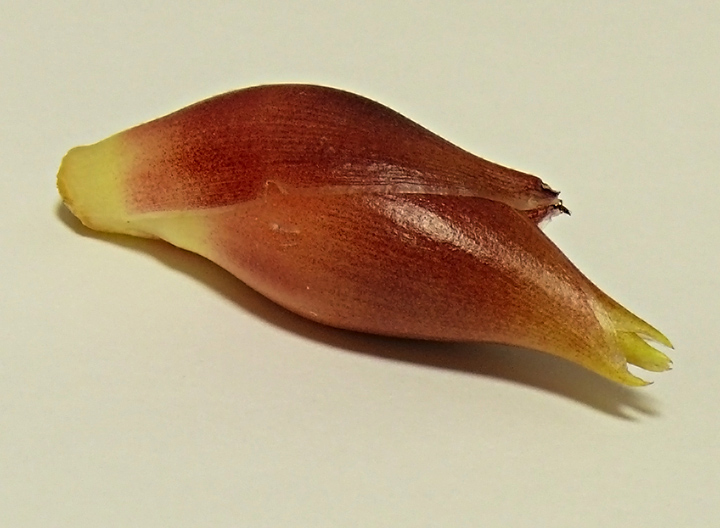 MyogaZingiber mioga
-
 Beehive GingerZingiber spectabile
-
 Cassumunar GingerZingiber montanum
-
 Zingiber barbatum
-
 Zingiber kelabitianum
-
 GingerZingiber collinsii
- Zingiber matutumense
Compare
Questions and answers
What is the scientific name of the Ginger?
The scientific name of the Ginger is Zingiber officinale. Written with its author, the full name is Zingiber officinale Roscoe.
Which family does the Ginger belong to?
Zingiber officinale belongs to the family Zingiberaceae, in the order Zingiberales and the class Liliopsida.
Where is the Ginger found?
Checklists and occurrence records place Zingiber officinale in 31 countries, including Indonesia, Malaysia, Japan, South Korea, Nepal and Hong Kong.
What is the conservation status of the Ginger?
The IUCN Red List category recorded for Zingiber officinale is Data Deficient (DD).
What other names does the Ginger have?
Zingiber officinale is also known in English as Cooking Ginger and Garden Ginger.
What are the medicinal uses of ginger?
Ginger is used medicinally for ailments including headaches, colds, nausea, and vomiting. It has been used in traditional medicine in China, India, and Japan for centuries.[33][34]
What family is ginger in?
Ginger belongs to the family Zingiberaceae.[1]
What is ginger technically?
Ginger is a flowering plant classified as Zingiber officinale Roscoe, in the family Zingiberaceae, order Zingiberales, and class Liliopsida.[1]
What is the habitat of ginger?
Ginger is native to humid, partly shaded habitats in moist tropical and subtropical forests of Southeast Asia.[13]
What is the description of ginger?
Ginger produces annual pseudostems with narrow leaf blades and has thick, branched, warty rhizomes with corky brown to golden outer skin. The rhizome interior is pale yellow and has a spicy, almost lemon-like scent. Its flowers have cream to yellowish green petals and mauve or deep purple lips.[1][5][6][8]
Sources
Passages the profile rests on
- The plant produces annual pseudostems with narrow leaf blades. Source passage: “It is an herbaceous perennial that grows annual pseudostems (false stems made of the rolled bases of leaves) about one meter tall, bearing narrow leaf blades.” — English Wikipedia
- The annual pseudostems grow to approximately one meter tall. Source passage: “about one meter tall” — English Wikipedia
- The leaves are medium green, alternate, long, and narrow. Source passage: “The blades of the medium green, alternate leaves are long and narrow” — hort.extension.wisc.edu
- The shoots consist of tightly wrapped leaf sheaths forming pseudostems. Source passage: “The shoots are actually pseudostems formed from a series of leaf sheaths wrapped tightly around one another.” — hort.extension.wisc.edu
- The rhizomes are thick, branched, warty, and have a corky brown to golden outer skin. Source passage: “The thick, warty, branched rhizomes have a corky, brown to golden outer skin” — hort.extension.wisc.edu
- The interior of the rhizome is pale yellow and has a spicy, almost lemon-like scent. Source passage: “The interior is pale yellow with a spicy, almost lemony scent.” — hort.extension.wisc.edu
- The flower spikes are dense and cone-shaped, with greenish or yellowish bracts. Source passage: “The dense, cone-shaped flower spikes are composed of a series of greenish or yellowish bracts” — hort.extension.wisc.edu
- The flowers are cream to yellowish green and have mauve or deep purple lips. Source passage: “Cream to yellowish green flowers, each with a mauve or deep purple lip” — hort.extension.wisc.edu
- The inflorescences emerge directly from the rhizome on separate shoots. Source passage: “arise directly from the rhizome on separate shoots.” — English Wikipedia
- The inflorescence develops on a separate, leafless stem. Source passage: “The terminal inflorescence grows on a separate, leafless stem from the foliage stem.” — hort.extension.wisc.edu
- Young ginger rhizomes are juicy, fleshy, and mildly flavored. Source passage: “When young, the rhizomes are juicy and fleshy with a very mild taste” — hort.extension.wisc.edu
- Mature ginger rhizomes become hotter, more fibrous, and drier than young ones. Source passage: “become hotter, more fibrous and drier as they mature.” — hort.extension.wisc.edu
- The species is native to humid, partly shaded habitats in moist tropical and subtropical forests of Southeast Asia. Source passage: “native to humid, partly-shaded habitats in moist tropical and subtropical forests of Southeast Asia.” — hort.extension.wisc.edu
- The species originated in Maritime Southeast Asia. Source passage: “Ginger originated in Maritime Southeast Asia.” — English Wikipedia
- The plant grows best in hot, humid conditions and fertile soil. Source passage: “Ginger thrives in hot, humid conditions and fertile soil.” — hort.extension.wisc.edu
- Ginger grows best in soil temperatures around 77 degrees Fahrenheit. Source passage: “grows best with soil temperatures around 77 °F” — hort.extension.wisc.edu
- The species is cultivated commercially in South and Southeast Asia, tropical Africa, parts of Central America and the Caribbean, and Australia. Source passage: “It is grown commercially in South and Southeast Asia (India, China, Nepal), tropical Africa, parts of Central America and the Caribbean, and Australia” — hort.extension.wisc.edu
- Ginger is cultivated in India, China, and Nepal. Source passage: “South and Southeast Asia (India, China, Nepal)” — hort.extension.wisc.edu
- The plant was transported throughout the Indo-Pacific during the Austronesian expansion. Source passage: “It was transported with them throughout the Indo-Pacific during the Austronesian expansion” — English Wikipedia
- Austronesian voyagers introduced ginger to the Pacific Islands in prehistoric times. Source passage: “They introduced it to the Pacific Islands in prehistory” — English Wikipedia
- Ginger was carried to Madagascar and the Comoros during the first millennium CE. Source passage: “It was also carried by Austronesian voyagers into Madagascar and the Comoros in the 1st millennium CE.” — English Wikipedia
- Ginger was introduced to the Caribbean islands from Asia during the sixteenth century. Source passage: “The ginger plant was smuggled onto the Caribbean islands from Asia sometime in the 16th century” — English Wikipedia
- Unharvested ginger plants gradually spread outward and form dense clumps. Source passage: “gradually spreading outwards to eventually form a dense clump if not harvested.” — hort.extension.wisc.edu
- Ginger plants become dormant and lose their stems during short winter days and cool temperatures. Source passage: “The plants will go dormant and lose all the stems with the onset of our short winter days and cool temperatures.” — hort.extension.wisc.edu
- Culinary ginger flowers are usually sterile and rarely produce seeds. Source passage: “Culinary ginger flowers are usually sterile, and they rarely produce seed.” — hort.extension.wisc.edu
- Flowering generally begins when ginger clumps are at least two years old. Source passage: “Clumps need to be at least two years old before they will flower.” — hort.extension.wisc.edu
- Ginger rhizomes are widely used as a culinary spice and traditional folk medicine. Source passage: “whose rhizome, ginger root or ginger, is widely used as a spice and a folk medicine.” — English Wikipedia
- The plant's rhizome can be used fresh, dried, ground, or preserved in brine, vinegar, or sugar syrup. Source passage: “the rhizome which can be used fresh, dried, ground, or preserved (in brine, vinegar or sugar syrup).” — hort.extension.wisc.edu
- Ginger is used in vegetables, candy, soda, pickles, and alcoholic beverages. Source passage: “Ginger can be used for a variety of food items such as vegetables, candy, soda, pickles, and alcoholic beverages.” — English Wikipedia
- Young ginger rhizomes are commonly pickled in vinegar or sherry or cooked in various dishes. Source passage: “They are often pickled in vinegar or sherry as a snack or cooked as an ingredient in many dishes.” — English Wikipedia
- Ginger can be steeped in boiling water to prepare herbal tea. Source passage: “They can be steeped in boiling water to make ginger herb tea” — English Wikipedia
- Ginger is commonly used as a spice in Chinese, Korean, Japanese, Vietnamese, and South Asian cuisines. Source passage: “is a common ingredient of Chinese, Korean, Japanese, Vietnamese, and many South Asian cuisines” — English Wikipedia
- Ginger is used medicinally for ailments including headaches, colds, nausea, and vomiting. Source passage: “Ginger root is used to attenuate and treat several common diseases, such as headaches, colds, nausea, and emesis.” — pmc.ncbi.nlm.nih.gov
- Ginger has been used in traditional medicine in China, India, and Japan for centuries. Source passage: “Ginger has been used in traditional medicine in China, India and Japan for centuries” — English Wikipedia
- Ginger rhizomes and leaves were historically used to flavor food or eaten directly by Austronesian peoples. Source passage: “The rhizomes and the leaves were used to flavour food or eaten directly.” — English Wikipedia
- Ginger leaves were historically used to weave mats. Source passage: “The leaves were also used to weave mats.” — English Wikipedia
- Ginger was used in Austronesian rituals for healing and protection from spirits. Source passage: “being used in rituals for healing and for asking protection from spirits.” — English Wikipedia
- The distantly related plants in the genus Asarum are commonly called wild ginger because of their similar taste. Source passage: “The distantly related dicots in the genus Asarum are commonly called wild ginger because of their similar taste.” — English Wikipedia
Data
- Catalogue of Life, 2026-10-16 XR cc by
- Global Biodiversity Information Facility CC BY 4.0
- Wikidata CC0
- GeoNames CC BY 4.0
- Wikimedia Commons per image; credit shown with each image
- Within the Catalogue of Life, this name comes from The World Checklist of Vascular Plants (WCVP) cc by
References
- Trans. Linn. Soc. London 8: 348 (1807) where the name was published
This species in other databases
Page built on 27 November 2026. See how the catalog is made and all sources and licences.
Cite this page
ScientificNames.org. (2026). Zingiber officinale (Ginger). Retrieved November 27, 2026, from https://scientificnames.org/species/zingiber-officinale
“Zingiber officinale (Ginger).” ScientificNames.org, 2026, scientificnames.org/species/zingiber-officinale. Accessed 27 Nov. 2026.
ScientificNames.org. “Zingiber officinale (Ginger).” Accessed November 27, 2026. https://scientificnames.org/species/zingiber-officinale.
@misc{scientificnames_zingiber_officinale_ginger,
  author = {{ScientificNames.org}},
  title = {Zingiber officinale (Ginger)},
  year = {2026},
  url = {https://scientificnames.org/species/zingiber-officinale},
  note = {Accessed 2026-11-27}
}