Species · Insects
Dark Grass Blue Zizeeria karsandra
The scientific name of the Dark Grass Blue is Zizeeria karsandra. It is a species of insect in the family Lycaenidae (blues), order Lepidoptera. The name dates from 1865.
- Scientific name
- Zizeeria karsandra (Moore, 1865)
- Common name
- Dark Grass Blue
- Genus
- Zizeeria
- Family
- Lycaenidae (Blues)
- Order
- Lepidoptera
- Class
- Insecta
- Recorded in
- 32 countries
- Name status
- accepted in the Catalogue of Life

Overview
The Dark Grass Blue is a small butterfly in the family Lycaenidae, order Lepidoptera, and tribe Polyommatini. It occurs in the southern Mediterranean region, the Andaman and Nicobar islands, the United Arab Emirates, and northern and eastern Australia. It has purple-brown upper wings, greyish-brown undersides, and distinctive black and pale markings on both pairs of wings.
Written 26 November 2026 from the sources listed below. Each statement was checked against the passage it cites; statements that could not be supported were removed.
Appearance
The Dark Grass Blue has purple-brown upper wings and greyish-brown undersides. The forewing has a black spot within the discoidal cell, a discocellular streak, and a spot above it.[1][2][3][4]
The forewing has six black spots in a transverse discal series, each surrounded by white. Its marginal and submarginal rows consist of pale-brown lunules bordered with white.[5][6]
The hindwing has twelve black spots arranged in a series and a pale discocellular streak surrounded by white. Its marginal row has pale-brown spots encircled with whitish markings, while its submarginal row has whitish lunules.[7][8][9][10]
Habitat
The Dark Grass Blue occurs in the southern Mediterranean region, the Andaman and Nicobar islands, the United Arab Emirates, and northern and eastern Australia.[11][12][13][14]
Diet
Recorded food plants include Trifolium alexandrinum. Amaranthus viridis is recorded as a food plant in association with the ant Tapinoma melanocephalum.[15][16]
Classification of the Dark Grass Blue
| Kingdom | Animalia |
|---|---|
| Phylum | Arthropoda |
| Subphylum | Hexapoda |
| Class | Insecta (Insect) |
| Order | Lepidoptera |
| Superfamily | Papilionoidea |
| Family | Lycaenidae (Blues) |
| Subfamily | Polyommatinae |
| Tribe | Polyommatini |
| Genus | Zizeeria |
| Species | Zizeeria karsandra (Moore, 1865) |
Where the Dark Grass Blue is found
Checklists and occurrence records place Zizeeria karsandra in 32 countries. GBIF holds 8,476 georeferenced records of it.
Countries
- Australia 638
- Bangladesh 49
- Bhutan 5
- Cambodia 40
- China 18
- Hong Kong 110
- India 2,961
- Indonesia 74
- Iran 23
- Iraq 21
- Israel 3,452
- Japan 144
- Jordan 12
- Kuwait 6
- Malaysia 16
- Myanmar 5
- Nepal 19
- Oman 17
- Pakistan 248
- Palestinian Territory 23
- Papua New Guinea 4
- Philippines 57
- Saudi Arabia 11
- Solomon Islands 3
- Sri Lanka 53
- Syria 12
- Taiwan 125
- Thailand 43
- Timor Leste 16
- Turkey 163
- United Arab Emirates 83
- Vietnam 25
Regions and cities with the most records
- Central District, Israel 1,407
- Yehud Monosson, Israel 1,285
- Hod HaSharon, Israel 1,255
- Ramat HaSharon, Israel 1,241
- Kfar Saba, Israel 1,228
- Or Yehuda, Israel 1,227
- Herzliya, Israel 1,225
- Yehud-Monosson, Israel 1,223
- Ra'anana, Israel 1,210
- Qalqīlyah, Palestinian Territory 1,194
- Eṭ Ṭīra, Israel 1,119
- Even Yehuda, Israel 1,103
- H̱olon, Israel 1,098
- Lod, Israel 1,043
- Kadima Zoran, Israel 1,031
- Shoham, Israel 1,023
- Be’er Ya‘aqov, Israel 1,002
- Rishon LeTsiyyon, Israel 984
- Ganei Tikva, Israel 971
- Kiryat Ono, Israel 971
- Giv'at Shmuel, Israel 965
- Kafr Qāsim, Israel 964
- Givatayim, Israel 961
- Bnei Brak, Israel 955
- Ramat Gan, Israel 951
- Tel Aviv, Israel 949
- Petaẖ Tiqva, Israel 904
- El‘ad, Israel 881
- Rosh Ha‘Ayin, Israel 877
- Northern District, Israel 825
- Bat Yam, Israel 779
- Maharashtra, India 777
- Eṭ Ṭaiyiba, Israel 744
- Bāqa el Gharbīya, Israel 736
- Hadera, Israel 726
- Netanya, Israel 723
7 more countries have a few records outside this range
These countries hold a few records of Zizeeria karsandra but lie outside the range the checklists give for it. Such records are often zoo or garden specimens, museum material or vagrants, so the species is not counted as occurring there.
A number beside a place is its count of GBIF occurrence records. A place without a number comes from a checklist alone. Records show where a species has been observed or collected, which can include escapes and vagrants.
Common names
English
- Dark Grass Blue
- Spotted Grass-blue
Names in 9 other languages
- Arabic
- فراشة الحشائش الداكنة الزرقاء, فراشة العشب الزرقاء القاتمة
- Chinese
- 吉灰蝶, 暗草灰蝶, 濱大和小灰蝶, 臺灣小灰蝶, 莧藍灰蝶
- Danish
- Orientalsk Græsblåfugl
- Dutch
- Oostelijk amethistblauwtje
- Hebrew
- כחלון הקוטב, כחליל הקוטב
- Japanese
- ハマヤマトシジミ
- Tamil
- கரும்புல் நீலன்
- Thai
- ผีเสื้อฟ้าเซลล์จุดสีคล้ำ
- Turkish
- Karsandra
Synonyms
4 other scientific names have been used for this species and are now treated as synonyms of Zizeeria karsandra.
- Lampides neis Walker, 1870
- Lycaena brahmina Felder, C. & Felder, R., 1865
- Lycaena conformis Butler, 1877
- Polyommatus karsandra Moore, 1865
Related species
-
 African Grass BlueZizeeria knysna
- Zizeeria ossa
-
 Common BluePolyommatus icarus
-
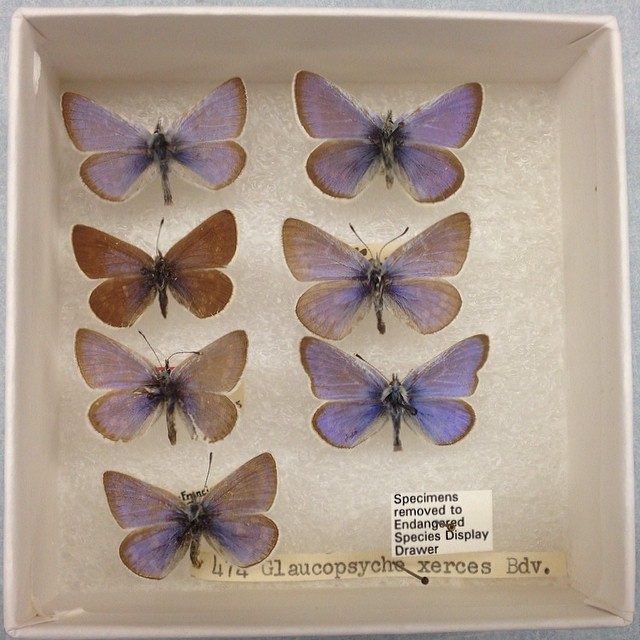 Xerces BlueGlaucopsyche xerces
-
 Adonis BlueLysandra bellargus
-
 Western Pygmy BlueBrephidium exilis
-
 AtalaEumaeus atala
-
 Holly BlueCelastrina argiolus
Compare
Questions and answers
What is the scientific name of the Dark Grass Blue?
The scientific name of the Dark Grass Blue is Zizeeria karsandra. Written with its author, the full name is Zizeeria karsandra (Moore, 1865).
Which family does the Dark Grass Blue belong to?
Zizeeria karsandra belongs to the family Lycaenidae, in the order Lepidoptera and the class Insecta.
Where is the Dark Grass Blue found?
Checklists and occurrence records place Zizeeria karsandra in 32 countries, including Israel, India, Australia, Pakistan, Turkey and Japan.
What other names does the Dark Grass Blue have?
Zizeeria karsandra is also known in English as Spotted Grass-blue.
Sources
Passages the profile rests on
- The butterfly has purple-brown upper wings. Source passage: “Upperside purple-brown.” — English Wikipedia
- The underside of the wings is greyish brown. Source passage: “Underside greyish brown” — English Wikipedia
- The forewing has a black spot within the discoidal cell. Source passage: “fore wing with a spot within discoidal cell” — English Wikipedia
- The forewing has a discocellular streak and a spot above it. Source passage: “a discocellular streak, a spot above it” — English Wikipedia
- The forewing has six black spots arranged in a transverse discal series, each surrounded by white. Source passage: “a transverse discal series of six spots black, each encircled with white” — English Wikipedia
- The forewing has marginal and submarginal rows of pale-brown lunules bordered with white. Source passage: “a marginal and submarginal row of pale brown, white-bordered lunules” — English Wikipedia
- The hindwing has twelve black spots arranged in a series. Source passage: “hind wing with a series of twelve black spots” — English Wikipedia
- The hindwing has a pale discocellular streak surrounded by white. Source passage: “a pale discocellular streak, encircled with white” — English Wikipedia
- The hindwing has a marginal row of pale-brown spots encircled with whitish markings. Source passage: “a marginal row of pale brown, whitish-encircled spots” — English Wikipedia
- The hindwing has a submarginal row of whitish lunules. Source passage: “a submarginal row of whitish lunules” — English Wikipedia
- The species occurs in the southern Mediterranean region. Source passage: “found from the southern Mediterranean” — English Wikipedia
- The species occurs in the Andaman and Nicobar islands. Source passage: “the Andaman and Nicobar islands” — English Wikipedia
- The species occurs in the United Arab Emirates. Source passage: “United Arab Emirates” — English Wikipedia
- The species occurs in northern and eastern Australia. Source passage: “northern and eastern Australia” — English Wikipedia
- The recorded food plants include Trifolium alexandrinum. Source passage: “Trifolium alexandrinum” — English Wikipedia
- Amaranthus viridis is recorded as a food plant in association with the ant Tapinoma melanocephalum. Source passage: “Amaranthus viridis (in association with the ant Tapinoma melanocephalum)” — English Wikipedia
Data
- Catalogue of Life, 2026-10-16 XR cc by
- Global Biodiversity Information Facility CC BY 4.0
- Wikidata CC0
- GeoNames CC BY 4.0
- Wikimedia Commons per image; credit shown with each image
- Within the Catalogue of Life, this name comes from Global Lepidoptera Index cc by
References
- Moore. (1865). Proceedings of the Zoological Society of London. http://www.biodiversitylibrary.org/item/90412#page/588/mode/2up Link where the name was published
This species in other databases
Page built on 28 November 2026. See how the catalog is made and all sources and licences.
Cite this page
ScientificNames.org. (2026). Zizeeria karsandra (Dark Grass Blue). Retrieved November 28, 2026, from https://scientificnames.org/species/zizeeria-karsandra
“Zizeeria karsandra (Dark Grass Blue).” ScientificNames.org, 2026, scientificnames.org/species/zizeeria-karsandra. Accessed 28 Nov. 2026.
ScientificNames.org. “Zizeeria karsandra (Dark Grass Blue).” Accessed November 28, 2026. https://scientificnames.org/species/zizeeria-karsandra.
@misc{scientificnames_zizeeria_karsandra_dark_grass_blue,
  author = {{ScientificNames.org}},
  title = {Zizeeria karsandra (Dark Grass Blue)},
  year = {2026},
  url = {https://scientificnames.org/species/zizeeria-karsandra},
  note = {Accessed 2026-11-28}
}