Species · Insects
Zizina labradus
Zizina labradus has no English name on record in the checklists used here. It is a species of insect in the family Lycaenidae (blues), order Lepidoptera. The name dates from 1824.
- Scientific name
- Zizina labradus (Godart, 1824)
- Genus
- Zizina
- Family
- Lycaenidae (Blues)
- Order
- Lepidoptera
- Class
- Insecta
- Recorded in
- 9 countries
- Name status
- accepted in the Catalogue of Life

Overview
Zizina labradus lives in urban areas and suburban gardens, where it frequently perches in grass. Adults have purplish-blue upper wing surfaces, black or brown wing margins and brown to pale brownish grey undersides patterned with fawn bands and spots.
Written 26 November 2026 from the sources listed below. Each statement was checked against the passage it cites; statements that could not be supported were removed.
Appearance
Adult butterflies have purplish-blue upper wing surfaces, black bodies and black or brown wing margins. Females have wider wing margins than males, and their bodies are covered with white or grey hairs.[1][2][3]
The underside of the wings is brown to pale brownish grey, patterned with fawn bands and spots.[4]
Caterpillars are predominantly green, with a yellow lateral stripe, a darker green dorsal stripe and a usually concealed brown or black head. Caterpillars raised in captivity on artificial food can vary in colour from white to red and dark purple.[5][6]
Behaviour
Adults have a weak, fluttering flight and generally remain close to the ground near food sources.[7]
Larvae are typically attended by ants belonging to the genera Paratrechina, Rhytidoponera and Tapinoma.[8]
Larger larvae may cannibalize smaller larvae when food is scarce in captivity.[9]
Reproduction and life cycle
Females lay individual eggs rather than clusters. Eggs are deposited on leaves, stems, flower buds and young pods of food plants, and can hatch within a few days of being laid.[10][11][12]
The pupa attaches to the underside of a food-plant leaf using anal hooks and a central girdle.[13]
Similar species
The Common Grass Blue is frequently confused with the Lesser Grass Blue, Zizina otis.[14]
Habitat
The species occurs in suburban gardens and urban areas. It frequently perches in grass.[15][16]
The subspecies Zizina labradus labradus occurs across most of continental Australia, as well as on Lord Howe Island, Norfolk Island and Christmas Island. The subspecies Zizina labradus labdalon is mainly restricted to Cape York Peninsula.[17][18][19][20][21]
Diet
The larvae feed chiefly on legumes belonging to the plant family Fabaceae. Recorded food plants include beans and clover, as well as Cullen australasicum, commonly called Tall Scurf-pea, Hardenbergia violacea, commonly called Native Lilac, Kennedia prostrata, commonly called Running Postman, and Lotus australis, commonly called Austral Trefoil.[22][23][24][25][26][27]
Newly hatched larvae feed by making small holes in young leaves or flower buds. Older larvae feed mainly inside flowers.[28][29]
Classification of Zizina labradus
| Kingdom | Animalia |
|---|---|
| Phylum | Arthropoda |
| Subphylum | Hexapoda |
| Class | Insecta (Insect) |
| Order | Lepidoptera |
| Superfamily | Papilionoidea |
| Family | Lycaenidae (Blues) |
| Subfamily | Polyommatinae |
| Tribe | Polyommatini |
| Genus | Zizina |
| Species | Zizina labradus (Godart, 1824) |
Where Zizina labradus is found
Checklists and occurrence records place Zizina labradus in 9 countries across Asia. GBIF holds 10,860 georeferenced records of it.
Countries
- Australia 8,530
- India 3
- Indonesia 23
- Japan 151
- Malaysia 16
- New Zealand 1,443
- Pakistan 14
- Philippines 6
- Taiwan 674
Regions and cities with the most records
- Victoria, Australia 2,964
- Queensland, Australia 1,930
- New South Wales, Australia 1,826
- South Australia, Australia 1,041
- Burwood, Australia 699
- Balwyn North, Australia 634
- Melbourne, Australia 527
- Adelaide, Australia 481
- Sydney, Australia 438
- Adelaide Hills, Australia 430
- Brisbane, Australia 402
- Parramatta, Australia 334
- Hornsby, Australia 292
- Taiwan, Taiwan 276
- Auckland, New Zealand 271
- St Albans, Australia 259
- Western Australia, Australia 255
- Waikato Region, New Zealand 231
- Logan City, Australia 213
- Geelong, Australia 205
- Frankston East, Australia 185
- Torquay, Australia 177
- Mount Eden, New Zealand 175
- Auckland, New Zealand 174
- New Lynn, New Zealand 170
- Avondale, New Zealand 169
- Remuera, New Zealand 169
- Capalaba, Australia 160
- Otahuhu, New Zealand 154
- Narangba, Australia 152
- Australian Capital Territory, Australia 147
- Banqiao, Taiwan 143
- New Taipei City, Taiwan 143
- Taipei, Taiwan 138
- Wellington Region, New Zealand 137
- Shulin, Taiwan 136
10 more countries have a few records outside this range
These countries hold a few records of Zizina labradus but lie outside the range the checklists give for it. Such records are often zoo or garden specimens, museum material or vagrants, so the species is not counted as occurring there.
A number beside a place is its count of GBIF occurrence records. A place without a number comes from a checklist alone. Records show where a species has been observed or collected, which can include escapes and vagrants.
Synonyms
12 other scientific names have been used for this species and are now treated as synonyms of Zizina labradus.
- Cupido delicata Tepper, 1882
- Lycaena communis Herrich-Schäffer, 1869
- Lycaena novaehollandiae Felder, 1862
- Lycaena pervulgatus Guest, 1882
- Lycaena phoebe Murray, 1873
- Polyommatus labradus Godart, 1824
- Zizera communis Seitz, 1924
- Zizera labradus (Godart, 1824)
- Zizina frequens Scott, 1890
- Zizina labdalon Waterhouse & Lyell, 1914
- Zizina novhollandiae Godart, 1824
- Zizina otis labradus (Godart, 1824)
Subspecies and varieties
- Zizina labradus cheesmanae subspecies
- Zizina labradus riukuensis subspecies
- Zizina labradus subcoerulea subspecies
Related species
-
 Lesser Grass BlueZizina otis
-
 Dark Grass BlueZizina antanossa
-
 Common BluePolyommatus icarus
-
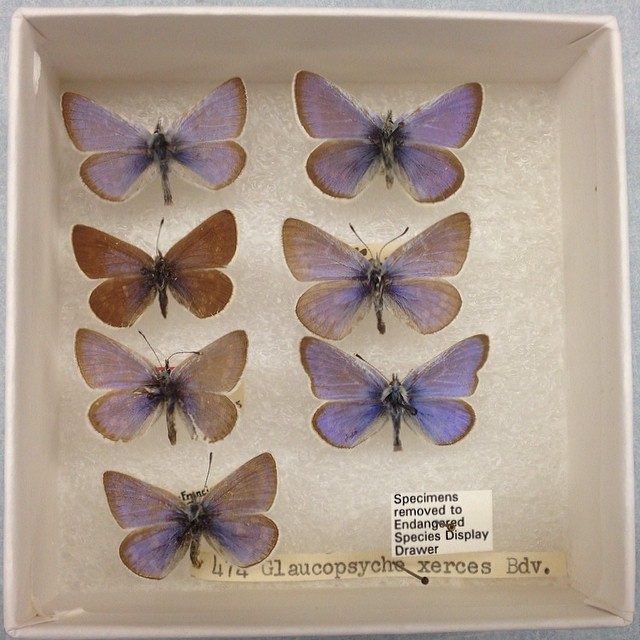 Xerces BlueGlaucopsyche xerces
-
 Adonis BlueLysandra bellargus
-
 Western Pygmy BlueBrephidium exilis
-
 AtalaEumaeus atala
-
 Holly BlueCelastrina argiolus
Compare
Sources
Passages the profile rests on
- Adult butterflies have purplish-blue upper wing surfaces, black bodies, and black or brown wing margins. Source passage: “Adults are purplish blue on the upper wing surface with a black body and black or brown wing margins.” — English Wikipedia
- Female butterflies have wider wing margins than males. Source passage: “These margins are larger on the female than the male.” — English Wikipedia
- The adult butterfly's body is covered with white or grey hairs. Source passage: “with the body covered in white or grey hairs.” — English Wikipedia
- The underside of the wings is brown to pale brownish grey, patterned with fawn bands and spots. Source passage: “The lower wing surface is brown to pale brownish grey with a pattern of fawn bands and spots” — English Wikipedia
- Caterpillars are predominantly green, with a yellow lateral stripe, a darker green dorsal stripe, and a usually concealed brown or black head. Source passage: “their appearance is primarily green with a yellow stripe at the sides and a darker green stripe on the back, and brown or black head usually obscured under the thorax.” — English Wikipedia
- Caterpillars raised in captivity on artificial food can vary in colour from white to red and dark purple. Source passage: “In captivity, fed on an artificial diet, larvae come in highly variable colours, ranging from white through red to dark purple.” — English Wikipedia
- Adults have a weak, fluttering flight and generally remain close to the ground near food sources. Source passage: “Common grass blues have a weak, fluttering flight and so usually fly near ground level close to a food source.” — English Wikipedia
- Larvae are typically attended by ants belonging to the genera Paratrechina, Rhytidoponera, and Tapinoma. Source passage: “The larvae are typically attended by ants of the genera Paratrechina, Rhytidoponera, and Tapinoma.” — English Wikipedia
- Larger larvae may cannibalize smaller larvae when food is scarce in captivity. Source passage: “In captivity when food is scarce the larger larvae will cannibalize smaller ones.” — English Wikipedia
- Females lay individual eggs rather than clusters. Source passage: “Single eggs are laid” — English Wikipedia
- The eggs can hatch within a few days of being laid. Source passage: “which can hatch in a matter of days.” — English Wikipedia
- Eggs are deposited on leaves, stems, flower buds, and young pods of food plants. Source passage: “The eggs are laid on leaves, stems, flower buds and young pods of food plants” — English Wikipedia
- The pupa attaches to the underside of a food-plant leaf using anal hooks and a central girdle. Source passage: “The pupa attaches to the lower leaf surface of the food plants with anal hooks and a central girdle.” — English Wikipedia
- The Common Grass Blue is frequently confused with the Lesser Grass Blue, Zizina otis. Source passage: “The common grass blue is often misidentified as the lesser grass blue, Zizina otis.” — English Wikipedia
- The species occurs in suburban gardens and frequently perches in grass. Source passage: “can be found in suburban gardens, particularly perching in grass;” — English Wikipedia
- The Common Grass Blue lives in urban areas. Source passage: “The Common Grass Blue lives in urban areas.” — australian.museum
- The subspecies Zizina labradus labradus occurs across most of continental Australia. Source passage: “is found over most of continental Australia” — English Wikipedia
- The subspecies Zizina labradus labradus also occurs on Lord Howe Island. Source passage: “as well as on Lord Howe Island, Norfolk Island, and Christmas Island” — English Wikipedia
- The subspecies Zizina labradus labradus occurs on Norfolk Island. Source passage: “as well as on Lord Howe Island, Norfolk Island, and Christmas Island” — English Wikipedia
- The subspecies Zizina labradus labradus occurs on Christmas Island. Source passage: “as well as on Lord Howe Island, Norfolk Island, and Christmas Island” — English Wikipedia
- The subspecies Zizina labradus labdalon is mainly restricted to Cape York Peninsula. Source passage: “The subspecies Zizina labradus labdalon is restricted mainly to Cape York Peninsula.” — English Wikipedia
- The larvae feed chiefly on legumes belonging to the plant family Fabaceae. Source passage: “food plants, chiefly legumes of the family Fabaceae” — English Wikipedia
- Recorded larval food plants include beans and clover. Source passage: “such as beans, clover” — English Wikipedia
- Larval food plants include Cullen australasicum, commonly called Tall Scurf-pea. Source passage: “Cullen australasicum (Tall Scurf-pea)” — English Wikipedia
- Larval food plants include Hardenbergia violacea, commonly called Native Lilac. Source passage: “Hardenbergia violacea (Native Lilac)” — English Wikipedia
- Larval food plants include Kennedia prostrata, commonly called Running Postman. Source passage: “Kennedia prostrata (Running Postman)” — English Wikipedia
- Larval food plants include Lotus australis, commonly called Austral Trefoil. Source passage: “Lotus australis (Austral Trefoil)” — English Wikipedia
- Newly hatched larvae feed by making small holes in young leaves or flower buds. Source passage: “Newly hatched larvae eat small holes from young leaves or flower buds” — English Wikipedia
- Older larvae feed mainly inside flowers. Source passage: “and later feed mainly inside flowers.” — English Wikipedia
Data
- Catalogue of Life, 2026-10-16 XR cc by
- Global Biodiversity Information Facility CC BY 4.0
- Wikidata CC0
- GeoNames CC BY 4.0
- Wikimedia Commons per image; credit shown with each image
- Within the Catalogue of Life, this name comes from Global Lepidoptera Index cc by
References
- Godart. (1824). Encyclopédie méthodique d’histoire naturelle. (Ins.) (2). http://www.biodiversitylibrary.org/item/78660#page/32/mode/2up Link where the name was published
This species in other databases
Page built on 29 November 2026. See how the catalog is made and all sources and licences.
Cite this page
ScientificNames.org. (2026). Zizina labradus. Retrieved November 29, 2026, from https://scientificnames.org/species/zizina-labradus
“Zizina labradus.” ScientificNames.org, 2026, scientificnames.org/species/zizina-labradus. Accessed 29 Nov. 2026.
ScientificNames.org. “Zizina labradus.” Accessed November 29, 2026. https://scientificnames.org/species/zizina-labradus.
@misc{scientificnames_zizina_labradus,
  author = {{ScientificNames.org}},
  title = {Zizina labradus},
  year = {2026},
  url = {https://scientificnames.org/species/zizina-labradus},
  note = {Accessed 2026-11-29}
}