Species · Birds
Indian White-eye Zosterops palpebrosus
The scientific name of the Indian White-eye is Zosterops palpebrosus. It is a species of bird in the family Zosteropidae (white-eye), order Passeriformes. The name dates from 1824.
- Scientific name
- Zosterops palpebrosus (Temminck, 1824)
- Common name
- Indian White-eye
- Genus
- Zosterops
- Family
- Zosteropidae (White-eye)
- Order
- Passeriformes
- Class
- Aves
- Red List category
- LC Least Concern
- Recorded in
- 23 countries
- Name status
- accepted in the Catalogue of Life

Overview
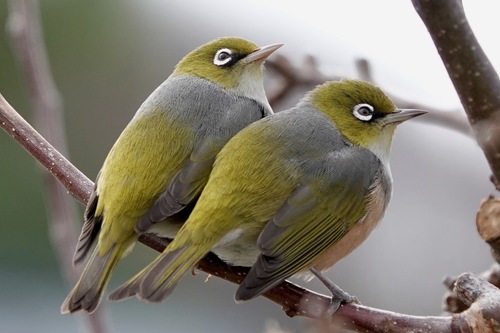
The Indian White-eye is a bird described by Coenraad Jacob Temminck in 1824. It inhabits open woodland, scrub, moist forest, gardens and forest edges, and sometimes occurs in mangrove habitats. It has yellowish olive upperparts, a white eye-ring, a yellow throat and vent, and a whitish-grey belly.
Written 26 November 2026 from the sources listed below. Each statement was checked against the passage it cites; statements that could not be supported were removed.
Appearance
The Indian White-eye has yellowish olive upperparts, a conspicuous white eye-ring, a yellow throat and vent, and a whitish-grey belly. Males and females have similar appearances.[1][2]
The Indian White-eye measures approximately 8–9 cm in length.[3]
Habitat
The Indian White-eye inhabits open woodland on the Indian subcontinent. Its habitats range from scrub to moist forest, and it is also found in gardens and along forest edges.[4][5][6]
It sometimes occurs in mangrove habitats, including the Karachi region of Pakistan.[7]
Diet
The Indian White-eye is mainly insectivorous and feeds on small insects. It also consumes nectar and various fruits.[8][9]
Behaviour
The Indian White-eye forages in small groups and forms sociable flocks that separate as the breeding season approaches. It spends most of its time in trees and rarely descends to the ground.[10][11][12]
It frequently calls while foraging, usually giving a soft nasal contact call. It has also been observed bathing in dew collected on leaves.[13][14]
The Indian White-eye sometimes steals nesting material from other birds' nests and has been observed feeding the chicks of paradise flycatchers. It sometimes mobs palm squirrels while nesting.[15][16][17]
Despite being a relatively weak flier, the Indian White-eye can be transported to new areas by winds and storms.[18]
Reproduction and life cycle
The breeding season extends from February through September, with April as the peak breeding month.[19][20]
The Indian White-eye builds a compact, cup-shaped nest suspended like a hammock on a branch fork. The nest is constructed from cobwebs, lichens and plant fibres, and construction takes approximately four days.[21][22][23]
The Indian White-eye typically lays two pale blue eggs within a couple of days of each other. The eggs hatch approximately ten days after being laid.[24][25][26]
Both sexes participate in brooding the chicks. The chicks fledge approximately ten days after hatching.[27][28]
Conservation
A feral population detected in San Diego, California, during the 1980s was subsequently eradicated.[29]
Classification of the Indian White-eye
| Kingdom | Animalia |
|---|---|
| Phylum | Chordata |
| Subphylum | Vertebrata |
| Infraphylum | Gnathostomata |
| Parvphylum | Osteichthyes |
| Megaclass | Tetrapoda |
| Class | Aves (Bird) |
| Order | Passeriformes (Passerine) |
| Family | Zosteropidae (White-eye) |
| Genus | Zosterops (Lesser White-eyes) |
| Species | Zosterops palpebrosus (Temminck, 1824) |
Where the Indian White-eye is found
Checklists and occurrence records place Zosterops palpebrosus in 23 countries. GBIF holds 327,396 georeferenced records of it.
Countries
- Afghanistan 6
- Bangladesh 1,952
- Bhutan 3,460
- Brunei 6
- Cambodia 630
- China 5,223
- India 275,546
- Indonesia 511
- Iran 70
- Japan 70
- Laos 595
- Malaysia 3,653
- Myanmar 532
- Nepal 13,849
- Oman 68
- Pakistan 2,833
- Philippines 17
- Singapore 8
- South Korea 3
- Sri Lanka 11,713
- Taiwan 31
- Thailand 6,515
- Vietnam 105
Regions and cities with the most records
- Karnataka, India 58,663
- Uttarakhand, India 44,677
- Maharashtra, India 37,865
- Bengaluru, India 33,141
- Yelahanka, India 23,968
- Tamil Nadu, India 21,021
- Dehradun, India 18,518
- Rāipur, India 18,413
- Electronic City Phase I, India 18,108
- Clement Town, India 18,033
- koppana Agrahara, India 17,949
- Hebbagodi, India 16,787
- Madhya Pradesh, India 16,704
- Pune, India 16,534
- Bommasandra Industrial Area, India 16,157
- Kharakvasla, India 15,647
- Khadki, India 15,397
- Jigani, India 15,147
- Pimpri, India 14,683
- Pimpri-Chinchwad, India 14,656
- Kerala, India 11,741
- Mussoorie, India 11,350
- Gujarat, India 10,247
- Saiyad-ul-ajaib, India 9,797
- Sultan Pur, India 9,711
- Neb Sarai, India 9,682
- Rijokri, India 9,604
- Kusum Pur, India 9,383
- Chhatarpur, India 9,303
- Tighri, India 9,155
- Malakpur Kohi Rangpur, India 9,099
- Deoli, India 9,069
- New Delhi, India 9,054
- Aya Nagar, India 9,011
- Pul Pehlad, India 8,983
- Delhi Cantonment, India 8,953
4 more countries have a few records outside this range
These countries hold a few records of Zosterops palpebrosus but lie outside the range the checklists give for it. Such records are often zoo or garden specimens, museum material or vagrants, so the species is not counted as occurring there.
A number beside a place is its count of GBIF occurrence records. A place without a number comes from a checklist alone. Records show where a species has been observed or collected, which can include escapes and vagrants.
Common names
English
- Indian White-eye
- Oriental White-eye
Names in 34 other languages
- Bengali
- বাবুনাই বা উদয়ী ধলা-চোখ
- Catalan
- Ull-blanc Oriental, zostèrops oriental
- Chinese
- 灰腹繡眼, 灰腹繡眼鳥, 灰腹绣眼鸟
- Croatian
- sivotrba bjelooka
- Czech
- kruhoočko indomalajské, kruhoočko pruhoprsé
- Danish
- Brillefugl
- Dutch
- Gangesbrilvogel, Indiase Brilvogel, Indische Brilvogel
- Esperanto
- hindia zosteropo
- Finnish
- aasianrilli
- French
- Zostérops oriental
- German
- Ganges-Brillenvogel, Gangesbrillenvogel
- Hungarian
- gangeszi pápaszemesmadár
- Indonesian
- Kacamata biasa
- Irish
- Bánsúileach oirthearach
- Italian
- Occhialino orientale
- Japanese
- インドメジロ, ハイバラメジロ
- Kannada
- ಬೆಳ್ಗಣ್ಣ, ಮಲ್ಲಿಕಾಕ್ಷ
- Latvian
- austrumu baltactiņa
- Lithuanian
- rytinis baltavokis
- Malayalam
- വെള്ളക്കണ്ണിക്കുരുവി
- Marathi
- भारतीय चष्मेवाला
- Norwegian
- lundbrillefugl
- Persian
- سسک چشم سفید هندی
- Polish
- szlarnik indyjski
- Portuguese
- olho-branco-oriental
- Russian
- Восточная белоглазка
- Serbian
- Indijska belooka
- Slovak
- okánik riasnatý
- Spanish
- Anteojitos oriental
- Swedish
- indisk glasögonfågel
- Tamil
- வெள்ளைக் கண்ணி
- Thai
- นกแว่นตาขาวสีทอง
- Turkish
- Bengal Gözlükçüsü
- Ukrainian
- окулярник південний
Synonyms
One other scientific name has been used for this species and is now treated as a synonym of Zosterops palpebrosus.
- Sylvia palpebrosa Temminck, CJ, 1824
Subspecies and varieties
- Zosterops palpebrosus auriventer (Hume's White-eye) subspecies
- Zosterops palpebrosus buxtoni subspecies
- Zosterops palpebrosus egregius subspecies
- Zosterops palpebrosus melanurus (Sangkar White-eye) subspecies
- Zosterops palpebrosus nicobaricus (Andaman White-eye) subspecies
- Zosterops palpebrosus nilgiriensis (Nilgiri White-eye) subspecies
- Zosterops palpebrosus occidentis subspecies
- Zosterops palpebrosus palpebrosus subspecies
- Zosterops palpebrosus salimalii (Salim Ali's White-eye) subspecies
- Zosterops palpebrosus siamensis (Indochinese White-eye) subspecies
- Zosterops palpebrosus unicus (Yellow-bellied White-eye) subspecies
- Zosterops palpebrosus williamsoni subspecies
Related species
-
 SilvereyeZosterops lateralis
-
 Warbling White-eyeZosterops japonicus
-
 White-chested White-eyeZosterops albogularis
-
 Bridled White-eyeZosterops conspicillatus
-
 Green-backed White-eyeZosterops xanthochroa
-
 Mauritius Grey White-eyeZosterops mauritianus
-
 Mauritius Olive White-eyeZosterops chloronothos
-
 Christmas White-eyeZosterops natalis
Compare
Questions and answers
What is the scientific name of the Indian White-eye?
The scientific name of the Indian White-eye is Zosterops palpebrosus. Written with its author, the full name is Zosterops palpebrosus (Temminck, 1824).
Which family does the Indian White-eye belong to?
Zosterops palpebrosus belongs to the family Zosteropidae, in the order Passeriformes and the class Aves.
Where is the Indian White-eye found?
Checklists and occurrence records place Zosterops palpebrosus in 23 countries, including India, Nepal, Sri Lanka, Thailand, China and Malaysia.
What is the conservation status of the Indian White-eye?
The IUCN Red List category recorded for Zosterops palpebrosus is Least Concern (LC).
What other names does the Indian White-eye have?
Zosterops palpebrosus is also known in English as Oriental White-eye.
Sources
Passages the profile rests on
- The Indian White-eye has yellowish olive upperparts, a white eye-ring, a yellow throat and vent, and a whitish-grey belly. Source passage: “with yellowish olive upper parts, a white eye ring, a yellow throat, and a vent. The belly is whitish-grey” — English Wikipedia
- Male and female Indian White-eyes have similar appearances. Source passage: “The sexes look similar.” — English Wikipedia
- The Indian White-eye measures approximately 8–9 cm in length. Source passage: “This bird is small (about 8–9 cm long)” — English Wikipedia
- The Indian White-eye inhabits open woodland on the Indian subcontinent. Source passage: “It is a resident breeder in open woodland on the Indian subcontinent.” — English Wikipedia
- The Indian White-eye occurs in habitats ranging from scrub to moist forest. Source passage: “The species is found in a wide range of habitats from scrub to moist forest.” — English Wikipedia
- The Indian White-eye is found in gardens and along forest edges. Source passage: “Found in a wide range of habitats, from mangroves to gardens to forest edge;” — ebird.org
- The Indian White-eye sometimes occurs in mangrove habitats, including the Karachi region of Pakistan. Source passage: “They sometimes occur in mangrove areas, such as in the Karachi region, Pakistan” — English Wikipedia
- The Indian White-eye feeds on nectar and small insects. Source passage: “They forage in small groups, feeding on nectar and small insects.” — English Wikipedia
- The Indian White-eye is mainly insectivorous but also consumes nectar and various fruits. Source passage: “Though mainly insectivorous, the Indian white-eye will also eat nectar and fruits of various kinds.” — English Wikipedia
- The Indian White-eye forages in small groups. Source passage: “They forage in small groups, feeding on nectar and small insects.” — English Wikipedia
- The Indian White-eye forms sociable flocks that separate as the breeding season approaches. Source passage: “These white-eyes are sociable, forming flocks which only separate on the approach of the breeding season.” — English Wikipedia
- The Indian White-eye spends most of its time in trees and rarely descends to the ground. Source passage: “They are highly arboreal and only rarely descend to the ground.” — English Wikipedia
- The Indian White-eye frequently calls while foraging, usually giving a soft nasal contact call. Source passage: “They call frequently as they forage, and the usual contact call is a soft nasal cheer.” — English Wikipedia
- The Indian White-eye has been observed bathing in dew collected on leaves. Source passage: “They have been observed bathing in dew accumulated on leaves.” — English Wikipedia
- The Indian White-eye sometimes steals nesting material from other birds' nests. Source passage: “they sometimes steal nest material from the nests of other birds.” — English Wikipedia
- The Indian White-eye has been observed feeding the chicks of paradise flycatchers. Source passage: “Cases of interspecific feeding have been noted with white-eyes feeding the chicks of a paradise flycatcher.” — English Wikipedia
- The Indian White-eye sometimes mob palm squirrels while nesting. Source passage: “When nesting, they may mob palm squirrels” — English Wikipedia
- The Indian White-eye can be transported to new areas by winds and storms despite being a relatively weak flier. Source passage: “Although not strong fliers, they can be carried by winds and storms to new areas” — English Wikipedia
- The Indian White-eye breeding season extends from February through September. Source passage: “The breeding season is February to September” — English Wikipedia
- April is the peak breeding month for the Indian White-eye. Source passage: “April is the peak breeding season” — English Wikipedia
- The Indian White-eye builds a compact cup-shaped nest suspended like a hammock on a branch fork. Source passage: “the compact cup nest is placed like a hammock on the fork of a branch.” — English Wikipedia
- The Indian White-eye constructs its nest using cobwebs, lichens, and plant fibres. Source passage: “The nest is made of cobwebs, lichens, and plant fibre.” — English Wikipedia
- The Indian White-Eye completes nest construction in approximately four days. Source passage: “The nest is built in about 4 days” — English Wikipedia
- The Indian White-Eye typically lays two pale blue eggs. Source passage: “the two pale blue eggs are laid” — English Wikipedia
- The two eggs of the Indian White-Eye are laid within a couple of days of each other. Source passage: “the two pale blue eggs are laid within a couple of days of each other.” — English Wikipedia
- Indian White-Eye eggs hatch approximately ten days after being laid. Source passage: “The eggs hatch in about 10 days.” — English Wikipedia
- Both sexes participate in brooding the Indian White-Eye chicks. Source passage: “Both sexes take care of brooding the chicks” — English Wikipedia
- Indian White-Eye chicks fledge approximately ten days after hatching. Source passage: “which fledge in about 10 days.” — English Wikipedia
- A feral population of the Indian White-Eye detected in San Diego, California, during the 1980s was subsequently eradicated. Source passage: “A feral population was detected in San Diego, California, in the 1980s and subsequently eradicated.” — English Wikipedia
- The scientific name palpebrosus refers to the bird's conspicuous white feather ring around its eyes. Source passage: “The English and scientific names refer to the conspicuous ring of white feathers round the eyes” — English Wikipedia
Data
- Catalogue of Life, 2026-10-16 XR cc by
- Global Biodiversity Information Facility CC BY 4.0
- Wikidata CC0
- GeoNames CC BY 4.0
- Wikimedia Commons per image; credit shown with each image
- Within the Catalogue of Life, this name comes from The Integrated Taxonomic Information System cc0
References
- Gill, Frank, & and Minturn Wright. (2006). Birds of the World: Recommended English Names.
This species in other databases
Page built on 27 November 2026. See how the catalog is made and all sources and licences.
Cite this page
ScientificNames.org. (2026). Zosterops palpebrosus (Indian White-eye). Retrieved November 27, 2026, from https://scientificnames.org/species/zosterops-palpebrosus
“Zosterops palpebrosus (Indian White-eye).” ScientificNames.org, 2026, scientificnames.org/species/zosterops-palpebrosus. Accessed 27 Nov. 2026.
ScientificNames.org. “Zosterops palpebrosus (Indian White-eye).” Accessed November 27, 2026. https://scientificnames.org/species/zosterops-palpebrosus.
@misc{scientificnames_zosterops_palpebrosus_indian_white_eye,
  author = {{ScientificNames.org}},
  title = {Zosterops palpebrosus (Indian White-eye)},
  year = {2026},
  url = {https://scientificnames.org/species/zosterops-palpebrosus},
  note = {Accessed 2026-11-27}
}