Genus · Birds
Pseudasthenes False Canasteros
Pseudasthenes, known in English as false canasteros, is a genus in the family Furnariidae (ovenbird). The Catalogue of Life lists 4 species in it.
- Scientific name
- Pseudasthenes Derryberry, Claramunt, O'Quin, Aleixo, Chesser, Remsen & Brumfield, 2010
- Rank
- genus
- Common name
- False Canasteros
- Belongs to
- Furnariidae (Ovenbird)
- Species
- 4
- Direct members
- 4
- Name status
- accepted in the Catalogue of Life
Overview
Wikidata describes Pseudasthenes as “genus of birds”.
Best-known species of Pseudasthenes


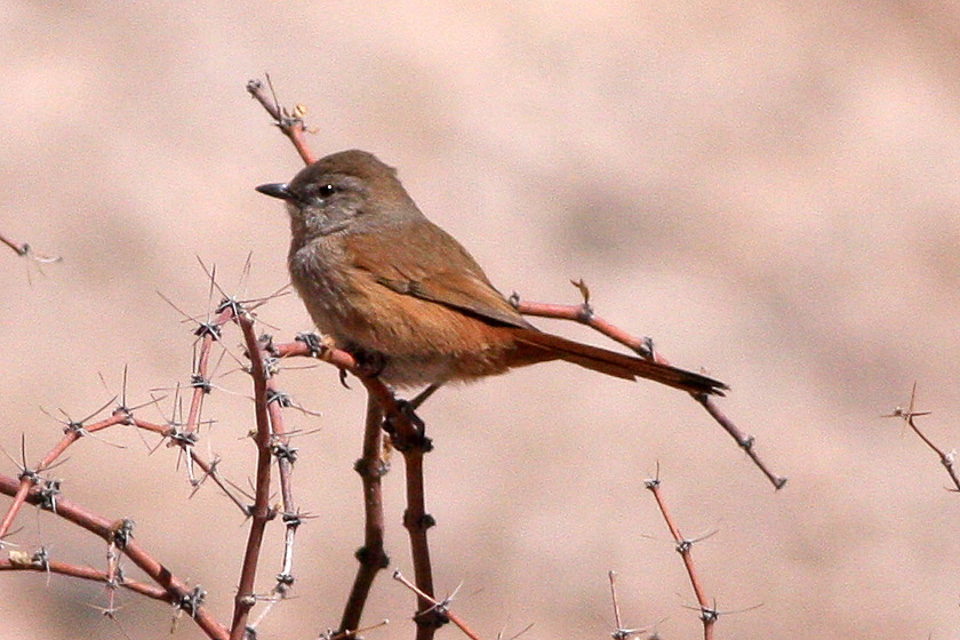
Species of Pseudasthenes
4 in all. Those with an English name come first.
| Scientific name | Common name | Rank | Species |
|---|---|---|---|
| Pseudasthenes humicola | Dusky-tailed Canastero | species | |
| Pseudasthenes patagonica | Patagonian Canastero | species | |
| Pseudasthenes cactorum | Cactus Canastero | species | |
| Pseudasthenes steinbachi | Steinbach's Canastero | species |
Classification
| Kingdom | Animalia |
|---|---|
| Phylum | Chordata |
| Subphylum | Vertebrata |
| Infraphylum | Gnathostomata |
| Parvphylum | Osteichthyes |
| Megaclass | Tetrapoda |
| Class | Aves (Bird) |
| Order | Passeriformes (Passerine) |
| Family | Furnariidae (Ovenbird) |
| Genus | Pseudasthenes Derryberry, Claramunt, O'Quin, Aleixo, Chesser, Remsen & Brumfield, 2010 |
Origin of the name. Etymology. The generic name, from the Greek pseudo (false) and asthenes (insignificant, strengthless), denotes the outward resemblance of species of this genus to species of Asthenes but highlights the fact that they are not closely related. The name is feminine in gender. Genetic analyses. A preliminary genetic analysis of our data from all furnariid species found that Pseudasthenes was sister to a clade composed of Pseudoseisura and Spartonoica. This preliminary analysis also indicated that Asthenes, as currently recognized, is not monophyletic because Schizoeaca and Oreophylax are nested within it. To demonstrate that Asthenes is not monophyletic, and to propose a new hypothesis for phylogenetic relationships among Asthenes, Schizoeaca, and Oreophylax, we present an analysis of a subset of taxa from this larger study. This restricted analysis includes all species of Asthenes except A. heterura (Berlepsch) (Maquis Canastero) and A. berlepschi (Hellmayr) (Berlepsch's Canastero), all species of Schizoeaca except S. coryi (Berlepsch) (Ochre-browed Thistletail), and Oreophylax moreirae (Ribeiro) (Itatiaia Spinetail). We also included in the analysis the furnariids Furnarius rufus (Gmelin) (Rufous Hornero), Leptasthenura aegithaloides (Kittlitz) (Plain-mantled Tit-Spinetail), Cranioleuca erythrops (Sclater) (Redfaced Spinetail), Thripophaga fusciceps Sclater (Plain Softtail), Phacellodomus rufifrons (Wied-Neuwied) (Rufous-fronted Thornbird), Spartonoica maluroides, Xenerpestes singularis (Taczanowski & Berlepsch) (Equatorial Graytail), Pseudoseisura lophotes, Philydor pyrrhodes (Cabanis) (Cinnamon-rumped Foliagegleaner), Automolus infuscatus (Sclater) (Olive-backed Foliage-gleaner), and Xenops minutus (Sparrman) (Plain Xenops) (Table 1). We used the dendrocolaptid species Dendrocolaptes sanctithomae (Lafresnaye) (Northern Barred Woodcreeper) to root the tree. TABLE 1. Tissue samples used in the genetic analysis. Taxon Museum Sample ID Locality Furnarius rufus AMNH DOT 10431 ARGENTINA: prov. Neuquen; depto. Confluencia, Centenario. Leptasthenura aegithaloides AMNH DOT 10306 ARGENTINA: prov. Neuquen; depto. Anelo, Sierra Auca Mahuida. Schizoeaca perijana ICN AMC 879 COLOMBIA: depto. Cesar; Mun. Manaure, Sabana Rubia. S. fuliginosa fuliginosa LSUMNS B 30039 ECUADOR: prov. Carchi; 8 km W Tufino. S. fuliginosa plengei LSUMNS B 8233 PERU: depto. Pasco; Millpo, E Tambo de Vacas on Pozuzo- Chaglla trail. S. vilcabambae FMNH 390681 PERU: depto. Junin; Cordillera Vilcabamba, headwaters Rio Pomureni. S. griseomurina LSUMNS B 34804 PERU: depto. Cajamarca; Cordillera del Condor; Picorana. S. palpebralis LSUMNS B 49625 PERU: depto. Junin; E Comas, ca. 45 km NE Huancayo. S. helleri AMNH DOT 2479 BOLIVIA: depto. La Paz; prov. Franz Tamayo, Tojoloque, near Queara. S. harterti LSUMNS B 1271 BOLIVIA: depto. La Paz; 1 km S Chuspipata. Oreophylax moreirae DZUFMG 2841 BRAZIL: Minas Gerais; municipio de Catas Altas, Serra do Caraca, Pico do Inficionado. Asthenes pyrrholeuca LSUMNS B 56783 ARGENTINA: prov. Chubut; 22 km N Pta. Mugryn on Provincial road 1 to Pto. Lobos. A. baeri AMNH DOT 12134 ARGENTINA: prov. Buenos Aires; depto. Partido Patagones, ca. 35 km E Carmen de Patagones, on Ruta National 3. A. humicola AMNH DOT 12194 CHILE: prov. Chacabuco; Colina, El Potezuelo. A. patagonica LSUMNS B 56798 ARGENTINA: prov. Chubut; 75 km W Puerto Madryn, Estancia Sierra Colorada on Provincial Route 8. A. pudibunda LSUMNS B 103915 PERU: depto. Ayacucho; km 48 on Nazca-Puquio Road. A. ottonis LSUMNS B 61395 PERU: depto. Cusco; 1 km E Huacarpay. A. modesta LSUMNS B 103883 PERU: depto. Tacna; Tacna-Ilave Road, 25 km NE Tarata. A. cactorum LSUMNS B 103812 PERU: depto. Ica; 24 km on Nazca-Purquio Road. A. humilis FMNH 391862 PERU: depto. Lima; Maticuna. A. dorbignyi LSUMNS 95386 BOLIVIA: depto. La Paz; Huajchilla, 18 rd km S Calacoto. A. steinbachi AMNH DOT 10390 ARGENTINA: depto. Anelo; Sierra Auca Mahuida. A. luizae UFMG B 3066 BRAZIL: Minas Gerais; municipio de Cardeal Mota, Serra do Cipo. A. wyatti LSUMNS B 103905 PERU: depto. Puno; km 44 Juliaca-Arequipa Road ca. 18 road km E Santa Hucia. A. sclateri AMNH DOT 12103 ARGENTINA: prov. Cordoba; depto. Punilla, Pampa de Achala, 8 km E El Condor on Provincial Route 20. A. anthoides LSUMNS B 56816 ARGENTINA: prov. Chubut; 16 km WNW Rio Pico, Estancia Tres Valles Provincial Route 19. A. hudsoni USNM B 06349 URUGUAY: depto. Soriano; ca 9 km N of Cardona, at Estancia Santa Emilia. A. urubambensis LSUMNS B 8311 PERU: depto. Pasco; Millpo, E Tambo de Vacas on Pozuzo- Chaglla trail. A. flammulata LSUMNS B 32093 PERU: depto. Cajamarca; Quebrada Lanchal 8 km ESE Sallique. A. virgata LSUMNS B 61350 PERU: depto. Junin; 2 km N Casapalca. A. maculicauda AMNH DOT 2484 BOLIVIA: depto. La Paz; prov. Franz Tamayo, Tojoloque, Near Queara. Cranioleuca erythrops LSUMNS B 1364 PANAMA: prov. Darien; 9 km NW Cana on slopes Cerro Pirre. Thripophaga fusciceps LSUMNS B 7607 BOLIVIA: depto. Beni; Cercado, 6 km by rd. SE Trinidad. Phacellodomus rufifrons AMNH DOT 2305 BOLIVIA: depto. Santa Cruz; prov. Velasco; 300 m N of Rio Mercedes. Spartonoica maluroides AMNH DOT 12089 ARGENTINA: prov. Buenos Aires; Reserva Punta Rasa. Xenerpestes singularis LSUMNS B 6301 ECUADOR: prov. Pichincha; Yanacocha, N Slope of Cerro Pichincha. Pseudoseisura lophotes AMNH DOT 6112 BOLIVIA: depto. Santa Cruz; prov. Cordillera, Izozog, Comunidad Karapari, Estancia San Julian, 1000 m W of Parapet. Philydor pyrrhodes AMNH DOT 8864 VENEZUELA: Amazonas; Mrakapiwie. Automolus infuscatus LSUMNS B 4283 PERU: depto. Loreto; Lower Rio Napo region, E bank Rio Yanayacu, 90 km N Iquitos. Xenops minutus AMNH DOT 8845 VENEZUELA: Amazonas; Mrakapiwie. Dendrocolaptes sanctithomae AMNH DOT 3689 COSTA RICA: prov. Puntarenas; 0.8 km NW Cuatro Cruces on Route 1. Tissue collections: AMNH - American Museum of Natural History, New York City, USA; DZUFMG - Colecao Ornitologica do Departamento de Zoologia da Universidade Federal de Minas Gerais, Belo Horizonte, MG, Brazil; FMNH - Field Museum of Natural History, Chicago, USA; ICN - Instituto de Ciencias Naturales, Universidad Nacional de Colombia, Bogota, Columbia; LSUMNS - Louisiana State University Museum of Natural Science, Baton Rouge, USA; UFMG - Laboratorio de Biodiversidade e Evolucao Molecular da Universidade Federal de Minas Gerais, Belo Horizonte, MG, Brazil; USNM - National Museum of Natural History, Smithsonian Institution, Washington, D. C, USA. Using the Qiagen DNeasy kit, genomic DNA was extracted from 25 mg of pectoral muscle following the manufacturer's protocol. We amplified and sequenced three mitochondrial genes (ND 3, CO 2, and ND 2), as well as the autosomal nuclear gene beta-fibrinogen intron 7 (Bf 7), following methods described in Chesser et al. (2007). For at least one individual per genus, two additional nuclear protein-coding genes (RAG 1 and RAG 2) were sequenced. Most of the RAG sequences from were taken from Moyle et al. (2009); samples of Xenerpestes singularis, Pseudoseisura lophotes, and Oreophylax moreirae were amplified and sequenced for this study, according to methods described in Moyle et al. (2009). Following alignment and the exclusion of unique inserts from Bf 7, the six-gene concatenated dataset included 6,972 base pairs. In model-based phylogenetic inference, there is a trade-off between modeling the evolutionary process as closely as possible and the risk of over parameterization (Sullivan & Joyce 2005; McGuire et al. 2007). In preliminary analyses using the Akaike Information Criterion (Sullivan & Joyce 2005) we identified the General Time Reversible model of nucleotide substitution with gamma distributed rate variation across sites (GTR + Γ) and a fully partitioned dataset (a different model for each position of each coding gene [15] and the nuclear intron) as the best model and partitioning regime. We then performed a Bayesian analysis as implemented in MRBAYES 3.1 (Altekar et al. 2004; Huelsenbeck & Ronquist 2001; Ronquist & Huelsenbeck 2003) on CIPRES Portal v 1.15 (Miller et al. 2009). The Bayesian posterior probability density was estimated by Metropolis-coupled Markov chain Monte Carlo in two independent runs. Each run consisted of four incrementally heated chains, continued for 25 million generations, and was sampled every 2500 generations. All chains reached stationarity, the independent runs converged (split frequencies <0.01), and all parameters met benchmark ESS values (> 200) as evaluated in Tracer v 1.4.1 (Drummond & Rambaut 2007). After discarding the first 5 million generations as burn-in, we computed a majority-rule consensus tree. Following methods in Chesser et al. (2009), we also performed a Maximum Likelihood (ML) analysis. The best tree from this analysis was identical to the majority-rule consensus tree; therefore, we do not include the ML results here. All individuals of Pseudasthenes formed a strongly supported clade (posterior probability = 1.0) sister to the Pseudoseisura-Spartonoica clade (Fig. 1). All other Asthenes species (hereafter Asthenes sensu stricto), together with Oreophylax moreirae and all sampled species of Schizoeaca, formed a monophyletic group. These results demonstrate that Pseudasthenes and Asthenes sensu stricto do not form a clade. Although several authors have suggested that Asthenes is not monophyletic (Pacheco et al. 1996; Zyskowski & Prum 1999; Remsen 2003; Vasconcelos et al. 2008), the pattern of relationships that we found had not been predicted.
Common names
English
- False Canasteros
Names in 4 other languages
- Finnish
- rinnekanasterot
- Lithuanian
- Netikrosios kanasteros
- Norwegian Bokmål
- Uekte kurvfugler
- Spanish
- Canasteros
Sources
- Catalogue of Life, 2026-10-16 XR cc by
- Wikidata CC0
- Wikimedia Commons per image; credit shown with each image
- Within the Catalogue of Life, this name comes from The Integrated Taxonomic Information System cc0
References
- Article title: Pseudasthenes, a new genus of ovenbird (Aves: Passeriformes: Furnariidae). Link
In other databases
Cite this page
ScientificNames.org. (2026). Pseudasthenes (False Canasteros). Retrieved November 25, 2026, from https://scientificnames.org/taxon/pseudasthenes
“Pseudasthenes (False Canasteros).” ScientificNames.org, 2026, scientificnames.org/taxon/pseudasthenes. Accessed 25 Nov. 2026.
ScientificNames.org. “Pseudasthenes (False Canasteros).” Accessed November 25, 2026. https://scientificnames.org/taxon/pseudasthenes.
@misc{scientificnames_pseudasthenes_false_canasteros,
  author = {{ScientificNames.org}},
  title = {Pseudasthenes (False Canasteros)},
  year = {2026},
  url = {https://scientificnames.org/taxon/pseudasthenes},
  note = {Accessed 2026-11-25}
}