Overview
Wikidata describes Psocodea as “order (or superorder) of insects”.
Best-known species of Psocodea
-
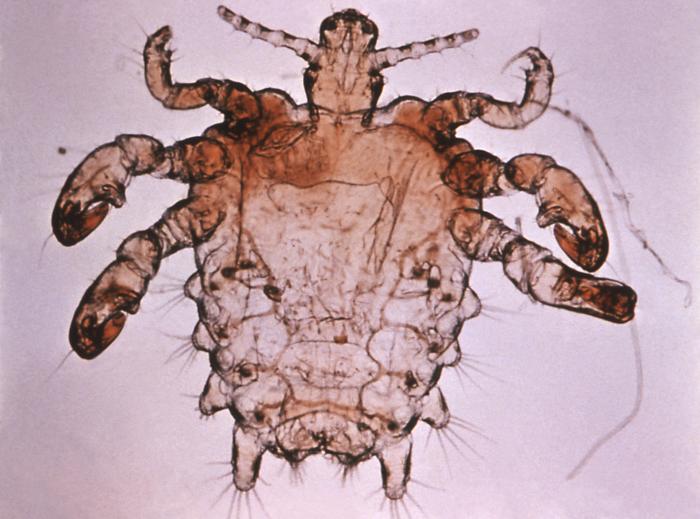 Crab LousePthirus pubis
-
 Human LousePediculus humanus
- Strigiphilus garylarsoni
- House PsocidLiposcelis bostrychophila
-
 Blotched BarklouseGraphopsocus cruciatus
-
 Gorilla LousePthirus gorillae
-
 Hog LouseHaematopinus suis
- Passenger Pigeon Chewing LouseColumbicola extinctus
- Dog Biting LouseTrichodectes (Trichodectes) canis
- Dorypteryx domestica
-
 BookwormTrogium pulsatorium
- Lepidophthirus macrorhini
Members of Psocodea
10 in all. Those with an English name come first.
| Scientific name | Common name | Rank | Species |
|---|---|---|---|
| Troctomorpha | suborder | 6,198 | |
| Psocomorpha | suborder | 5,492 | |
| Trogiomorpha | suborder | 487 | |
| Awightipsocus extinct | genus | 3 | |
| Wightipsocus extinct | genus | 3 | |
| Parapsocida extinct | suborder | 2 | |
| Miotroctes extinct | genus | 1 | |
| Sycopteron extinct | genus | 1 | |
| Wightimicropsocus extinct | genus | 1 | |
| Psoquilidae | family |
Classification
| Kingdom | Animalia |
|---|---|
| Phylum | Arthropoda |
| Subphylum | Hexapoda |
| Class | Insecta (Insect) |
| Order | Psocodea Hennig, 1966 |
Sources
- Catalogue of Life, 2026-10-16 XR cc by
- Wikidata CC0
- Within the Catalogue of Life, this name comes from Psocodea Species File cc by
References
- Hennig, W. (1966) Phylogenetic systematics. University of Illinois Press, Urbana, IL.
- Wu, Z., Ma, S., Lu, J., Ye, H., Yang, D. & Hong, M. (2024) Vertical distribution and driving mechanisms of soil microarthropods in a Stipa baicalensis meadow steppe under long-term nitrogen addition. Ecological Indicators, 159, 111732: 10 pages. https://doi.org/10.1016/j.ecolind.2024.111732
- Warburg, I. & Steinberger, Y. (2024) Micro-Arthropods in the Surroundings of Nests of Messor arenarius Ants in the Negev Desert in Israel. Open Journal of Ecology, 14(07), 563–570. https://doi.org/10.4236/oje.2024.147032
- Sánchez-Loja, S., Donoso, D.A. & Páez-Vacas, M.I. (2024) Conspicuous and cryptic poison frogs are picky and prefer different meals in syntopy. Evolutionary Ecology, 38(5), 679–691. https://doi.org/10.1007/s10682-023-10282-0
- Zhang, Y., Wang, C.-F., Wang, J.-Z., He, H.-Y., Zhang, Y., Zheng, W.-Y., Shi, X.-Y. & Du, S.-S. (2026) Seasonal harvest dictates insecticidal efficacy of Hedychium longipetalum essential oil against stored product pests. Pesticide Biochemistry and Physiology, 217(106898), 1–17. https://doi.org/10.1016/j.pestbp.2025.106898
- Bajracharya, S., Ghimire, R., Dahal, D.R., Rai, V. & Thapa, S. (2025) Diet of Insectivorous Bats (Mammalia: Chiroptera) from Nepal. Acta Chiropterologica, 27(1), 65–74. https://doi.org/10.3161/15081109acc2025.27.1.006
- Villemant, C., Álvarez-Parra, S. & Santos, B.F. (2023) Mymarommatidae, new family and superfamily of parasitoid wasps for Corsica (Hymenoptera, Mymarommatoidea). Bulletin de la Société Entomologique de France, 128(4), 411–419. https://doi.org/10.32475/bsef_2295
- Alfeus, M., Hering, R., Schnerch, B., Angombe, S. & Birkhofer, K. (2026) Moderately thinning encroaching shrub species is key to balancing rangeland restoration and arthropod biodiversity conservation in Namibia. Journal of Applied Ecology, 63(e70454), 1–14. https://doi.org/10.1111/1365-2664.70454
- Maya-García, O., Maya-Elizarrarás, E., Lara, C. & Schondube, J.E. (2024) Arthropod Foraging in a Temperate Mountain Hummingbird Ensemble. Birds, 5(4), 774–797. https://doi.org/10.3390/birds5040052
- Hernandez-Urbina, C.F., Fernández, J.A., Titulaer, M., Aguilar-Palma, N.G., Acosta, R. & Camargo-Sanabria, A.A. (2025) How much do we know about wild canid (Carnivora: Canidae) ectoparasites in Mexico? Current state of knowledge. Mammalia, 89(3), 264–273.
- Feugang Youmessi, F.D. (2025) Forensic entomology in Cameroon (Central African sub-region): the use of arthropod fauna of rat (Rattus norvegicus, Berkenhout, 1769, var. Wistar) carcasses as silent crime scene witnesses. Frontiers in Ecology and Evolution, 13(1512949), 1–6. https://doi.org/10.3389/fevo.2025.1513949
- Ostrovsky, A., Zurawlew, P. & Dobosz, R. (2023) Contribution to the knowledge of the barkflies (Psocodea) of Poland. Wiadomości Entomologiczne, 42, 65–68.
- Brewer, P.J. & Sweet, A.D. (2023) Prevalence and diversity of parasitic bird lice (Insecta: Psocodea) in northeast Arkansas. International Journal for Parasitology: Parasites and Wildlife, 22, 205–215. https://doi.org/10.1016/j.ijppaw.2023.06.007
- Su, Z.-H., Sasaki, A., Minami, H. & Ozaki, K. (2024) Arthropod Phylotranscriptomics With a Special Focus on the Basal Phylogeny of the Myriapoda. Genome Biology and Evolution, 16(9), 1–16. https://doi.org/10.1093/gbe/evae189
- Dagati, C.V., Campon, F.F., Gonzalez, M.F., Mazzitelli, M.E., Marcucci, B., Solis, S.E., Bonfanti, S. & Uliarte, E.M. (2024) Diversity of insects, Collembola and spiders in vineyards under different production systems, conventional and agroecological, in Mendoza, Argentina. Ecologia Austral, 34(1), 141–158.
- Seropian, A., Arsenashvili, E., Bulbulashvili, N., Shubashishvili, A., Iankoshvili, G., Todua, M., Ananiashvili, A., Japarashvili, S., Chkhartisvhili, T., Memishishi, A., Balkhamishvili, S., Chitadze, B., Karalashvili, E., Mumladze, L., Hein, N. & Rulik, B. (2023) Into the unknown: the first barcode-assisted checklist of Psocoptera (Insecta, Psocodea) of Georgia with a census on country species richness. ZooKeys, 1168, 77–105. https://doi.org/10.3897/zookeys.1168.103666
- Boyd, B.M., Bush, S.E. & Dale, C. (2026) Untangling nature’s experiment with lice and endosymbiotic bacteria. Trends in Parasitology, 42(4), 288–296. https://doi.org/10.1016/j.pt.2026.01.015
- Zawierucha, K., Szudarek‐Trepto, N., Laniecki, R., Valle, B., Mikołajczyk, M., Trzebny, A., Nahimova, O., Wierzgoń, M., Kaźmierski, A., Niedbała, W., Rutkowski, T., Kołtonik, K., Łokas, E., Ficetola, G.F., Konwerski, S., Stachowiak, M., Yde, J.C. & Calhim, S. (2026) Morphological and molecular inventory of invertebrates reveals a unique faunal diversity in glacier mice. Journal of Zoology, 328(4), 384–401. https://doi.org/10.1111/jzo.70105
- Mally, R., Turner, R.M., Nahrung, H.F., Yamanaka, T., Fenn-Moltu, G., Bertelsmeier, C., Roques, A., Brockerhoff, E.G., Pureswaran, D.S. & Liebhold, A.M. (2025) Insect invasion success depends on taxon and trophic group. NeoBiota, 99, 19–43. https://doi.org/10.3897/neobiota.99.151227
- Stejskal, V., Vendl, T., Feng, S., Qin, Y., Aulicky, R. & Li, Z. (2025) The relationship between taxonomic classification and applied entomology: stored product pests as a model group. Journal of Insect Science, 25(2:ieaf019), 1–15. https://doi.org/10.1093/jisesa/ieaf019
- García, C.B., Díaz-Siefer, P., Smith-Ramírez, C., Montero-Silva, F., Martínez-Harms, J., Murúa, M. & Celis-Diez, J.L. (2025) Synergistic effect of honeybees and wild floral visitors in promoting sweet cherry fruit set in central Chile. Biological Research Journal, 58(39), 1–8. https://doi.org/10.1186/s40659-025-00617-2
- Ríos-Moyano, D.K., Rodríguez-Cruz, F.A., Hormaza-Martínez, P.A. & Ramírez-Godoy, A. (2025) Characterization of Pollinators Associated with Cocoa Cultivation and Their Relationship with Natural Effective Pollination. Diversity, 17(189), 1–16. https://doi.org/10.3390/d17030189
- Brimblecombe, P. & Querner, P. (2026) Insect Pests and Arthropods in Heritage Interiors. Insects, 17(309), 1–21. https://doi.org/10.3390/insects17030309
- Hribar, L. (2025) Review of arthropod parasites and epifauna taken from the Ovenbird Seiurus aurocapilla in North America. Biodiversity Observations, 15, 43–49. https://doi.org/10.15641/bo.1781
- Boudinot, B.E., Beutel, R.G., Weingardt, M., van de Kamp, T., Hammel, J.U., Li, D., Richter, A. & Wipfler, B. (2025) The insect head rewound: Clarifications to the groundplan of Hexapoda (Pancrustacea). Arthropod Structure & Development, 89(101490), 1–11. https://doi.org/10.1016/j.asd.2025.101490
In other databases
Cite this page
ScientificNames.org. (2026). Psocodea. Retrieved November 24, 2026, from https://scientificnames.org/taxon/psocodea
“Psocodea.” ScientificNames.org, 2026, scientificnames.org/taxon/psocodea. Accessed 24 Nov. 2026.
ScientificNames.org. “Psocodea.” Accessed November 24, 2026. https://scientificnames.org/taxon/psocodea.
@misc{scientificnames_psocodea,
  author = {{ScientificNames.org}},
  title = {Psocodea},
  year = {2026},
  url = {https://scientificnames.org/taxon/psocodea},
  note = {Accessed 2026-11-24}
}