Infraorder · Insects
Termitoidae
Termitoidae is a infraorder in the order Blattodea (cockroaches and termites). The Catalogue of Life lists 3,326 species in it, 3,094 of them living.
Best-known species of Termitoidae
-
 Eastern Subterranean TermiteReticulitermes flavipes
-
 Formosan Subterranean TermiteCoptotermes formosanus
- Pacific Dampwood TermiteZootermopsis angusticollis
- Macrotermes bellicosus
-
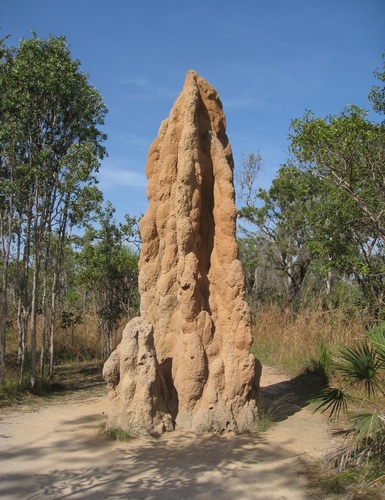 Spinifex TermiteNasutitermes triodiae
-
 Darwin TermiteMastotermes darwiniensis
- Desert Subterranean TermiteHeterotermes aureus
- Compass TermiteAmitermes meridionalis
- Western Drywood TermiteIncisitermes minor
- Tree TermiteNasutitermes corniger
- Western Subterranean TermiteReticulitermes hesperus
-
 Asian Subterranean TermiteCoptotermes gestroi
Members of Termitoidae
6 in all. Those with an English name come first.
| Scientific name | Common name | Rank | Species |
|---|---|---|---|
| Mastotermitidae | family | 35 | |
| Krausichnidae extinct | family | 11 | |
| Cratomastotermitidae extinct | family | 1 | |
| Euisoptera | parvorder | 3,271 | |
| Metatermitidae | family | 6 | |
| Pabuonqedidae extinct | family | 2 |
Classification
| Kingdom | Animalia |
|---|---|
| Phylum | Arthropoda |
| Subphylum | Hexapoda |
| Class | Insecta (Insect) |
| Order | Blattodea (Cockroaches and Termites) |
| Infraorder | Termitoidae Latreille, 1802 |
Synonyms
- Isoptera
Sources
- Catalogue of Life, 2026-10-16 XR cc by
- Within the Catalogue of Life, this name comes from Blattodea Species File cc by
References
- Latreille, P.A. (1802) In Histoire naturelle, générale et particulière des crustacés des insectes. Vol. 3. F. Dufart, Paris. 468 pp. [in French]
- Leach, W.E. (1815) Entomology. In D. Brewster (Ed.). Edinburgh encyclopædia. Vol. 9, part 1. William Blackwood. pp. 57–172. [384 pp.]
- Asigbaase, M., Kumi, S. & Acheamfour, S.A. (2025) Termite-tree-soil interactions in cocoa agroforestry systems: farmer perceptions of ecological dynamics, practices and challenges in three ecological zones of Ghana. International Journal of Tropical Insect Science, 45(3), 1439–1453. https://doi.org/10.1007/s42690-025-01534-3
- Fujiwara, K., Miyazaki, S. & Maekawa, K. (2024) Evolution of the sex-determination gene Doublesex within the termite lineage. Comparative Biochemistry and Physiology - Part D: Genomics and Proteomics, 52, 101297: 9 pages. https://doi.org/10.1016/j.cbd.2024.101297
- Pereira, R.de C., Albanez, J.M. & Paulo Mamedio, I.M. (2012) Diversity of meso and macrofauna in different management systems of land use in Cruz das Almas - Bahia. Magistra, 24, 63–76.
- Duong, L.D., Tran, G.V. & Hoang, N.T. (2025) Morphometry and feeding notes of an endemic frog Amolops spinapectoralis (Amphibia: Ranidae) from Hue City, central Vietnam. Journal of Threatened Taxa, 17(12), 28011–28025. https://doi.org/10.11609/jott.10064.17.12.28011-28025
- To, D., Le, M.D., Le, H., Phan, M., Ho, A., Nguyen, T., Ziegler, T. & Pham, A. (2025) Re-description and dietary ecology of the Hylarana annamitica (Sheridan & Stuart, 2018) (Ranidae) from central Vietnam. Biodiversity Data Journal, 13, e145094: 18 pages. https://doi.org/10.3897/bdj.13.e145094
- Su, N.-Y., Chouvenc, T. & Lee, C.-Y. (2025) Thirty years after the commercial launching of the first bait product for subterranean termites: introduction. Journal of Economic Entomology, 118(3), 979–981. https://doi.org/10.1093/jee/toaf100
- Igga, Y., Twongyirwe, R., Nkurunungi, J.B., Kagoro-Rugunda, G., Opio, A., Vanmaercke, M., Van Rompaey, A. & Poesen, J. (2025) Anthropogenic termite mound erosion: Spatio-temporal distribution, biophysical characteristics and farmers’ perceptions in SW Uganda. Acta Oecologica, 127(104078), 1–15. https://doi.org/10.1016/j.actao.2025.104078
- Wu, D., Seibold, S., Ellwood, M.D.F. & Chu, C. (2022) Differential effects of vegetation and climate on termite diversity and damage. Journal of Applied Ecology, 59(12), 2922–2935. https://doi.org/10.1111/1365-2664.14282
- Liebig, J. & Amsalem, E. (2025) The Evolution of Queen Pheromone Production and Detection in the Reproductive Division of Labor in Social Insects. Annual Review of Entomology, 70(1), 123–142. https://doi.org/10.1146/annurev-ento-022124-124437
- Joly, M.N. (1849) Recherches pour servir à l’histoire naturelle et à l’anatomie des termites, vulgairement désignés sous le nom de fourmis blanches. Mémoires de L’Académie des Sciences, Inscriptions et Belles-Lettres de Toulouse, 5, 1–37 + 3 pls.
- Kikuchi, K., Bourguignon, T. & Mizumoto, N. (2025) Nesting strategy reflects individual worker movement in termites. Movement Ecology, 13(88), 1–9. https://doi.org/10.1186/s40462-025-00612-y
- Wijas, B.J., Letnic, M. & Cornwell, W.K. (2024) Spatial variability in the contribution of termites to the decay of plant detritus. Austral Ecology, 49(7), e13555: 18 pages. https://doi.org/10.1111/aec.13555
- Li, J., Cheng, Y., Hong, Y., Yang, R., Li, C., Hu, X. & Zhang, X. (2026) Identifying suitable wildlife reintroduction/reinforcement habitats based on environmental, dietary, and behavioral suitability. Global Ecology and Conservation, 65(e04023), 1–12. https://doi.org/10.1016/j.gecco.2025.e04023
- Williams, O.L. (1934) Some factors limiting the distribution of termites. In C.A. Kofoid (Ed.). Termites and termite control, 2nd ed. University of California Press. pp. 42–49. [xxvii + [1] + 795 pp.]
- Crampton, G.C. (1920c) Some anatomical details of the remarkable winged zorapteran, Zorotypus hubbardis [sic] Caudell, with notes on its relationships. Proceedings of the Entomological Society of Washington, 22(5), 98–106.
- Dao, A.N.C., Sankara, F., Ndiaye, M.M., Ndiaye, A.B., Pousga, S., Somda, I. & Kenis, M. (2025) Diversity of Termites Used in Poultry Feed in Burkina Faso. Insects, 16(687), 1–13. https://doi.org/10.3390/insects16070687
- Kaur, J., Vaidya, S., Gautam, A., Sharma, I., Yadav, P.R., Ridhi, Nayak, K. & Pandey, M.P. (2026) Entomofauna Diversity Assessment. Indian Journal of Entomology, 89(1), 114–116. https://doi.org/10.55446/ije.2025.3487
- Tillyard, R.J. (1936) Are termites descended from true cockroaches? Nature, 137, 655.
- Iasczczaki, R.S., Beghelli, G.M., Carneiro, G.S. & de Assis, C.H.B. (2025) Honeydew-producing pest enhances density and predation behavior of ants: a case study in erva-mate agroecosystems. Arthropod-Plant Interactions, 19(60), 1–10. https://doi.org/10.1007/s11829-025-10169-7
- Hagen, H.A. (1858c) Monographie der Termiten. Linnaea Entomologica, 12, i-iii + 4–342 + 459 + 3 pls.
- Tuma, J., Frouz, J., Vesela, H., Krivohlavy, F. & Fayle, T.M. (2022) The impacts of tropical mound-building social insects on soil properties vary between taxa and with anthropogenic habitat change. Applied Soil Ecology, 179, 104576: 12 pages. https://doi.org/10.1016/j.apsoil.2022.104576
- Roobas, B. & Feulner, G.R. (2013) A population of Bosk's fringe-toed lizard Acanthodactylus boskianus (Daudin, 1802) in the Hajar Mountain foothills of the UAE. Tribulus: Bulletin of the Emirates Natural History Group, 21, 24–37.
- Neves, F.S., Gomes, I.P., da Silva, P.G., Beirão, M., Rosa, C.S., Castro, F., Júnior, J.E.S., Moura, M., Paglia, A., Dornas, T., Vieira, F. & Solar, R.R. (2026) Seasonal dynamics in terrestrial insect communities after the impact of the Brumadinho tailings dam disaster. Insect Conservation and Diversity, 19(3), 634–646. https://doi.org/10.1111/icad.70052
In other databases
Cite this page
ScientificNames.org. (2026). Termitoidae. Retrieved November 24, 2026, from https://scientificnames.org/taxon/termitoidae
“Termitoidae.” ScientificNames.org, 2026, scientificnames.org/taxon/termitoidae. Accessed 24 Nov. 2026.
ScientificNames.org. “Termitoidae.” Accessed November 24, 2026. https://scientificnames.org/taxon/termitoidae.
@misc{scientificnames_termitoidae,
  author = {{ScientificNames.org}},
  title = {Termitoidae},
  year = {2026},
  url = {https://scientificnames.org/taxon/termitoidae},
  note = {Accessed 2026-11-24}
}