Comparison

Algae Octopus vs Mimic Octopus

Algae Octopus (Abdopus aculeatus) and Mimic Octopus (Thaumoctopus mimicus) both belong to the family Octopodidae (scuttles) and part ways below it. Both are recorded in 4 countries.

Algae Octopus

Algae Octopus

Abdopus aculeatus

IchHier--15er (Diskussion), CC BY-SA 4.0, via Wikimedia Commons

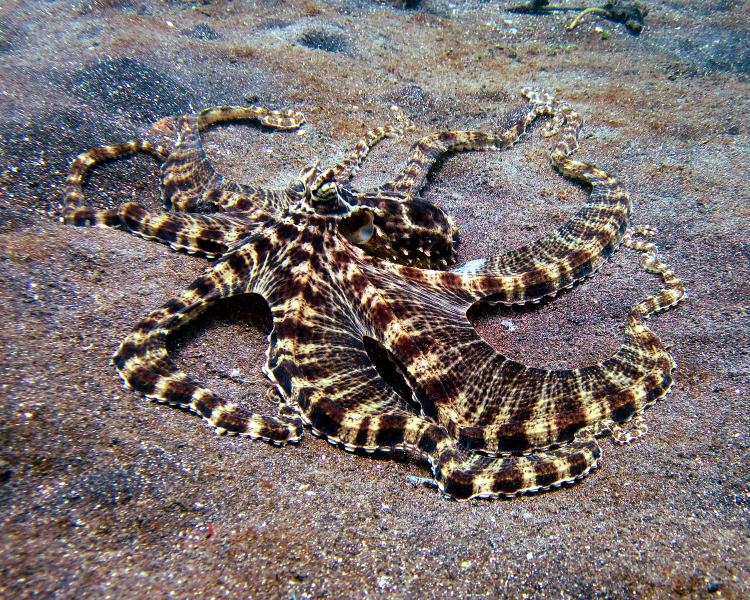
Mimic Octopus

Mimic Octopus

Thaumoctopus mimicus

Steve Childs, CC BY 2.0, via Wikimedia Commons

Side by side

Algae OctopusMimic Octopus
Scientific nameAbdopus aculeatus (A. d'Orbigny, 1834)Thaumoctopus mimicus M. Norman & Hochberg, 2005
English nameAlgae OctopusMimic Octopus
GroupMolluscsMolluscs
ClassCephalopoda CephalopodCephalopoda Cephalopod
FamilyOctopodidae ScuttlesOctopodidae Scuttles
GenusAbdopus White V OctopusThaumoctopus Mimic Octopus
Named in18342005
Red List categoryLeast ConcernLeast Concern
Environmentmarinemarine
Countries on record7 countries6 countries
GBIF occurrence records113 records220 records

Rows where the two agree are shown in grey.

Where each is found

Both recorded in 4 countries

Only Algae Octopus (3)

Only Mimic Octopus (2)

From Catalogue of Life checklists and GBIF occurrence records. A country missing from a list means no record is held, which is not proof of absence.

Checked facts

Algae OctopusMimic Octopus
Appearance
  • The species uses resting camouflage that resembles a gastropod shell covered with algae. English Wikipedia
  • Its resting coloration includes mottled ochre, gray, and brown tones. English Wikipedia
  • Its resting camouflage includes dark bars across its arms. English Wikipedia
  • The species has a natural beige or light-brown coloration with brown bands. English Wikipedia
  • Individuals commonly display contrasting white and brown stripes. English Wikipedia
  • The species has small horn-like projections above each eye. English Wikipedia
  • Its body is slender, with its arms approximately pencil-width at their widest. English Wikipedia
Size
  • The species reaches approximately 60 cm in total length, including its arms. English Wikipedia
Habitat
  • The species occurs in intertidal zones along coastlines. English Wikipedia
  • It primarily inhabits areas with abundant seagrass coverage. English Wikipedia
  • It occupies dens constructed in sandy seabeds and lined with small pebbles. English Wikipedia
  • As they grow, hatchlings remain in intertidal zones and begin burrowing into sandy substrates. English Wikipedia
Diet
  • The species feeds on small crustaceans, including portunid and calappid crabs. English Wikipedia
  • It uses its sharp beak to penetrate the exoskeletons of captured prey and access their muscles. English Wikipedia
Behaviour
  • The species is most active during daylight hours and returns to its den at night. English Wikipedia
  • In some areas of Northern Australia, individuals forage among coral. English Wikipedia
  • It searches for prey by probing and pouncing on small rocks and algae clusters and by digging into sand. English Wikipedia
  • It pursues prey by jetting water from its siphon to propel itself forward. English Wikipedia
  • It generally consumes captured prey where it catches it. English Wikipedia
  • When consuming prey near its den, it sometimes carries the discarded exoskeleton up to one metre away. English Wikipedia
  • Juveniles and adults use upright bipedal locomotion in addition to swimming, crawling, and jetting. English Wikipedia
  • The species uses upright bipedal locomotion as a rapid escape method. English Wikipedia
  • Its escape locomotion is often combined with camouflage resembling surrounding seagrass. English Wikipedia
  • The species uses chromatophores to camouflage itself. English Wikipedia
  • The species can imitate multiple marine animal species to avoid predators. English Wikipedia
  • The species has been observed imitating as many as 18 different marine animals. English Wikipedia
  • The species imitates lionfish by extending its arms radially. English Wikipedia
  • The species imitates sea snakes by concealing six arms and holding two parallel to one another. English Wikipedia
  • The species imitates jellyfish by inflating its mantle and trailing its arms. English Wikipedia
  • The species imitates flatfish by positioning all eight arms behind its body while swimming. English Wikipedia
  • The species can use mimicry to approach wary prey. English Wikipedia
  • The species propels itself over the seabed using jets of water expelled through its siphon. sites.evergreen.edu
  • The species can imitate a lionfish by spreading its tentacles away from its head. sites.evergreen.edu
  • The species can imitate a jellyfish by expanding its head and trailing its limbs. sites.evergreen.edu
  • The species can flatten its body and move its tentacles to one side to imitate a flatfish. sites.evergreen.edu
Reproduction
  • The species exhibits three mating strategies: mate guarding, transient copulation, and sneaker mating. English Wikipedia
  • A guarding male can mate with a female by extending his hectocotylus into her den while remaining in his own. English Wikipedia
  • Paired males and females may mate repeatedly for up to one week. English Wikipedia
  • Females may mate with sneaker males even when they have a guarding male. English Wikipedia
  • Smaller sneaker males sometimes camouflage themselves as small females when approaching a female's den. English Wikipedia
  • Transient copulation occurs when a male mates with an opportunistic female encountered while foraging. English Wikipedia
  • Males transfer spermatophores to females using their hectocotylus. English Wikipedia
  • After mating, females retreat into their dens and cover the entrances with rubble. English Wikipedia
  • Females remain in their dens for several days while spawning multiple festoons containing thousands of eggs. English Wikipedia
  • Females remain with their eggs until hatching and clean and care for them. English Wikipedia
  • Newly hatched individuals are planktonic and measure approximately 2 mm. English Wikipedia
  • Hatchlings receive no parental protection after hatching. English Wikipedia
No checked fact yet
Lifespan
  • The species is semelparous, with adults dying shortly after their offspring hatch. English Wikipedia
No checked fact yet
DistributionNo checked fact yet
Similar species
  • The species is sometimes confused with an undescribed member of the same genus discovered in 2011. English Wikipedia
  • Octopus bimaculoides is suggested as a potentially close relative because both species share skin components involved in camouflage. English Wikipedia
No checked fact yet

In brief

Algae Octopus

Abdopus aculeatus occurs in intertidal zones along the coastlines of Indonesia, the Philippines, and Northern Australia. Its resting camouflage resembles a gastropod shell covered with algae. Full profile

Mimic Octopus

Thaumoctopus mimicus inhabits muddy river-mouth bottoms, estuaries, and shallow offshore waters, primarily on sandy or silty seabeds at depths below 15 meters. Full profile

Compare something else

Page built on 28 November 2026 from the data on the two species pages, where every source is listed.

Cite this page

ScientificNames.org. (2026). Algae Octopus vs Mimic Octopus. Retrieved November 28, 2026, from https://scientificnames.org/compare/algae-octopus-vs-mimic-octopus