Species · Molluscs
Mimic Octopus Thaumoctopus mimicus
The scientific name of the Mimic Octopus is Thaumoctopus mimicus. It is a species of mollusc in the family Octopodidae (scuttles). The name dates from 2005.
- Scientific name
- Thaumoctopus mimicus M. Norman & Hochberg, 2005
- Common name
- Mimic Octopus
- Genus
- Thaumoctopus
- Family
- Octopodidae (Scuttles)
- Class
- Cephalopoda
- Red List category
- LC Least Concern
- Environment
- marine
- Recorded in
- 6 countries
- Name status
- accepted in the Catalogue of Life
Overview
Thaumoctopus mimicus inhabits muddy river-mouth bottoms, estuaries, and shallow offshore waters, primarily on sandy or silty seabeds at depths below 15 meters.
Written 24 November 2026 from the sources listed below. Each statement was checked against the passage it cites; statements that could not be supported were removed.
Appearance
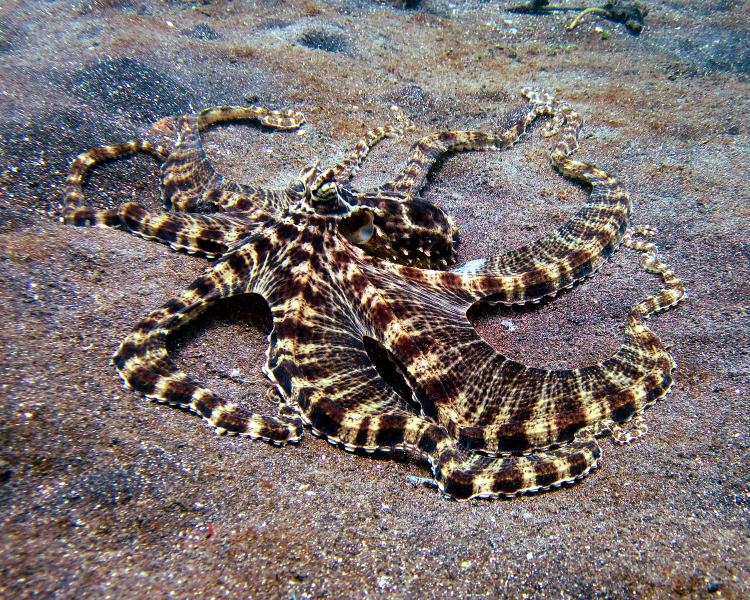
The species has a natural beige or light-brown coloration with brown bands. Individuals commonly display contrasting white and brown stripes.[1][2]
It has small horn-like projections above each eye and a slender body. Its arms are approximately pencil-width at their widest.[3][4]
The species reaches approximately 60 cm in total length, including its arms.[5]
Habitat
The species inhabits muddy river-mouth bottoms and prefers river mouths and estuaries. It primarily occupies sandy or silty seabeds at depths below 15 meters and also inhabits shallow offshore waters.[6][7][8][9]
It prefers muddy seabeds that match its natural skin coloration.[10]
Diet
The species feeds on small fish, crabs, and worms. Its recorded prey also includes echinoderms and crustaceans.[11][12]
Behaviour
The species uses chromatophores to camouflage itself. It can imitate multiple marine animal species to avoid predators and has been observed imitating as many as 18 different marine animals.[13][14][15]
It imitates lionfish by extending its arms radially. It can also spread its tentacles away from its head to imitate a lionfish.[16][17]
It imitates sea snakes by concealing six arms and holding two parallel to one another.[18]
It imitates jellyfish by inflating its mantle and trailing its arms. It can also expand its head and trail its limbs to produce this imitation.[19][20]
It imitates flatfish by positioning all eight arms behind its body while swimming. It can also flatten its body and move its tentacles to one side to imitate a flatfish.[21][22]
The species can use mimicry to approach wary prey. It propels itself over the seabed using jets of water expelled through its siphon.[23][24]
Classification of the Mimic Octopus
| Kingdom | Animalia |
|---|---|
| Phylum | Mollusca |
| Class | Cephalopoda (Cephalopod) |
| Subclass | Coleoidea |
| Superorder | Octopodiformes |
| Family | Octopodidae (Scuttles) |
| Genus | Thaumoctopus (Mimic Octopus) |
| Species | Thaumoctopus mimicus M. Norman & Hochberg, 2005 |
Where the Mimic Octopus is found
Checklists and occurrence records place Thaumoctopus mimicus in 6 countries. GBIF holds 220 georeferenced records of it.
Countries
Regions and cities with the most records
- Bitung, Indonesia 91
- Batangas, Philippines 44
- Dumaguete, Philippines 7
- Banjar, Indonesia 6
- Bali, Indonesia 5
- Ambon, Indonesia 3
- Ban Talat Yai, Thailand 3
- Phuket, Thailand 3
1 more country has a few records outside this range
These countries hold a few records of Thaumoctopus mimicus but lie outside the range the checklists give for it. Such records are often zoo or garden specimens, museum material or vagrants, so the species is not counted as occurring there.
A number beside a place is its count of GBIF occurrence records. A place without a number comes from a checklist alone. Records show where a species has been observed or collected, which can include escapes and vagrants.
Common names
English
- Mimic Octopus
- George Cloney
Names in 10 other languages
- Chinese
- 擬態章魚
- French
- Poulpe mimétique
- German
- Karnevalstintenfisch, Mimik-Oktopus
- Hebrew
- תמנון חקיין
- Italian
- Polpo mimo
- Japanese
- ミミックオクトパス
- Portuguese
- Polvo-mímico
- Spanish
- Pulpo mimico, Pulpo mímico
- Thai
- ปลาหมึกสายลายเสือ
- Turkish
- Taklitçi Ahtapot
Related species
-
 Common OctopusOctopus vulgaris
-
 Greater Blue-ringed OctopusHapalochlaena lunulata
-
 Gold-spot OctopusAmphioctopus fangsiao
-
 Southern Blue-ringed OctopusHapalochlaena maculosa
-
 Coconut OctopusAmphioctopus marginatus
-
 Star-sucker Pygmy OctopusOctopus wolfi
-
 Day OctopusOctopus cyanea
-
 Gloomy OctopusOctopus tetricus
Compare
Questions and answers
What is the scientific name of the Mimic Octopus?
The scientific name of the Mimic Octopus is Thaumoctopus mimicus. Written with its author, the full name is Thaumoctopus mimicus M. Norman & Hochberg, 2005.
Which family does the Mimic Octopus belong to?
Thaumoctopus mimicus belongs to the family Octopodidae and the class Cephalopoda.
Where is the Mimic Octopus found?
Checklists and occurrence records place Thaumoctopus mimicus in 6 countries: Indonesia, Philippines, Australia, New Caledonia, Taiwan and Thailand.
What is the conservation status of the Mimic Octopus?
The IUCN Red List category recorded for Thaumoctopus mimicus is Least Concern (LC).
What other names does the Mimic Octopus have?
Thaumoctopus mimicus is also known in English as George Cloney.
How many species can a mimic octopus mimic?
It has been observed imitating as many as 18 different marine animals.[15]
Sources
Passages the profile rests on
- The species has a natural beige or light-brown coloration with brown bands. Source passage: “The octopus' natural color is light brown/beige” — English Wikipedia
- Individuals commonly display contrasting white and brown stripes. Source passage: “it usually takes on a more noticeable hue of striped white and brown” — English Wikipedia
- The species has small horn-like projections above each eye. Source passage: “Small horns protrude from each eye.” — English Wikipedia
- Its body is slender, with its arms approximately pencil-width at their widest. Source passage: “with a diameter approximately that of a pencil at their widest.” — English Wikipedia
- The species reaches approximately 60 cm in total length, including its arms. Source passage: “growing to a total length of about 60 cm (2 ft), including arms” — English Wikipedia
- The species inhabits muddy river-mouth bottoms. Source passage: “on the bottom of a muddy river mouth.” — English Wikipedia
- The species prefers river mouths and estuaries. Source passage: “It prefers river mouths and estuaries” — English Wikipedia
- The species primarily occupies sandy or silty seabeds at depths below 15 meters. Source passage: “It is primarily found in areas with sand or silt at depths of less than 15 m (49 ft).” — English Wikipedia
- The species inhabits shallow offshore waters. Source passage: “It resides in shallow offshore waters in the Indo-Pacific region” — sites.evergreen.edu
- The species prefers muddy seabeds that match its natural skin coloration. Source passage: “it prefers muddy sea beds the same color as its natural skin.” — sites.evergreen.edu
- The species feeds on small fish, crabs, and worms. Source passage: “which mostly consists of small fish, crabs, and worms.” — English Wikipedia
- Its recorded prey includes echinoderms, crustaceans, and fish. Source passage: “seeking prey such as echinoderms, crustaceans and fish.” — English Wikipedia
- The species uses chromatophores to camouflage itself. Source passage: “Like other octopuses, it uses its chromatophores to disguise itself.” — English Wikipedia
- The species can imitate multiple marine animal species to avoid predators. Source passage: “being able to impersonate a wide variety of other marine animals.” — English Wikipedia
- The species has been observed imitating as many as 18 different marine animals. Source passage: “up to 18 different marine animals.” — English Wikipedia
- The species imitates lionfish by extending its arms radially. Source passage: “the octopus holds its arms out radially to mimic the fish's spines” — English Wikipedia
- The species can imitate a lionfish by spreading its tentacles away from its head. Source passage: “By spreading its tentacles away from its head, it imitates the banded spines of a lionfish.” — sites.evergreen.edu
- The species imitates sea snakes by concealing six arms and holding two parallel to one another. Source passage: “hiding 6 of its arms, it holds the remaining 2 parallel to each other” — English Wikipedia
- The species imitates jellyfish by inflating its mantle and trailing its arms. Source passage: “by inflating its mantle and trailing its arms behind it” — English Wikipedia
- The species can imitate a jellyfish by expanding its head and trailing its limbs. Source passage: “expand its head, and trail its limbs, imitating a jellyfish.” — sites.evergreen.edu
- The species imitates flatfish by positioning all eight arms behind its body while swimming. Source passage: “holding all 8 arms behind it as it uses its siphon to swim.” — English Wikipedia
- The species can flatten its body and move its tentacles to one side to imitate a flatfish. Source passage: “The octopus can push its tentacles to one side and flatten its body like a flatfish.” — sites.evergreen.edu
- The species can use mimicry to approach wary prey. Source passage: “it also uses aggressive mimicry to approach wary prey” — English Wikipedia
- The species propels itself over the seabed using jets of water expelled through its siphon. Source passage: “It glides by drawing in and releasing jets of water from its siphon” — sites.evergreen.edu
Data
- Catalogue of Life, 2026-10-16 XR cc by
- Global Biodiversity Information Facility CC BY 4.0
- Wikidata CC0
- GeoNames CC BY 4.0
- Wikimedia Commons per image; credit shown with each image
- Within the Catalogue of Life, this name comes from World Register of Marine Species cc by
References
- Norman, M. D., & Hochberg, F. G. (2005). The “mimic Octopus”(Thaumoctopus mimicus n. gen. et sp.), a new octopus from the tropical Indo-West Pacific (Cephalopoda: Octopodidae). Molluscan Research, 25. https://doi.org/10.11646/mr.25.2.1 Link where the name was published
This species in other databases
Page built on 24 November 2026. See how the catalog is made and all sources and licences.
Cite this page
ScientificNames.org. (2026). Thaumoctopus mimicus (Mimic Octopus). Retrieved November 24, 2026, from https://scientificnames.org/species/thaumoctopus-mimicus
“Thaumoctopus mimicus (Mimic Octopus).” ScientificNames.org, 2026, scientificnames.org/species/thaumoctopus-mimicus. Accessed 24 Nov. 2026.
ScientificNames.org. “Thaumoctopus mimicus (Mimic Octopus).” Accessed November 24, 2026. https://scientificnames.org/species/thaumoctopus-mimicus.
@misc{scientificnames_thaumoctopus_mimicus_mimic_octopus,
  author = {{ScientificNames.org}},
  title = {Thaumoctopus mimicus (Mimic Octopus)},
  year = {2026},
  url = {https://scientificnames.org/species/thaumoctopus-mimicus},
  note = {Accessed 2026-11-24}
}