Comparison
Elegant Fly Mimic vs Flying Peacock Spider
Elegant Fly Mimic (Abracadabrella elegans) and Flying Peacock Spider (Maratus volans) both belong to the family Salticidae (jumping spider) and part ways below it. Both are recorded in 1 country.



Side by side
| Elegant Fly Mimic | Flying Peacock Spider | |
|---|---|---|
| Scientific name | Abracadabrella elegans (L. Koch, 1879) | Maratus volans (O. Pickard-Cambridge, 1874) |
| English name | Elegant Fly Mimic | Flying Peacock Spider |
| Group | Spiders and other arachnids | Spiders and other arachnids |
| Class | Arachnida Arachnid | Arachnida Arachnid |
| Order | Araneae Spider | Araneae Spider |
| Family | Salticidae Jumping Spider | Salticidae Jumping Spider |
| Genus | Abracadabrella | Maratus Peacock Spiders |
| Named in | 1879 | 1874 |
| Countries on record | 1 country | 1 country |
| GBIF occurrence records | 30 records | 761 records |
Rows where the two agree are shown in grey.
Where each is found
Both recorded in 1 country
From Catalogue of Life checklists and GBIF occurrence records. A country missing from a list means no record is held, which is not proof of absence.
Checked facts
| Elegant Fly Mimic | Flying Peacock Spider | |
|---|---|---|
| Appearance |
|
|
| Size | No checked fact yet |
|
| Habitat |
|
|
| Diet | No checked fact yet |
|
| Behaviour |
|
|
| Reproduction | No checked fact yet |
|
| Distribution |
|
|
In brief
Elegant Fly Mimic
Elegant Fly Mimic is an arachnid in the family Salticidae, order Araneae and class Arachnida. The species is common in coastal eastern Australia, with most records from Queensland. It resembles a large fly, with two raised, rounded black mounds on its abdomen that resemble eyes and spinnerets that resemble fly mouthparts. Full profile
Flying Peacock Spider
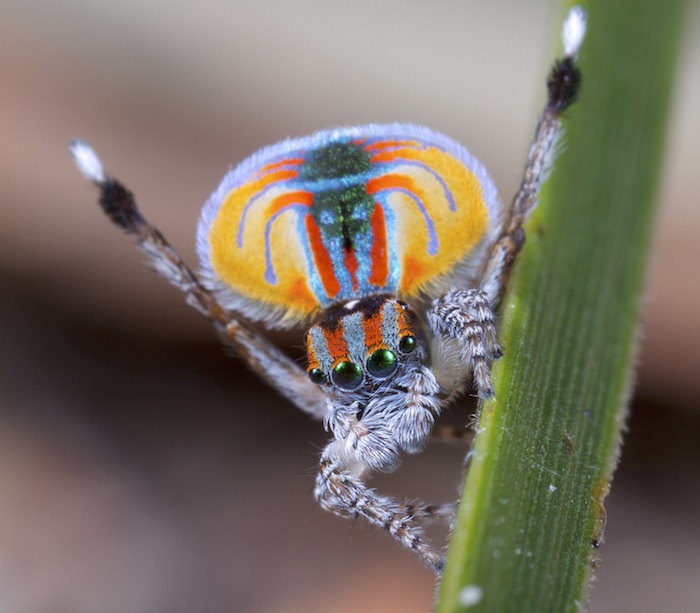
The species occurs in Queensland, New South Wales, the Australian Capital Territory, Western Australia, and Tasmania. Males are distinguished by colourful abdominal flaps and specialized scales that produce visual displays. Full profile
Compare something else
Page built on 28 November 2026 from the data on the two species pages, where every source is listed.
Cite this page
ScientificNames.org. (2026). Elegant Fly Mimic vs Flying Peacock Spider. Retrieved November 28, 2026, from https://scientificnames.org/compare/elegant-fly-mimic-vs-flying-peacock-spider
“Elegant Fly Mimic vs Flying Peacock Spider.” ScientificNames.org, 2026, scientificnames.org/compare/elegant-fly-mimic-vs-flying-peacock-spider. Accessed 28 Nov. 2026.
ScientificNames.org. “Elegant Fly Mimic vs Flying Peacock Spider.” Accessed November 28, 2026. https://scientificnames.org/compare/elegant-fly-mimic-vs-flying-peacock-spider.
@misc{scientificnames_elegant_fly_mimic_vs_flying_peacock_spider,
  author = {{ScientificNames.org}},
  title = {Elegant Fly Mimic vs Flying Peacock Spider},
  year = {2026},
  url = {https://scientificnames.org/compare/elegant-fly-mimic-vs-flying-peacock-spider},
  note = {Accessed 2026-11-28}
}