Species · Spiders and other arachnids
Flying Peacock Spider Maratus volans
The scientific name of the Flying Peacock Spider is Maratus volans. It is a species of arachnid in the family Salticidae (jumping spider), order Araneae. The name dates from 1874.
- Scientific name
- Maratus volans (O. Pickard-Cambridge, 1874)
- Common name
- Flying Peacock Spider
- Genus
- Maratus
- Family
- Salticidae (Jumping Spider)
- Order
- Araneae
- Class
- Arachnida
- Recorded in
- 1 country
- Name status
- accepted in the Catalogue of Life
Overview
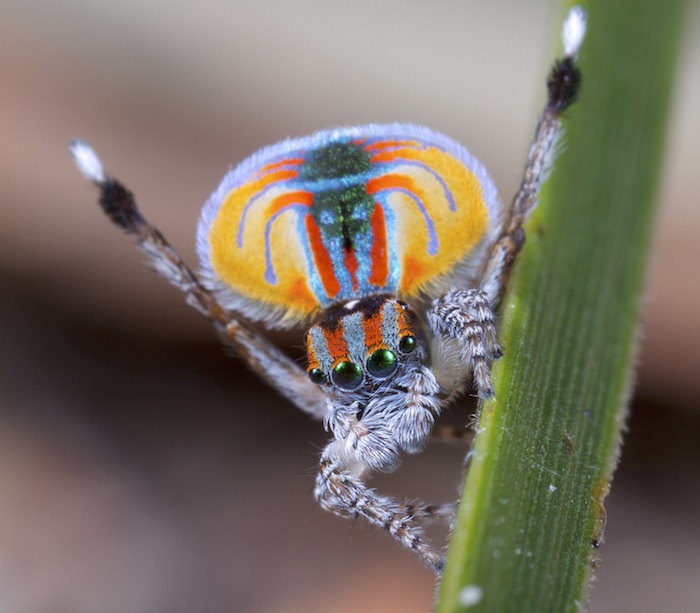
The species occurs in Queensland, New South Wales, the Australian Capital Territory, Western Australia, and Tasmania. Males are distinguished by colourful abdominal flaps and specialized scales that produce visual displays.
Written 26 November 2026 from the sources listed below. Each statement was checked against the passage it cites; statements that could not be supported were removed.
Appearance
Adult males have red, blue, and black coloration and colourful abdominal flaps edged with white hairs. Their abdominal scales produce the species' characteristic colourful display and can reflect visible and ultraviolet light.[1][2][3]
Females and immature specimens are brown and have colour patterns that distinguish them from related species. Immature males lack the abdominal fan and specialized third legs found in mature males.[4][5]
Both males and females reach approximately 5 mm in body length.[6]
Habitat
Individuals occur in habitats ranging from sand dunes to grasslands. Peacock spiders are commonly ground-dwelling and occur on leaf litter and dry twigs.[7][8]
Diet
The species feeds primarily on insects and other spiders. Individuals capture prey by stalking it visually, chasing it, and jumping onto it to deliver a fatal bite.[9][10]
Behaviour
The species is active during daylight hours. Individuals have been observed jumping up to 40 times their body length.[11][12]
During courtship, males raise and expand their abdominal flaps to display a circular field of colour. They also raise their third pair of legs, displaying black hairs and white tips, and use a clapping motion of these legs to attract female attention.[13][14][15]
Males vibrate their abdomens, wave their raised legs and tails, and dance sideways during courtship. Their courtship vibrations include rumble-rumps, crunch rolls, and grind-revs.[16][17]
Rumble-rump vibrations can begin before a male visually detects a female. Males and females also use contact pheromones deposited on silk drag-lines as chemical signals, and female pheromones can trigger male courtship without visual cues.[18][19][20]
Female mating preferences are more strongly influenced by male visual displays than by vibrational signals. Male visual courtship displays typically last approximately 24 minutes on average and can last between six and fifty minutes.[21][22][23]
Female aggression toward males can also occur after mating.[24]
Reproduction and life cycle
The species is typically most active during the Austral spring, which is its breeding season. Mature males typically appear between August and December, while females typically appear later than males and survive longer.[25][26][27]
Females of this species are likely to mate only once. Copulation can last from several minutes to several hours.[28][29]
Females lay between 6 and 15 eggs per clutch. They construct underground nests in December to lay their eggs and remain hidden during this period to protect them from predators.[30][31][32]
Some females have been observed producing several consecutive broods.[33]
Classification of the Flying Peacock Spider
| Kingdom | Animalia |
|---|---|
| Phylum | Arthropoda |
| Subphylum | Chelicerata |
| Class | Arachnida (Arachnid) |
| Order | Araneae (Spider) |
| Family | Salticidae (Jumping Spider) |
| Genus | Maratus (Peacock Spiders) |
| Species | Maratus volans (O. Pickard-Cambridge, 1874) |
Where the Flying Peacock Spider is found
Checklists and occurrence records place Maratus volans in 1 country across Oceania. GBIF holds 761 georeferenced records of it.
Countries
Regions and cities with the most records
- Victoria, Australia 302
- New South Wales, Australia 249
- Queensland, Australia 193
- Brisbane, Australia 59
- Burwood, Australia 56
- Balwyn North, Australia 49
- Central Coast, Australia 25
- Melbourne, Australia 24
- Newcastle, Australia 19
- Hornsby, Australia 16
- Hervey Bay, Australia 15
- Frankston East, Australia 9
- Cessnock, Australia 6
- Liverpool, Australia 6
- Logan City, Australia 6
- Narangba, Australia 5
- Batemans Bay, Australia 4
- Caloundra, Australia 3
- Gold Coast, Australia 3
Range as the checklists state it
Australia (Queensland, New South Wales, Victoria)
Australia
A number beside a place is its count of GBIF occurrence records. A place without a number comes from a checklist alone. Records show where a species has been observed or collected, which can include escapes and vagrants.
Common names
English
- Flying Peacock Spider
Names in 1 other language
- German
- Fliegende Spinne, Gleitende Spinne
Synonyms
3 other scientific names have been used for this species and are now treated as synonyms of Maratus volans.
- Maratus amoenus Karsch, 1878
- Saitis volans Simon, 1901
- Salticus volans O. Pickard-Cambridge, 1874
Related species
- SparklemuffinMaratus jactatus
-
 White Banded House JumperMaratus griseus
-
 Maratus pavonis
-
 Coastal Peacock SpiderMaratus speciosus
-
 Bat Peacock SpiderMaratus vespertilio
- SkeletorusMaratus sceletus
-
 Seashore JumperMaratus marinus
-
 Unusual Peacock SpiderMaratus anomalus
Compare
Questions and answers
What is the scientific name of the Flying Peacock Spider?
The scientific name of the Flying Peacock Spider is Maratus volans. Written with its author, the full name is Maratus volans (O. Pickard-Cambridge, 1874).
Which family does the Flying Peacock Spider belong to?
Maratus volans belongs to the family Salticidae, in the order Araneae and the class Arachnida.
Where is the Flying Peacock Spider found?
Checklists and occurrence records place Maratus volans in 1 country: Australia.
What habitat do peacock spiders live in?
The Flying Peacock Spider occurs in habitats ranging from sand dunes to grasslands. It is commonly ground-dwelling and occurs on leaf litter and dry twigs.[7][8]
What does the peacock spider eat?
The Flying Peacock Spider feeds primarily on insects and other spiders.[9]
Do peacock spider females eat males?
Females may attack, kill, and consume males whose courtship displays continue despite their lack of interest.[34]
What is the diet of a spider?
The Flying Peacock Spider feeds primarily on insects and other spiders.[9]
Sources
Passages the profile rests on
- Adult males have red, blue, and black coloration and colourful abdominal flaps edged with white hairs. Source passage: “The red, blue and black males have flap-like extensions of the abdomen with white hairs that can be folded down.” — English Wikipedia
- Male abdominal scales produce the species' characteristic colourful display. Source passage: “The male abdomen contains scales that produce its well known colorful display.” — English Wikipedia
- Specialized male abdominal scales can reflect visible and ultraviolet light. Source passage: “They can reflect light in both the visible and the ultraviolet range.” — English Wikipedia
- Female and immature specimens are brown and have colour patterns that distinguish them from related species. Source passage: “Females and immatures of both sexes are brown but have colour patterns by which they can be distinguished from related species.” — English Wikipedia
- Immature males lack the abdominal fan and specialized third legs found in mature males. Source passage: “The immature male peacock spiders lack an opisthosomal fan, a prominent white marginal band of the carapace, as well as specialization of the third legs.” — English Wikipedia
- Both males and females reach approximately 5 mm in body length. Source passage: “Both sexes reach about 5 mm in body length.” — English Wikipedia
- Individuals occur in habitats ranging from sand dunes to grasslands. Source passage: “they can be found in a wide variety of habitats such as sand dunes to grasslands.” — English Wikipedia
- Peacock spiders are commonly ground-dwelling and occur on leaf litter and dry twigs. Source passage: “The majority of Peacock spiders are ground dwelling and found on leaf litter or dry twigs.” — English Wikipedia
- The species feeds primarily on insects and other spiders. Source passage: “Peacock spiders are diurnal cursorial hunters feeding primarily on insects and other spiders.” — English Wikipedia
- Individuals capture prey by stalking it visually, chasing it, and jumping onto it to deliver a fatal bite. Source passage: “They use their keen eyesight to stalk their prey and eventually chase and leap on their target to deliver a fatal bite.” — English Wikipedia
- The species is active during daylight hours. Source passage: “Peacock spiders are diurnal cursorial hunters” — English Wikipedia
- Individuals have been observed jumping up to 40 times their body length. Source passage: “They have been observed to jump up to 40 times higher than their body length.” — English Wikipedia
- Males raise and expand their abdominal flaps during courtship to display a circular field of colour. Source passage: “The male raises his abdomen, then expands and raises the flaps so that the abdomen forms a white-fringed, circular field of colour.” — English Wikipedia
- Males raise their third pair of legs during courtship, displaying black hairs and white tips. Source passage: “The third pair of legs is also raised for display, showing a brush of black hairs and white tips.” — English Wikipedia
- Males use a clapping motion of their third pair of legs to attract female attention. Source passage: “These legs are also used in a clapping motion to further attract a female's attention.” — English Wikipedia
- During courtship, males vibrate their abdomens, wave their raised legs and tails, and dance sideways. Source passage: “the male vibrates his abdomen while waving raised legs and tail, and dances from side to side.” — English Wikipedia
- Male courtship vibrations include rumble-rumps, crunch rolls, and grind-revs. Source passage: “There are three kinds of vibrations: rumble-rumps, crunch rolls, and grind-revs.” — English Wikipedia
- Rumble-rump vibrations can begin before a male visually detects a female. Source passage: “Rumble-rumps are continuously emitted during the courtship, and can even start before the male sees the female.” — English Wikipedia
- Males and females use contact pheromones deposited on silk drag-lines as chemical signals. Source passage: “Contact pheromones, which are often released onto the silk drag-lines, can be detected by chemoreceptors on both the legs and palps.” — English Wikipedia
- Female pheromones can trigger male courtship without visual cues. Source passage: “These pheromones, which are released by the abdomen of the female spider, can trigger male courtship even in the absence of visual cues.” — English Wikipedia
- Female mating preferences are more strongly influenced by male visual displays than by vibrational signals. Source passage: “However, females are more attracted to the visual efforts of the dance done by the males rather than the vibrational signals.” — English Wikipedia
- Male visual courtship displays typically last approximately 24 minutes on average. Source passage: “These visual efforts typically last around twenty-four minutes on average” — English Wikipedia
- Male visual courtship displays can last between six and fifty minutes. Source passage: “but can range from six to fifty minutes.” — English Wikipedia
- Female aggression toward males can also occur after mating. Source passage: “she may also do this after mating (sexual cannibalism).” — English Wikipedia
- Mature males typically appear between August and December. Source passage: “The mature males appear from August to December” — English Wikipedia
- Females typically appear later than males and survive longer. Source passage: “while the females appear a bit later and survive longer.” — English Wikipedia
- The species is typically most active during the Austral spring, which is its breeding season. Source passage: “M. volans are typically most active during the spring (Austral Spring), which is their breeding season.” — English Wikipedia
- Females of this species are likely to mate only once. Source passage: “In M. volans, they found that the females are only likely to mate once.” — English Wikipedia
- Copulation can last from several minutes to several hours. Source passage: “Copulation can last a duration of several minutes to several hours.” — English Wikipedia
- Females lay between 6 and 15 eggs per clutch. Source passage: “M. volans females have been observed to lay between 6 and 15 eggs per clutch.” — English Wikipedia
- Females construct underground nests in December to lay their eggs. Source passage: “In December, the females are observed to create nests underground where they will lay eggs.” — English Wikipedia
- Females remain hidden in December to lay eggs and protect them from predators. Source passage: “In December, the females will stay hidden in order to lay their eggs and guard them from predators.” — English Wikipedia
- Some females have been observed producing several consecutive broods. Source passage: “Some M. volans were observed to have several consecutive broods.” — English Wikipedia
- Females may attack, kill, and consume males whose courtship displays continue despite their lack of interest. Source passage: “If the male continues his dance when the female is not interested, she attempts to attack, kill, and feed on him” — English Wikipedia
Data
- Catalogue of Life, 2026-10-16 XR cc by
- Global Biodiversity Information Facility CC BY 4.0
- Wikidata CC0
- GeoNames CC BY 4.0
- Wikimedia Commons per image; credit shown with each image
- Within the Catalogue of Life, this name comes from The World Spider Catalog cc by
References
- Pickard-Cambridge, O. (1874c). On some new genera and species of Araneidea. Annals and Magazine of Natural History (4) 14(81): 169-183, pl. 17. doi: <a href="https://doi.org/10.1080/00222937408680951" target="_blank">10.1080/00222937408680951 Link where the name was published
This species in other databases
Page built on 26 November 2026. See how the catalog is made and all sources and licences.
Cite this page
ScientificNames.org. (2026). Maratus volans (Flying Peacock Spider). Retrieved November 26, 2026, from https://scientificnames.org/species/maratus-volans
“Maratus volans (Flying Peacock Spider).” ScientificNames.org, 2026, scientificnames.org/species/maratus-volans. Accessed 26 Nov. 2026.
ScientificNames.org. “Maratus volans (Flying Peacock Spider).” Accessed November 26, 2026. https://scientificnames.org/species/maratus-volans.
@misc{scientificnames_maratus_volans_flying_peacock_spider,
  author = {{ScientificNames.org}},
  title = {Maratus volans (Flying Peacock Spider)},
  year = {2026},
  url = {https://scientificnames.org/species/maratus-volans},
  note = {Accessed 2026-11-26}
}