Comparison

Aegiale occidentalis vs Silver-spotted Skipper

Aegiale occidentalis (Aegiale occidentalis) and Silver-spotted Skipper (Epargyreus clarus) both belong to the family Hesperiidae (skipper) and part ways below it.
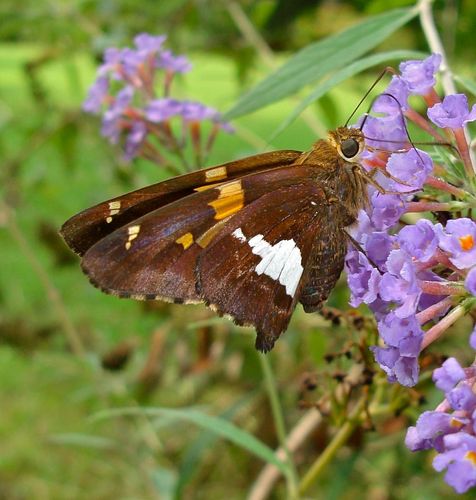
Silver-spotted Skipper

Silver-spotted Skipper

Epargyreus clarus

no rights reserved, uploaded by Elin Pierce, CC0, via iNaturalist

Side by side

Aegiale occidentalisSilver-spotted Skipper
Scientific nameAegiale occidentalis Kc, McGuire, Willmott, Sapkota, Shirey & Shirey, 2026Epargyreus clarus (Cramer, 1775)
English nameNot recordedSilver-spotted Skipper
GroupInsectsInsects
ClassInsecta InsectInsecta Insect
OrderLepidopteraLepidoptera
FamilyHesperiidae SkipperHesperiidae Skipper
GenusAegiale The Tequila Giant-SkipperEpargyreus Silverdrops
Named in20261775
Countries on recordNot recorded3 countries
GBIF occurrence recordsNot recorded100,908 records

Rows where the two agree are shown in grey.

Where each is found

Only Silver-spotted Skipper (3)

From Catalogue of Life checklists and GBIF occurrence records. A country missing from a list means no record is held, which is not proof of absence.

Checked facts

Aegiale occidentalisSilver-spotted Skipper
Appearance
  • The female holotype has a blackish-brown dorsal forewing with orange scaling at its base and along the discal band. English Wikipedia
  • The forewing discal cell spot is entirely orange. English Wikipedia
  • The female has unevenly conjoined, uniformly orange subapical spots between M2 and R3. English Wikipedia
  • The female hindwing has extensive orange scaling extending from its base through the postdiscal area. English Wikipedia
  • The ventral wing surfaces are covered with dark gray overscales. English Wikipedia
  • The female antennae are mostly white-scaled and have long, slender clubs. English Wikipedia
  • The eggs are dome-shaped and have a circular depression approximately 0.6 mm wide at the top. English Wikipedia
  • The museum specimen's eggs are amber in color. English Wikipedia
  • The female's papillae anales are almond-shaped and approximately twice as long as they are wide. English Wikipedia
  • The female's papillae anales bear rows of long, dense setae. English Wikipedia
  • The female's sterigma is generally sclerotized but has an unsclerotized lower margin. English Wikipedia
  • The upper margin of the female's sterigma bears two rounded humps. English Wikipedia
Size
Habitat
  • The known type locality is situated in the Sierra Madre Occidental. English Wikipedia
  • The species inhabits fields, gardens, and forest edges. English Wikipedia
  • The species prefers open habitats containing nectar plants, including swamps, brushy areas, and riparian habitats at lower elevations. English Wikipedia
  • In the western part of its range, the species occurs primarily in mountainous locations. animaldiversity.org
Diet
  • The larval host plant of Aegiale occidentalis has not been confirmed. English Wikipedia
  • Agave or related agavoid plants are suspected larval host plants for the species. English Wikipedia
  • Larvae consume leaves of plants belonging to the pea family, Fabaceae. English Wikipedia
  • Recorded larval host plants include false indigobush, American hogpeanut, groundnut, and American wisteria. English Wikipedia
  • Larvae have also been recorded feeding on kudzu, black locust, and Chinese wisteria. animaldiversity.org
  • Adults feed on nectar from various flowers, as well as mud and animal feces. English Wikipedia
  • Adults favor blue, red, pink, and purple flowers and rarely visit yellow flowers. English Wikipedia
  • Recorded adult food plants include everlasting pea, common milkweed, red clover, buttonbush, blazing star, and thistles. English Wikipedia
Behaviour
  • Larvae construct leaf shelters using silk and may connect multiple leaves to form larger shelters. animaldiversity.org
  • Larvae generally leave their shelters only to feed or construct larger shelters. animaldiversity.org
  • Larvae can eject their waste as a defensive behaviour to reduce the attraction of parasitic wasps. animaldiversity.org
  • Threatened larvae regurgitate a greenish defensive chemical. English Wikipedia
Reproduction
  • The species lays dome-shaped eggs with a circular depression at the top. English Wikipedia
  • Females generally deposit one egg on or occasionally near a host plant. English Wikipedia
  • Females have been recorded laying eggs on least snoutbean. English Wikipedia
  • Each copulation results in a female receiving a spermatophore from the male. English Wikipedia
  • After mating, females appear to reject additional males for at least some time. English Wikipedia
  • The species produces one generation annually in northern and western regions, two in eastern regions, and three to four in the Deep South. English Wikipedia
  • The last generation of the year overwinters in the pupal stage. animaldiversity.org
Distribution
  • The species is currently known only from its type locality near San Antonio, Sonora, Mexico. English Wikipedia
  • The species ranges from southern Canada through most of the United States to northern Mexico, excluding the Great Basin and western Texas. English Wikipedia
  • The species occurs throughout the United States and in southern Canada. animaldiversity.org
UsesNo checked fact yet
Similar species
  • Aegiale hesperiaris is the other recognized species in the genus Aegiale. English Wikipedia
  • Aegiale occidentalis has dark orange apical forewing spots with unaligned inner margins, unlike the white to whitish anterior apical spots of Aegiale hesperiaris. English Wikipedia
  • The CuA1 and M3 forewing spots are obliquely inclined toward the costa in Aegiale occidentalis, unlike their more vertical orientation in Aegiale hesperiaris. English Wikipedia
  • The forewing discal cell spot is entirely orange in Aegiale occidentalis, whereas its upper portion is white to whitish in Aegiale hesperiaris. English Wikipedia
  • Aegiale occidentalis has darker gray ventral wing surfaces than Aegiale hesperiaris. English Wikipedia
  • Female papillae anales are approximately twice as long as wide in Aegiale occidentalis, compared with more than three times as long as wide in Aegiale hesperiaris. English Wikipedia
  • The sterigma of Aegiale occidentalis is shorter and has an unsclerotized lower margin and a rounded upper margin with two humps, unlike the longer, fully sclerotized sterigma of Aegiale hesperiaris. English Wikipedia
Other
  • The estimated coordinates of the type locality are 28.415°N, 109.110°W. English Wikipedia
  • The type locality is approximately 1,170 m above sea level. English Wikipedia
  • The holotype was collected approximately seven miles east of the junction of Route 117 (San Nicolas) on Route 16 in Sonora. English Wikipedia
No checked fact yet

In brief

Aegiale occidentalis

The species is currently known only from its type locality near San Antonio, Sonora, Mexico, in the Sierra Madre Occidental. The female is distinguished by an entirely orange forewing discal cell spot, extensive orange hindwing scaling, and dark gray ventral wing surfaces. Full profile

Silver-spotted Skipper

Epargyreus clarus inhabits fields, gardens, forest edges, swamps, brushy areas, and riparian habitats at lower elevations. Full profile

Compare something else

Page built on 28 November 2026 from the data on the two species pages, where every source is listed.

Cite this page

ScientificNames.org. (2026). Aegiale occidentalis vs Silver-spotted Skipper. Retrieved November 28, 2026, from https://scientificnames.org/compare/aegiale-occidentalis-vs-silver-spotted-skipper