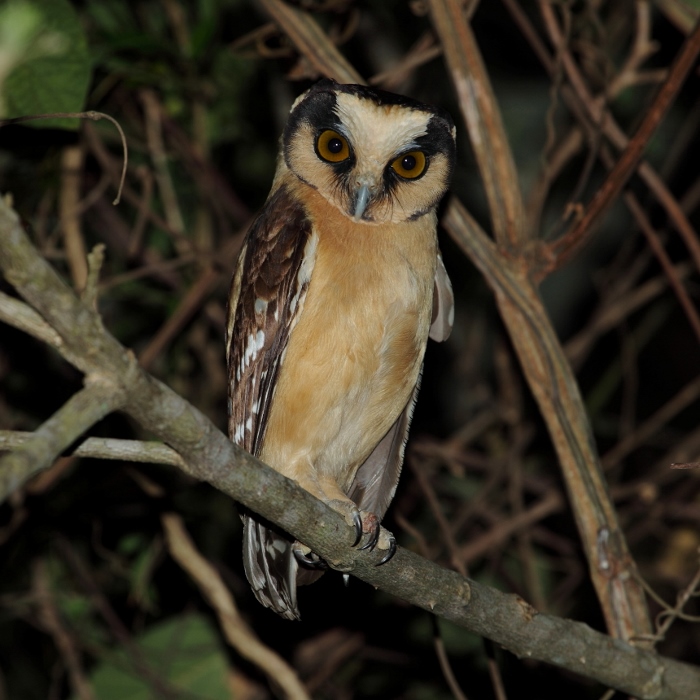
| Appearance | - The buff-fronted owl has a compact body, a short tail, and a large, block-shaped head without ear tufts. English Wikipedia
- Its facial disks are buff-colored with black borders and distinctive black patches above its greenish-yellow eyes. English Wikipedia
- The nominate subspecies has a yellowish-buff forehead and hindneck, while the remainder of its head and upperparts are chocolate brown. English Wikipedia
- Its blackish tail has two white bars and a white tip. English Wikipedia
- The nominate subspecies has a small brown chin patch and otherwise yellowish-buff underparts. English Wikipedia
- The subspecies Aegolius harrisii dabbenei has darker upperparts and cinnamon-tinged underparts. English Wikipedia
- The subspecies Aegolius harrisii iheringi has darker upperparts and deeper-orange underparts. English Wikipedia
| - Adults have a round, light-colored face marked with brown and cream streaks, a dark beak, and yellow eyes. English Wikipedia
- The upperparts are brown or reddish with white spots, while the underparts are pale with darker shading. English Wikipedia
- Juveniles have dark brown heads and wings and tawny, rust-colored breasts and bellies. English Wikipedia
- Juveniles have a distinctive white Y-shaped marking between their eyes. English Wikipedia
- The species lacks sexual dimorphism in plumage. English Wikipedia
- The species has no ear tufts. audubon.org
|
|---|
| Size | | - Adults measure 17–22 cm in length and have a wingspan of 42–56.3 cm. English Wikipedia
- Adult body weight ranges from 54 to 151 g, with an average of approximately 80 g. English Wikipedia
- Females are larger than males, with average weights of 100 g and 75 g respectively. English Wikipedia
|
|---|
| Habitat | | - The species inhabits coniferous forests as well as some mixed and deciduous woodlands across North America. English Wikipedia
- During breeding, most individuals nest in dense coniferous forests near wetlands. English Wikipedia
- Individuals may also breed in mixed-deciduous forests in the southern part of their eastern United States range. English Wikipedia
- Wintering individuals prefer conifer stands or shrub thickets near water. English Wikipedia
- The species can occupy dense thickets and may perch approximately 6.1 m above the ground. English Wikipedia
|
|---|
| Diet | | - The species feeds predominantly on small mammals, particularly rodents. English Wikipedia
- A review of ten studies found that mammals accounted for 88% to 100% of recorded prey, with rodents representing 85% to more than 99% of mammalian prey. English Wikipedia
- In a Wisconsin study, deer mice accounted for approximately 68% of captured prey. English Wikipedia
- In the same Wisconsin study, voles represented approximately 16% of captured prey. English Wikipedia
- Shrews represented approximately 9% of captured prey in the Wisconsin study. English Wikipedia
- A Montana study found that voles accounted for 60% of the species' prey. English Wikipedia
- Other mammalian prey include chipmunks, red squirrels, flying squirrels, moles, and bats. English Wikipedia
- Small bird prey includes swallows, sparrows, kinglets, and chickadees. English Wikipedia
- On the Pacific coast, the species may also consume crustaceans, frogs, and aquatic insects. English Wikipedia
- The species occasionally captures birds as large as rock doves. English Wikipedia
|
|---|
| Behaviour | | - The species is migratory, although its movements do not follow a strict pattern. English Wikipedia
- Some individuals remain in the same area year-round, while others migrate south or move to lower elevations during winter. English Wikipedia
- Individuals wait on elevated perches at night before swooping down to capture prey. English Wikipedia
- The species can locate and hunt prey in complete darkness using sound. English Wikipedia
- The species produces repeated tooting whistles that resemble the sound of a saw being sharpened. English Wikipedia
- Male advertising calls are particularly common from January through early July. English Wikipedia
- The species vocalizes throughout the year. English Wikipedia
- At least eleven distinct vocalizations have been reported for the species. English Wikipedia
- Adults, juveniles, and nestlings use bill snapping as a warning sound when approached closely. English Wikipedia
|
|---|
| Reproduction | - Very little information is available about the breeding phenology of the buff-fronted owl. English Wikipedia
- A nest containing three eggs was discovered in Brazil in March. English Wikipedia
- One recorded nest was located inside a dead palm. English Wikipedia
- The nest found in the dead palm appeared to occupy an abandoned parrot nest cavity. English Wikipedia
- Another recorded nest was situated in a hollow tree. English Wikipedia
| - The species lays approximately four to six white eggs in natural tree cavities or woodpecker holes. English Wikipedia
- Males may sing from nest sites and store food there to attract females. English Wikipedia
- The male hunts while the female incubates the eggs. English Wikipedia
- Females may produce multiple clutches in one breeding season with different males. English Wikipedia
- The species exhibits sequential polyandry, with females potentially leaving the first male to reproduce with another after the first offspring develop feathers. English Wikipedia
- The species uses existing cavities rather than excavating its own nest holes. English Wikipedia
|
|---|
| Distribution | - The species occurs in widely separated areas throughout South America, excluding French Guiana and Suriname. English Wikipedia
| - The species' range includes southeastern and southcentral Alaska, southern Canada, most of the United States, and the central mountains of Mexico. English Wikipedia
|
|---|
| Conservation | - The species is generally considered rare but may be overlooked. English Wikipedia
- The population of the buff-fronted owl is unknown and is believed to be stable. English Wikipedia
| - The species is classified as being of low conservation concern with a Continental Concern Score of 8 out of 20. English Wikipedia
- The global breeding population is estimated at approximately two million individuals. English Wikipedia
- The general population has probably declined in recent decades because of habitat loss. English Wikipedia
- In some North Carolina counties, the species is listed as threatened because of declining suitable habitat. English Wikipedia
- Habitat loss associated with hemlock woolly adelgid, logging, and pollution is identified as a threat in North Carolina. English Wikipedia
- Nest boxes can help compensate for the loss of natural nesting sites. English Wikipedia
|
|---|
| Similar species | - Its closest relative is the northern saw-whet owl (Aegolius acadicus), which occurs in Canada and the United States. English Wikipedia
| - The northern saw-whet owl can be confused with the boreal owl but differs in size, bill color, and forehead markings. English Wikipedia
|
|---|
| Name origin | No checked fact yet | - The common name saw-whet refers to the resemblance between the owl's vocalizations and the sound of sharpening a saw on a whetting stone. English Wikipedia
|
|---|
| Other | - The buff-fronted owl is the only member of the genus Aegolius occurring in South America. English Wikipedia
| No checked fact yet |
|---|