Species · Birds
Buff-fronted Owl Aegolius harrisii
The scientific name of the Buff-fronted Owl is Aegolius harrisii. It is a species of bird in the family Strigidae (owls), order Strigiformes. The name dates from 1849.
- Scientific name
- Aegolius harrisii (Cassin, 1849)
- Common name
- Buff-fronted Owl
- Genus
- Aegolius
- Family
- Strigidae (Owls)
- Order
- Strigiformes
- Class
- Aves
- Red List category
- LC Least Concern
- Recorded in
- 10 countries
- Name status
- accepted in the Catalogue of Life
Overview
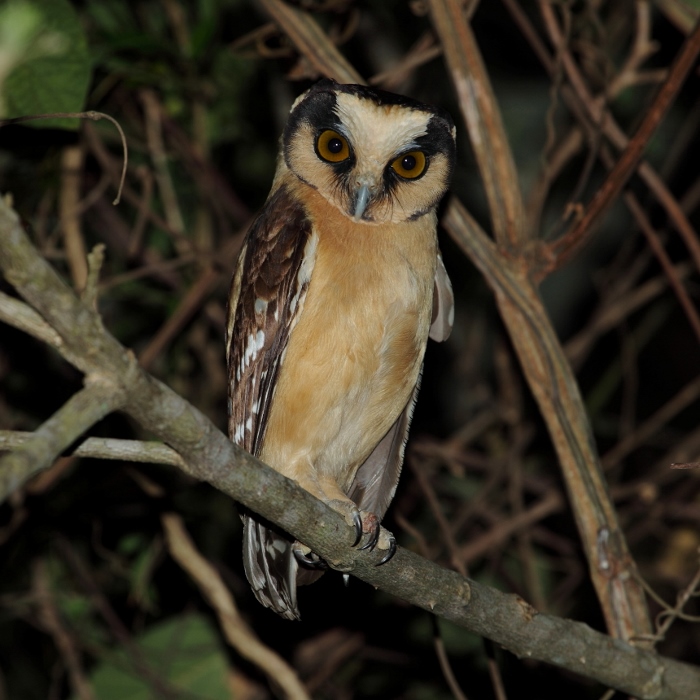
The Buff-fronted Owl is the only member of the genus Aegolius occurring in South America. It occurs in widely separated areas throughout South America, excluding French Guiana and Suriname. It has a compact body, a short tail, a large block-shaped head without ear tufts, and buff-colored facial disks with black borders.
Written 26 November 2026 from the sources listed below. Each statement was checked against the passage it cites; statements that could not be supported were removed.
Appearance
The Buff-fronted Owl measures 19–21 cm in length and weighs 104 to 155 g. It has a compact body, a short tail, and a large, block-shaped head without ear tufts.[1][2][3]
Its facial disks are buff-colored with black borders and distinctive black patches above its greenish-yellow eyes. Its blackish tail has two white bars and a white tip.[4][5]
The nominate subspecies has a yellowish-buff forehead and hindneck, while the remainder of its head and upperparts are chocolate brown. It has a small brown chin patch and otherwise yellowish-buff underparts.[6][7]
Aegolius harrisii dabbenei has darker upperparts and cinnamon-tinged underparts. Aegolius harrisii iheringi has darker upperparts and deeper-orange underparts.[8][9]
Habitat
The Buff-fronted Owl inhabits open humid forests, dry forests, forest edges, and subtropical rainforests. It also occurs in human-altered areas containing fruit trees and palms.[10][11][12][13]
In the Andes, the species occurs at elevations between 1,500 and 3,800 m. Outside the Andes, it occurs at elevations of approximately 600–1,000 m.[14][15]
Diet
Recorded prey includes insects, rodents, birds, and other small vertebrates. The hunting behaviour and diet of the species have not been studied.[16][17][18][19][20]
Behaviour
The male's song is a rapid, wavering trill. Dependent fledglings produce a hissing, raspy begging call.[21][22]
Reproduction and life cycle
Very little information is available about the breeding phenology of the Buff-fronted Owl. A nest containing three eggs was discovered in Brazil in March.[23][24]
One recorded nest was located inside a dead palm and appeared to occupy an abandoned parrot nest cavity. Another recorded nest was situated in a hollow tree.[25][26][27]
Conservation
The species is generally considered rare but may be overlooked. Its population is unknown and is believed to be stable.[28][29]
Similar species
The closest relative of the Buff-fronted Owl is the northern saw-whet owl (Aegolius acadicus), which occurs in Canada and the United States.[30]
Classification of the Buff-fronted Owl
| Kingdom | Animalia |
|---|---|
| Phylum | Chordata |
| Subphylum | Vertebrata |
| Infraphylum | Gnathostomata |
| Parvphylum | Osteichthyes |
| Megaclass | Tetrapoda |
| Class | Aves (Bird) |
| Order | Strigiformes (Owl) |
| Family | Strigidae (Owls) |
| Subfamily | Surniinae |
| Genus | Aegolius (Saw-whet Owls) |
| Species | Aegolius harrisii (Cassin, 1849) |
Where the Buff-fronted Owl is found
Checklists and occurrence records place Aegolius harrisii in 10 countries across South America. GBIF holds 1,833 georeferenced records of it.
Countries
- Argentina 408
- Bolivia 30
- Brazil 794
- Colombia 75
- Ecuador 244
- Guyana 3
- Paraguay 18
- Peru 229
- Uruguay 13
- Venezuela 19
Regions and cities with the most records
- São Paulo, Brazil 283
- Minas Gerais, Brazil 231
- Salta, Argentina 162
- Loja, Ecuador 122
- Paraisópolis, Brazil 120
- Santa Rita do Sapucaí, Brazil 117
- Salta, Argentina 104
- Amazonas, Peru 89
- Ceará, Brazil 82
- Sobradinho, Brazil 80
- Sobradinho II, Brazil 80
- Planaltina, Brazil 79
- Biritiba Mirim, Brazil 71
- Cuzco Department, Peru 64
- Guararema, Brazil 64
- Mogi das Cruzes, Brazil 61
- Jujuy, Argentina 60
- Cunha, Brazil 51
- Tucuman, Argentina 51
- Imbabura, Ecuador 49
- Paraná, Brazil 49
- Ibarra, Ecuador 48
- Atuntaqui, Ecuador 45
- Massapê, Brazil 43
- Meruoca, Brazil 43
- Junin, Peru 42
- Paraty, Brazil 40
- Salesópolis, Brazil 38
- Pichincha, Ecuador 37
- Arujá, Brazil 36
- Misiones, Argentina 36
- Pomasqui, Ecuador 36
- Jacareí, Brazil 35
- Sobral, Brazil 33
- Catamarca, Argentina 31
- Suzano, Brazil 31
Range as the checklists state it
South America
A number beside a place is its count of GBIF occurrence records. A place without a number comes from a checklist alone. Records show where a species has been observed or collected, which can include escapes and vagrants.
Common names
English
- Buff-fronted Owl
Names in 27 other languages
- Arabic
- بومة برتقالية الجبهة
- Catalan
- mussol canyella
- Chinese
- 黃額鬼鴞, 黄额鬼鸮
- Croatian
- smeđoleđi ćuk
- Czech
- sýc plavočelý
- Danish
- Okkerbrystet Perleugle
- Dutch
- Harris' Zaaguil
- Esperanto
- okrafrunta strigeto
- Estonian
- laukkakk
- Finnish
- keltahelmipöllö
- French
- Nyctale de Harris
- German
- Blassstirnkauz, Gelbstirnkauz, Südamerikanischer Sägekauz
- Hungarian
- halványhomlokú bagoly
- Italian
- Civetta capogrosso del Sudamerica, Civetta di Harris
- Japanese
- セグロキンメフクロウ
- Lithuanian
- geltonkaktė lututė
- Norwegian
- svartbrynugle
- Polish
- włochatka obrożna
- Portuguese
- caburé-acanelado, mocho-canela
- Russian
- Масковый сыч, Свеглолобый мохноногий сыч, Светлолобый мохноногий сыч
- Serbian
- Žutočela gaćasta kukumavka
- Slovak
- pôtik okrový
- Spanish
- Búho acanelado, Carburé Acanelado, Curucucú Barriga Amarilla, Lechucita Acanelada, Lechucita canela, Mochuelo canela
- Swedish
- gulpannad pärluggla
- Turkish
- Sarışın Paçalı Baykuş
- Ukrainian
- сич вохристолобий
- Welsh
- tylluan fronfelen
Synonyms
One other scientific name has been used for this species and is now treated as a synonym of Aegolius harrisii.
- Nyctale harrisii Cassin, 1849
Subspecies and varieties
- Aegolius harrisii dabbenei subspecies
- Aegolius harrisii harrisii subspecies
- Aegolius harrisii iheringi subspecies
Related species
-
 Northern Saw-whet OwlAegolius acadicus
-
 Boreal OwlAegolius funereus
- Bermuda Saw-whet OwlAegolius gradyi
-
 Unspotted Saw-whet OwlAegolius ridgwayi
-
 Great Horned OwlBubo virginianus
-
 Barred OwlStrix varia
-
 Eurasian Eagle-owlBubo bubo
-
 Snowy OwlBubo scandiacus
Compare
Questions and answers
What is the scientific name of the Buff-fronted Owl?
The scientific name of the Buff-fronted Owl is Aegolius harrisii. Written with its author, the full name is Aegolius harrisii (Cassin, 1849).
Which family does the Buff-fronted Owl belong to?
Aegolius harrisii belongs to the family Strigidae, in the order Strigiformes and the class Aves.
Where is the Buff-fronted Owl found?
Checklists and occurrence records place Aegolius harrisii in 10 countries, including Brazil, Argentina, Ecuador, Peru, Colombia and Bolivia.
What is the conservation status of the Buff-fronted Owl?
The IUCN Red List category recorded for Aegolius harrisii is Least Concern (LC).
Sources
Passages the profile rests on
- The buff-fronted owl measures 19–21 cm in length. Source passage: “The buff-fronted owl is 19 to 21 cm (7.5 to 8.3 in) long” — English Wikipedia
- Its body weight ranges from 104 to 155 g. Source passage: “weighs 104 to 155 g (3.7 to 5.5 oz).” — English Wikipedia
- The buff-fronted owl has a compact body, a short tail, and a large, block-shaped head without ear tufts. Source passage: “It is compact and has a short tail and a large blocky head without ear tufts.” — English Wikipedia
- Its facial disks are buff-colored with black borders and distinctive black patches above its greenish-yellow eyes. Source passage: “Its facial disks are buff with a black surround and distinctive black patches above its greenish yellow eyes.” — English Wikipedia
- Its blackish tail has two white bars and a white tip. Source passage: “The tail is blackish and has two white bars and a white tip.” — English Wikipedia
- The nominate subspecies has a yellowish-buff forehead and hindneck, while the remainder of its head and upperparts are chocolate brown. Source passage: “The nominate subspecies' forehead and hindneck are yellowish buff and the rest of the head and upperparts chocolate brown.” — English Wikipedia
- The nominate subspecies has a small brown chin patch and otherwise yellowish-buff underparts. Source passage: “Its chin has a small brown patch and the rest of the underparts are yellowish buff.” — English Wikipedia
- The subspecies Aegolius harrisii dabbenei has darker upperparts and cinnamon-tinged underparts. Source passage: “A. h. dabbenei has darker upperparts and a cinnamon tinge on the underparts.” — English Wikipedia
- The subspecies Aegolius harrisii iheringi has darker upperparts and deeper-orange underparts. Source passage: “A. h. iheringi is also darker above and its underparts are a deeper orange.” — English Wikipedia
- The buff-fronted owl inhabits open humid forests. Source passage: “The buff-fronted owl inhabits a variety of landscapes including open humid forest” — English Wikipedia
- The species also occupies dry forests and forest edges. Source passage: “dry forest, forest edges” — English Wikipedia
- Subtropical rainforests are among its habitats. Source passage: “subtropical rainforest” — English Wikipedia
- The species also inhabits human-altered areas containing fruit trees and palms. Source passage: “human-altered areas with fruit trees and palms.” — English Wikipedia
- In the Andes, the species occurs at elevations between 1,500 and 3,800 m. Source passage: “In the Andes it ranges between 1,500 and 3,800 m (4,900 and 12,500 ft)” — English Wikipedia
- Outside the Andes, the species occurs at elevations of approximately 600–1,000 m. Source passage: “and elsewhere between about 600 and 1,000 m (2,000 and 3,300 ft).” — English Wikipedia
- Recorded prey of the buff-fronted owl includes insects. Source passage: “It has been recorded taking insects, rodents, birds, and other small vertebrates.” — English Wikipedia
- The species has been recorded feeding on rodents. Source passage: “It has been recorded taking insects, rodents, birds, and other small vertebrates.” — English Wikipedia
- Birds have been recorded among the buff-fronted owl's prey. Source passage: “It has been recorded taking insects, rodents, birds, and other small vertebrates.” — English Wikipedia
- The species has also been recorded taking other small vertebrates as prey. Source passage: “It has been recorded taking insects, rodents, birds, and other small vertebrates.” — English Wikipedia
- The hunting behaviour and diet of the buff-fronted owl have not been studied. Source passage: “The buff-fronted owl's hunting behavior and diet have not been studied.” — English Wikipedia
- The male's song is a rapid, wavering trill. Source passage: “The male buff-fronted owl's song is "a rapid, wavering trill, 'frurururururururu'".” — English Wikipedia
- Dependent fledglings produce a hissing, raspy begging call. Source passage: “Dependent fledglings give a "hissing, raspy 'cheet' begging call".” — English Wikipedia
- Very little information is available about the breeding phenology of the buff-fronted owl. Source passage: “Almost nothing is known about the buff-fronted owl's breeding phenology.” — English Wikipedia
- A nest containing three eggs was discovered in Brazil in March. Source passage: “A nest with three eggs was found in Brazil in March;” — English Wikipedia
- One recorded nest was located inside a dead palm. Source passage: “it was in a dead palm” — English Wikipedia
- The nest found in the dead palm appeared to occupy an abandoned parrot nest cavity. Source passage: “in what appeared to be an abandoned parrot nest cavity.” — English Wikipedia
- Another recorded nest was situated in a hollow tree. Source passage: “Another nest was in a hollow tree.” — English Wikipedia
- The species is generally considered rare but may be overlooked. Source passage: “It is generally thought to be rare but is probably overlooked.” — English Wikipedia
- The population of the buff-fronted owl is unknown and is believed to be stable. Source passage: “Its population is unknown and believed to be stable.” — English Wikipedia
- Its closest relative is the northern saw-whet owl (Aegolius acadicus), which occurs in Canada and the United States. Source passage: “Its closest relative is the northern saw-whet owl (A. acadicus) of Canada and the U.S.” — English Wikipedia
Data
- Catalogue of Life, 2026-10-16 XR cc by
- Global Biodiversity Information Facility CC BY 4.0
- Wikidata CC0
- GeoNames CC BY 4.0
- Wikimedia Commons per image; credit shown with each image
- Within the Catalogue of Life, this name comes from The Integrated Taxonomic Information System cc0
References
- Gill, Frank, & and Minturn Wright. (2006). Birds of the World: Recommended English Names.
- Dickinson, E. C., and J. V. Remsen Jr., eds. (2013). The Howard and Moore Complete Checklist of the Birds of the World, 4th Edition, Vol. 1 Non-Passerines.
This species in other databases
Page built on 27 November 2026. See how the catalog is made and all sources and licences.
Cite this page
ScientificNames.org. (2026). Aegolius harrisii (Buff-fronted Owl). Retrieved November 27, 2026, from https://scientificnames.org/species/aegolius-harrisii
“Aegolius harrisii (Buff-fronted Owl).” ScientificNames.org, 2026, scientificnames.org/species/aegolius-harrisii. Accessed 27 Nov. 2026.
ScientificNames.org. “Aegolius harrisii (Buff-fronted Owl).” Accessed November 27, 2026. https://scientificnames.org/species/aegolius-harrisii.
@misc{scientificnames_aegolius_harrisii_buff_fronted_owl,
  author = {{ScientificNames.org}},
  title = {Aegolius harrisii (Buff-fronted Owl)},
  year = {2026},
  url = {https://scientificnames.org/species/aegolius-harrisii},
  note = {Accessed 2026-11-27}
}