Comparison

Buff-fronted Owl vs Boreal Owl

Buff-fronted Owl (Aegolius harrisii) and Boreal Owl (Aegolius funereus) both belong to the genus Aegolius (saw-whet owls) and part ways below it.
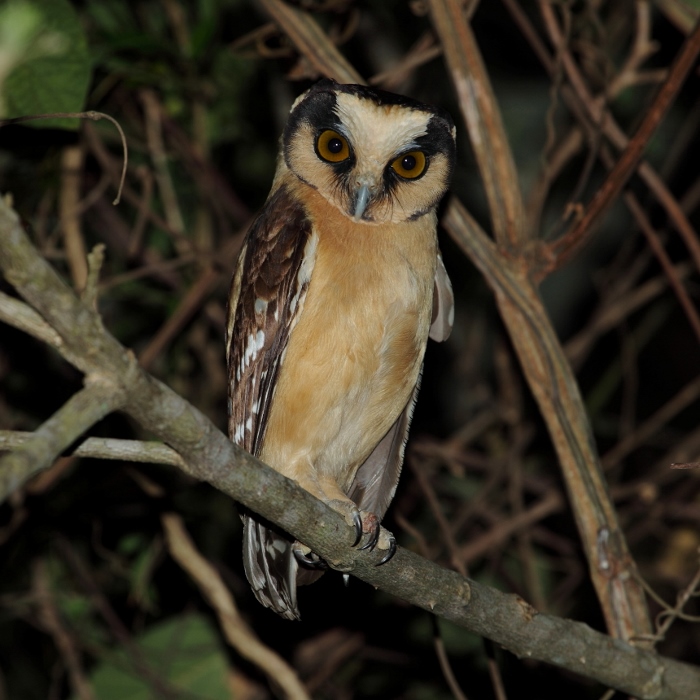
Buff-fronted Owl

Buff-fronted Owl

Aegolius harrisii

Hector Bottai, CC BY-SA 3.0, via Wikimedia Commons

Boreal Owl

Boreal Owl

Aegolius funereus

Christoph Moning, CC BY 4.0, via Wikimedia Commons

Side by side

Buff-fronted OwlBoreal Owl
Scientific nameAegolius harrisii (Cassin, 1849)Aegolius funereus (Linnaeus, 1758)
English nameBuff-fronted OwlBoreal Owl
GroupBirdsBirds
ClassAves BirdAves Bird
OrderStrigiformes OwlStrigiformes Owl
FamilyStrigidae OwlsStrigidae Owls
GenusAegolius Saw-whet OwlsAegolius Saw-whet Owls
Named in18491758
Red List categoryLeast ConcernLeast Concern
EnvironmentNot recordedterrestrial
Countries on record10 countries47 countries
GBIF occurrence records1,833 records304,772 records

Rows where the two agree are shown in grey.

Where each is found

Only Buff-fronted Owl (10)

Only Boreal Owl (47)

From Catalogue of Life checklists and GBIF occurrence records. A country missing from a list means no record is held, which is not proof of absence.

Checked facts

Buff-fronted OwlBoreal Owl
Appearance
  • The buff-fronted owl has a compact body, a short tail, and a large, block-shaped head without ear tufts. English Wikipedia
  • Its facial disks are buff-colored with black borders and distinctive black patches above its greenish-yellow eyes. English Wikipedia
  • The nominate subspecies has a yellowish-buff forehead and hindneck, while the remainder of its head and upperparts are chocolate brown. English Wikipedia
  • Its blackish tail has two white bars and a white tip. English Wikipedia
  • The nominate subspecies has a small brown chin patch and otherwise yellowish-buff underparts. English Wikipedia
  • The subspecies Aegolius harrisii dabbenei has darker upperparts and cinnamon-tinged underparts. English Wikipedia
  • The subspecies Aegolius harrisii iheringi has darker upperparts and deeper-orange underparts. English Wikipedia
  • The Boreal Owl has a large head, long wings, and a compact body. English Wikipedia
  • Its eyes are yellow and its crown is olive-brown with small white markings. English Wikipedia
  • Its facial disc is dull white and bordered by dark markings and raised white eyebrows. adfg.alaska.gov
  • Its bill is light yellow rather than dark. English Wikipedia
  • Its skull is asymmetrical, helping direct sounds toward its ears. adfg.alaska.gov
SizeNo checked fact yet
Habitat
  • The species breeds in dense boreal and subalpine forests as well as mixed woodland. English Wikipedia
  • Its preferred habitat includes old-growth forests. English Wikipedia
  • Its breeding habitat includes forests containing black spruce, white spruce, birch, and aspen. English Wikipedia
  • In Alaska, it nests in closed-canopy forests that contain at least some deciduous trees. adfg.alaska.gov
  • Individuals roost in coniferous trees approximately six metres high. English Wikipedia
Diet
  • Voles constitute the principal prey of the Boreal Owl. adfg.alaska.gov
  • Its diet includes mice, shrews, and small birds. adfg.alaska.gov
  • The species occasionally consumes insects during summer. adfg.alaska.gov
  • Its prey can include mammals as large as squirrels and birds as large as thrushes. adfg.alaska.gov
  • When vole populations decline, the species increases the proportion of shrews in its diet. adfg.alaska.gov
Behaviour
  • The Boreal Owl is primarily nocturnal. English Wikipedia
  • In Alaska, individuals are generally resident rather than migratory, although food availability can cause movements. adfg.alaska.gov
  • The species is rarely observed because it is primarily nocturnal and solitary. adfg.alaska.gov
  • The species can tolerate some human disturbance when the natural character of its forest habitat remains intact. adfg.alaska.gov
  • Males produce advertising calls in Alaska from late January or early February until late April. adfg.alaska.gov
  • The species has a rapid, soft, regularly repeated call. adfg.alaska.gov
Reproduction
  • Very little information is available about the breeding phenology of the buff-fronted owl. English Wikipedia
  • A nest containing three eggs was discovered in Brazil in March. English Wikipedia
  • One recorded nest was located inside a dead palm. English Wikipedia
  • The nest found in the dead palm appeared to occupy an abandoned parrot nest cavity. English Wikipedia
  • Another recorded nest was situated in a hollow tree. English Wikipedia
Distribution
  • The species occurs in widely separated areas throughout South America, excluding French Guiana and Suriname. English Wikipedia
  • In Alaska, the species occurs in the Interior, upper Kobuk Valley, Kodiak Island, and western Southcentral regions. adfg.alaska.gov
Conservation
  • The species is generally considered rare but may be overlooked. English Wikipedia
  • The population of the buff-fronted owl is unknown and is believed to be stable. English Wikipedia
  • The species is classified as Least Concern. English Wikipedia
  • The estimated population consists of 730,000–1,810,000 mature individuals. English Wikipedia
  • The reported population trend is stable. English Wikipedia
  • Logging can reduce prey availability, foraging efficiency, and the availability of suitable nesting sites. English Wikipedia
  • Agriculture and logging are identified as impacts on the species in Alaska. adfg.alaska.gov
  • The species is protected by state and federal laws in Alaska. adfg.alaska.gov
Similar species
  • Its closest relative is the northern saw-whet owl (Aegolius acadicus), which occurs in Canada and the United States. English Wikipedia
  • The Northern Saw-whet Owl is a related species whose range overlaps with the Boreal Owl in parts of North America. English Wikipedia
Other
  • The buff-fronted owl is the only member of the genus Aegolius occurring in South America. English Wikipedia
No checked fact yet

In brief

Buff-fronted Owl

The Buff-fronted Owl is the only member of the genus Aegolius occurring in South America. It occurs in widely separated areas throughout South America, excluding French Guiana and Suriname. It has a compact body, a short tail, a large block-shaped head without ear tufts, and buff-colored facial disks with black borders. Full profile

Boreal Owl

Aegolius funereus breeds in dense boreal and subalpine forests and mixed woodland. Full profile

Compare something else

Page built on 28 November 2026 from the data on the two species pages, where every source is listed.

Cite this page

ScientificNames.org. (2026). Buff-fronted Owl vs Boreal Owl. Retrieved November 28, 2026, from https://scientificnames.org/compare/buff-fronted-owl-vs-boreal-owl