Comparison

Buff-fronted Owl vs Great Horned Owl

Buff-fronted Owl (Aegolius harrisii) and Great Horned Owl (Bubo virginianus) both belong to the family Strigidae (owls) and part ways below it. Both are recorded in 10 countries.
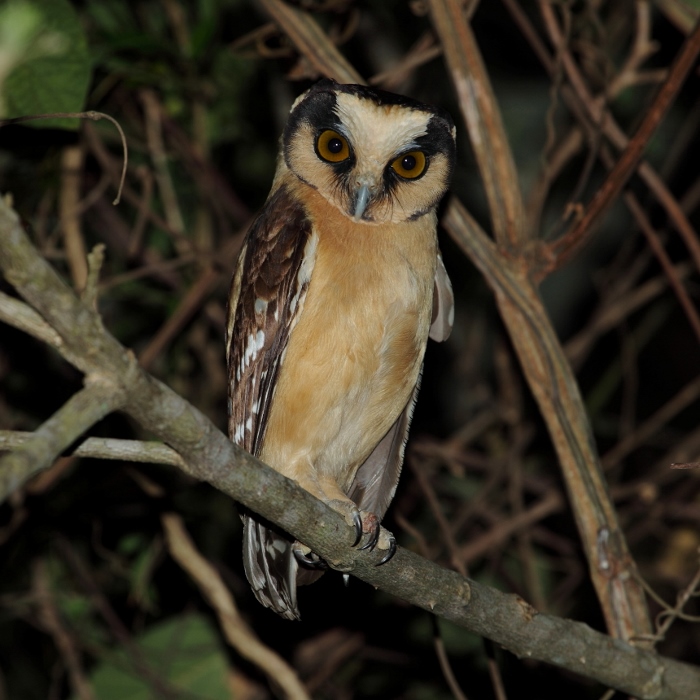
Buff-fronted Owl

Buff-fronted Owl

Aegolius harrisii

Hector Bottai, CC BY-SA 3.0, via Wikimedia Commons

Great Horned Owl

Great Horned Owl

Bubo virginianus

brendan.lally, CC BY 2.0, via Wikimedia Commons

Side by side

Buff-fronted OwlGreat Horned Owl
Scientific nameAegolius harrisii (Cassin, 1849)Bubo virginianus (J. F. Gmelin, 1788)
English nameBuff-fronted OwlGreat Horned Owl
GroupBirdsBirds
ClassAves BirdAves Bird
OrderStrigiformes OwlStrigiformes Owl
FamilyStrigidae OwlsStrigidae Owls
GenusAegolius Saw-whet OwlsBubo Horned Owl
Named in18491788
Red List categoryLeast ConcernLeast Concern
EnvironmentNot recordedterrestrial
Countries on record10 countries22 countries
GBIF occurrence records1,833 records1,552,226 records

Rows where the two agree are shown in grey.

Where each is found

Both recorded in 10 countries

Only Great Horned Owl (12)

From Catalogue of Life checklists and GBIF occurrence records. A country missing from a list means no record is held, which is not proof of absence.

Checked facts

Buff-fronted OwlGreat Horned Owl
Appearance
  • The buff-fronted owl has a compact body, a short tail, and a large, block-shaped head without ear tufts. English Wikipedia
  • Its facial disks are buff-colored with black borders and distinctive black patches above its greenish-yellow eyes. English Wikipedia
  • The nominate subspecies has a yellowish-buff forehead and hindneck, while the remainder of its head and upperparts are chocolate brown. English Wikipedia
  • Its blackish tail has two white bars and a white tip. English Wikipedia
  • The nominate subspecies has a small brown chin patch and otherwise yellowish-buff underparts. English Wikipedia
  • The subspecies Aegolius harrisii dabbenei has darker upperparts and cinnamon-tinged underparts. English Wikipedia
  • The subspecies Aegolius harrisii iheringi has darker upperparts and deeper-orange underparts. English Wikipedia
  • The great horned owl generally has light underparts with brown horizontal barring and mottled brown upperparts with darker markings. English Wikipedia
  • The great horned owl has a variable-sized white patch on its throat. English Wikipedia
  • The great horned owl has a facial disc that may be reddish, brown, or gray. English Wikipedia
  • The great horned owl's prominent eyebrow-like horns are feather tufts called plumicorns. English Wikipedia
  • The great horned owl has a dark gunmetal-gray bill and talons. English Wikipedia
  • The great horned owl has a barrel-shaped body, a large head, and broad wings. English Wikipedia
  • The great horned owl has feathered legs and feet, including in tropical populations. English Wikipedia
SizeNo checked fact yet
HabitatNo checked fact yet
Diet
  • The great horned owl primarily eats rabbits, hares, rats, mice, and voles. English Wikipedia
  • The great horned owl is one of the few regular predators of skunks. English Wikipedia
  • The great horned owl also hunts larger mid-sized mammals, birds, reptiles, amphibians, and invertebrates. English Wikipedia
  • Mammals constitute the majority of the great horned owl's diet in most regions. audubon.org
Behaviour
  • The great horned owl can fly almost silently. English Wikipedia
  • The great horned owl can glide at speeds as slow as 2 miles per hour. English Wikipedia
  • The great horned owl can rotate its neck through 270 degrees. English Wikipedia
  • The great horned owl typically makes a low-pitched but loud hooting call. English Wikipedia
  • The female great horned owl produces calls that are higher in pitch than those of the male. English Wikipedia
  • Territorial hooting by the great horned owl usually decreases in February or March when egg laying begins. English Wikipedia
  • Great horned owls may vocalize when disturbed or angered at the nest. English Wikipedia
Reproduction
  • Very little information is available about the breeding phenology of the buff-fronted owl. English Wikipedia
  • A nest containing three eggs was discovered in Brazil in March. English Wikipedia
  • One recorded nest was located inside a dead palm. English Wikipedia
  • The nest found in the dead palm appeared to occupy an abandoned parrot nest cavity. English Wikipedia
  • Another recorded nest was situated in a hollow tree. English Wikipedia
  • The great horned owl is among the earliest nesting birds in North America. English Wikipedia
  • The great horned owl often lays eggs weeks or months before other raptorial birds. English Wikipedia
Distribution
  • The species occurs in widely separated areas throughout South America, excluding French Guiana and Suriname. English Wikipedia
Conservation
  • The species is generally considered rare but may be overlooked. English Wikipedia
  • The population of the buff-fronted owl is unknown and is believed to be stable. English Wikipedia
No checked fact yet
Similar species
  • Its closest relative is the northern saw-whet owl (Aegolius acadicus), which occurs in Canada and the United States. English Wikipedia
  • The Eurasian eagle-owl occupies the same ecological niche as the great horned owl in Eurasia. English Wikipedia
  • The red-tailed hawk shares similar habitat, prey, and nesting habits with the great horned owl during the day. English Wikipedia
Other
  • The buff-fronted owl is the only member of the genus Aegolius occurring in South America. English Wikipedia
No checked fact yet

In brief

Buff-fronted Owl

The Buff-fronted Owl is the only member of the genus Aegolius occurring in South America. It occurs in widely separated areas throughout South America, excluding French Guiana and Suriname. It has a compact body, a short tail, a large block-shaped head without ear tufts, and buff-colored facial disks with black borders. Full profile

Great Horned Owl

The Great Horned Owl is native to the Americas and is the most widely distributed true owl in North America. It is distinguished by prominent eyebrow-like feather tufts called plumicorns. Full profile

Compare something else

Page built on 29 November 2026 from the data on the two species pages, where every source is listed.

Cite this page

ScientificNames.org. (2026). Buff-fronted Owl vs Great Horned Owl. Retrieved November 29, 2026, from https://scientificnames.org/compare/buff-fronted-owl-vs-great-horned-owl