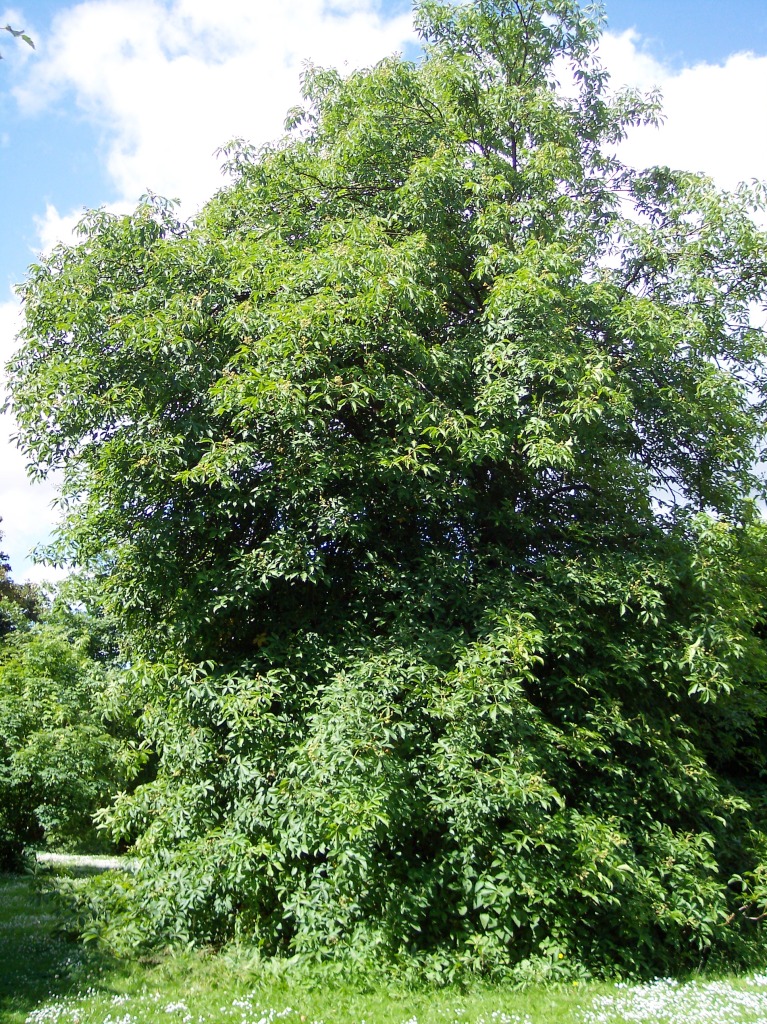
| Appearance | - Its leaves are opposite and palmately compound, usually consisting of five leaflets. English Wikipedia
- The leaflets have finely serrated margins and pointed tips. English Wikipedia
- The leaves are dark green on their upper surfaces and paler underneath. English Wikipedia
- Its fragrant flowers are white to pale pink and grow in dense, erect panicles. English Wikipedia
- Individual flowers have four or occasionally five petals and five to seven stamens. English Wikipedia
- Its fruit is a smooth, leathery, pear-shaped capsule measuring 5–8 centimetres long. English Wikipedia
- Mature fruit capsules turn brown and split open to expose a glossy brown seed. English Wikipedia
- The species produces large, glossy seeds that are poisonous. English Wikipedia
| |
|---|
| Size | | - Each leaflet measures 8–16 cm in length and width. English Wikipedia
- Fifty trees measured in Jefferson County, Indiana, averaged 20.7 m in height and 84 cm in diameter at breast height. research.fs.usda.gov
- On dry habitats in eastern Oklahoma, the species grows as a shrub measuring 1.2–1.5 m tall. research.fs.usda.gov
|
|---|
| Habitat | - The species grows on dry slopes, in canyons and along streams, generally below 1,700 metres elevation. English Wikipedia
- California buckeye occurs as scattered individuals in grasslands. English Wikipedia
- The species grows as an understory shrub in mixed evergreen forests. English Wikipedia
- California buckeye occurs as a component or local dominant of chaparral and oak woodlands. English Wikipedia
| - The species occurs along streambanks, in upland mesic forests, and beside old fields. English Wikipedia
- The species is typically associated with calcareous areas. English Wikipedia
- The species is most frequently found along river bottoms and in streambank soils. research.fs.usda.gov
- The species most commonly grows on Alfisol soils. research.fs.usda.gov
- The species also occurs in hardwood stands on moist sites in Kentucky's limestone-sink-and-cave section of the Bluegrass region. research.fs.usda.gov
- The species can occur on drier and clayey sites, although it usually grows slowly there and rarely becomes dominant. research.fs.usda.gov
- The species develops best as an isolated individual in openings along streambanks and other moist sites. research.fs.usda.gov
|
|---|
| Diet | - Squirrels and chipmunks consume California buckeye seeds. English Wikipedia
- Livestock and wildlife graze on young shoots and newly emerged leaves, which contain lower toxin levels. English Wikipedia
| - The seeds contain tannic acid and are poisonous to humans and cattle. English Wikipedia
- The young foliage, shoots, and bark are also poisonous to some degree. English Wikipedia
- The bark and seeds contain a narcotic glucoside considered poisonous to livestock. research.fs.usda.gov
|
|---|
| Behaviour | - California buckeye commonly sheds its leaves during late summer in dry inland environments. English Wikipedia
- Individuals in coastal environments tend to retain their leaves until mid-autumn. English Wikipedia
- The species is among the earliest native woody plants in its range to produce new leaves in spring. English Wikipedia
- The species can regenerate after fire by producing new shoots from its root crown. English Wikipedia
- New shoots can emerge within weeks after a fire. English Wikipedia
| No checked fact yet |
|---|
| Reproduction | - The species is andromonoecious, producing staminate and bisexual flowers on the same plant. English Wikipedia
- Only bisexual flowers develop into fruit. English Wikipedia
- California buckeye seeds are dispersed mainly by gravity or water, while animal dispersal is rare. English Wikipedia
- The seeds generally remain viable for only one year. English Wikipedia
- Under favourable conditions, the seeds can germinate within several weeks of being shed. English Wikipedia
| |
|---|
| Distribution | No checked fact yet | - The species is native to North America. English Wikipedia
- Its natural range is concentrated in the Midwestern and lower Great Plains regions of the United States. English Wikipedia
- Its natural range extends southeast into the Black Belt of Alabama and Mississippi. English Wikipedia
- The species occurs locally in extreme southwestern Ontario, including Walpole Island in Lake St. Clair. English Wikipedia
- Its range extends from western Pennsylvania, Ohio, and southern Michigan westward to Illinois and central Iowa. research.fs.usda.gov
- Its southern distribution reaches eastern Kansas, southwestern Oklahoma, and central Texas. research.fs.usda.gov
- Its eastern distribution reaches western Arkansas, Tennessee, central Alabama, and one location in eastern Mississippi. research.fs.usda.gov
|
|---|
| Conservation | - California buckeye is susceptible to leaf blight caused by the fungus Boeremia lilacis. English Wikipedia
- Leaf blight symptoms include leaf spots, leaf blight and premature leaf fall. English Wikipedia
| No checked fact yet |
|---|
| Uses | - The Pomo, Yokuts and Luiseño peoples used the poisonous seeds to stupefy fish in small streams for easier capture. English Wikipedia
- Indigenous communities processed the seeds by boiling and leaching out toxins before grinding them into flour or meal. English Wikipedia
- California buckeye is used as an ornamental plant for its foliage, flowers and architectural branches. English Wikipedia
- The species helps prevent erosion by binding soil in hilly regions. English Wikipedia
- California buckeye wood is suitable for making fireboards for bow drills and hand drills. English Wikipedia
| - Native Americans reportedly consumed the fruit after boiling it to remove tannin. English Wikipedia
- The Lenape carried the nuts in their pockets as a traditional remedy for rheumatism. English Wikipedia
- An infusion of ground nuts was traditionally mixed with sweet oil or mutton tallow for treating earaches. English Wikipedia
- Native Americans ground the nuts and used them to poison fish in streams. English Wikipedia
- The nuts were blanched to extract tannic acid for leather production. English Wikipedia
- Dried nuts were used to make necklaces. English Wikipedia
- The species has limited commercial value as sawtimber because its wood is soft and light. research.fs.usda.gov
- The species is cultivated as an ornamental tree. research.fs.usda.gov
- Extracts from the species have demonstrated anti-cancer properties. English Wikipedia
|
|---|
| Other | - The bark, leaves and fruits contain neurotoxic glycosides that cause red blood cell hemolysis when ingested. English Wikipedia
| No checked fact yet |
|---|