Species · Flowering plants
Aesculus californica
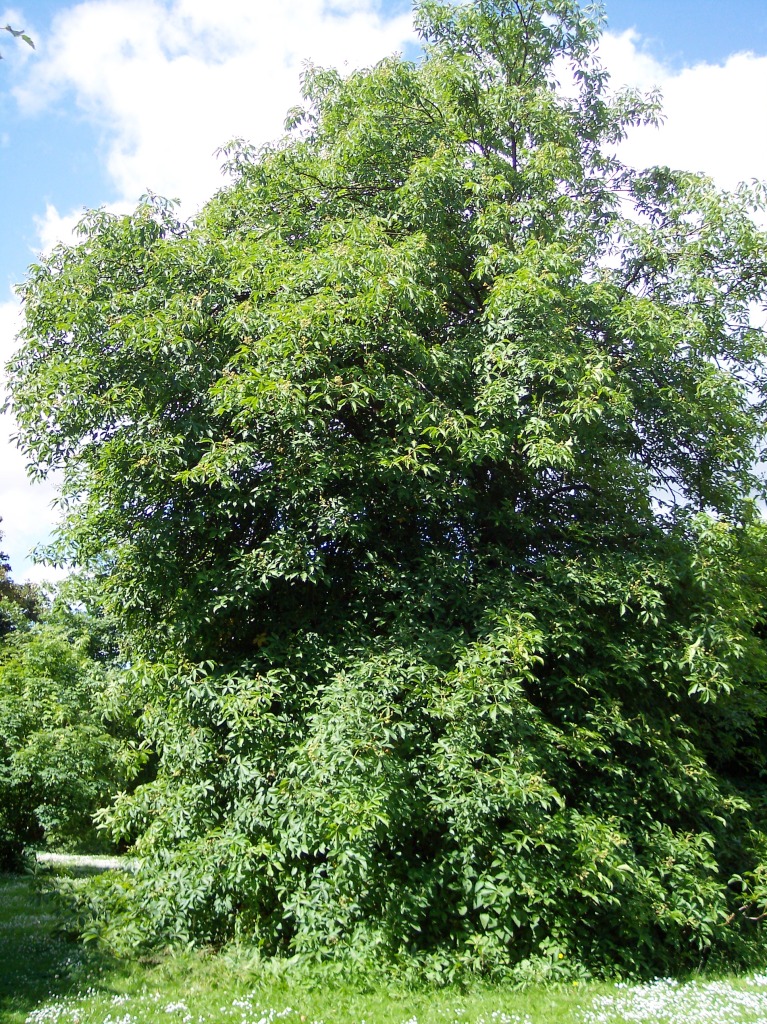
Aesculus californica has no English name on record in the checklists used here. It is a species of flowering plant in the family Sapindaceae (soapberry family), order Sapindales.
- Scientific name
- Aesculus californica (Spach) Nutt.
- Genus
- Aesculus
- Family
- Sapindaceae (Soapberry Family)
- Order
- Sapindales
- Class
- Magnoliopsida
- Red List category
- LC Least Concern
- Recorded in
- 2 countries
- Name status
- accepted in the Catalogue of Life

Overview
Written 26 November 2026 from the sources listed below. Each statement was checked against the passage it cites; statements that could not be supported were removed.
Appearance
Its opposite, palmately compound leaves usually consist of five leaflets measuring 6–17 centimetres in length. The leaflets have finely serrated margins, pointed tips, dark green upper surfaces and paler undersides.[1][2][3][4]
Its fragrant white to pale pink flowers grow in dense, erect panicles measuring 15–20 centimetres long and 5–8 centimetres wide. Individual flowers have four or occasionally five petals and five to seven stamens.[5][6][7]
Its fruit is a smooth, leathery, pear-shaped capsule measuring 5–8 centimetres long. Mature capsules turn brown and split open to expose a glossy brown seed measuring 2–7 centimetres in length.[8][9][10]
Habitat
The species grows on dry slopes, in canyons and along streams, generally below 1,700 metres elevation.[11]
It occurs as scattered individuals in grasslands and as an understory shrub in mixed evergreen forests. It is also a component or local dominant of chaparral and oak woodlands.[12][13][14]
Behaviour
California buckeye commonly sheds its leaves during late summer in dry inland environments, while individuals in coastal environments tend to retain their leaves until mid-autumn. It is among the earliest native woody plants in its range to produce new leaves in spring.[15][16][17]
The species can regenerate after fire by producing new shoots from its root crown. New shoots can emerge within weeks after a fire.[18][19]
Reproduction and life cycle
California buckeye is andromonoecious, producing staminate and bisexual flowers on the same plant. Only bisexual flowers develop into fruit.[20][21]
Its seeds are dispersed mainly by gravity or water, while animal dispersal is rare. Seeds generally remain viable for only one year and can germinate within several weeks of being shed under favourable conditions.[22][23][24]
Diet
Squirrels and chipmunks consume California buckeye seeds. Livestock and wildlife graze on young shoots and newly emerged leaves, which contain lower toxin levels.[25][26]
Conservation
California buckeye is susceptible to leaf blight caused by the fungus Boeremia lilacis. Symptoms include leaf spots, leaf blight and premature leaf fall.[27][28]
Uses
California buckeye is used as an ornamental plant for its foliage, flowers and architectural branches. It helps prevent erosion by binding soil in hilly regions, and its wood is suitable for making fireboards for bow drills and hand drills.[29][30][31]
Classification of Aesculus californica
| Kingdom | Plantae |
|---|---|
| Subkingdom | Pteridobiotina |
| Phylum | Tracheophyta |
| Class | Magnoliopsida |
| Order | Sapindales |
| Family | Sapindaceae (Soapberry Family) |
| Subfamily | Hippocastanoideae |
| Tribe | Hippocastaneae |
| Genus | Aesculus (Buckeye) |
| Species | Aesculus californica (Spach) Nutt. |
Where Aesculus californica is found
Checklists and occurrence records place Aesculus californica in 2 countries across North America. GBIF holds 23,269 georeferenced records of it.
Countries
Regions and cities with the most records
- California, United States 22,302
- Campbell, United States 2,977
- Cupertino, United States 2,918
- Sunnyvale, United States 2,861
- Lafayette, United States 2,827
- Los Altos, United States 2,827
- Palo Alto, United States 2,817
- Mountain View, United States 2,795
- San Jose, United States 2,785
- Santa Clara, United States 2,783
- Saratoga, United States 2,692
- East Palo Alto, United States 2,676
- Moraga, United States 2,653
- Menlo Park, United States 2,530
- Walnut Creek, United States 2,526
- Oakland, United States 2,515
- Orinda, United States 2,443
- Richmond, United States 2,404
- Albany, United States 2,391
- Los Gatos, United States 2,383
- Alameda, United States 2,367
- Berkeley, United States 2,349
- El Cerrito, United States 2,261
- Pleasant Hill, United States 2,237
- Redwood City, United States 2,166
- San Pablo, United States 2,104
- Danville, United States 1,947
- San Francisco, United States 1,908
- San Carlos, United States 1,847
- Milpitas, United States 1,714
- San Ramon, United States 1,701
- Bayview-Hunters Point, United States 1,677
- Belmont, United States 1,663
- San Rafael, United States 1,660
- Pinole, United States 1,625
- Concord, United States 1,582
2 more countries have a few records outside this range
These countries hold a few records of Aesculus californica but lie outside the range the checklists give for it. Such records are often zoo or garden specimens, museum material or vagrants, so the species is not counted as occurring there.
Range as the checklists state it
USA (California)
A number beside a place is its count of GBIF occurrence records. A place without a number comes from a checklist alone. Records show where a species has been observed or collected, which can include escapes and vagrants.
Common names
Names in 11 other languages
- Chinese
- 加州七叶树, 加州七葉樹
- Estonian
- kalifornia hobukastan
- French
- Marronnier de Californie, Pavier de Californie
- German
- kalifornische Rosskastanie
- Hungarian
- kaliforniai vadgesztenye
- Polish
- Kasztanowiec kalifornijski
- Russian
- Конский каштан калифорнийский
- Slovak
- pagaštan kalifornský
- Spanish
- Castaño de California
- Ukrainian
- Гіркокаштан каліфорнійський
- csi
- yáwi
Synonyms
4 other scientific names have been used for this species and are now treated as synonyms of Aesculus californica.
- Calothyrsus californica Spach
- Hippocastanum californicum (Spach) Greene
- Pavia californica (Spach) Hartw.
- Pawia californica (Spach) Kuntze
Related species
-
 Horse ChestnutAesculus hippocastanum
-
 Ohio BuckeyeAesculus glabra
-
 Yellow BuckeyeAesculus flava
-
 Red BuckeyeAesculus pavia
-
 Red Horse-chestnutAesculus × carnea
-
 Bottlebrush BuckeyeAesculus parviflora
-
 Indian Horse-chestnutAesculus indica
-
 Japanese Horse-chestnutAesculus turbinata
Compare
Questions and answers
Why can't you eat buckeye nuts?
California buckeye seeds are poisonous. The bark, leaves and fruits contain neurotoxic glycosides that cause red blood cell hemolysis when ingested. The seeds have been processed by boiling and leaching out toxins before being ground into flour or meal.[32][33][34]
Are buckeye trees good for anything?
California buckeye is used as an ornamental plant for its foliage, flowers and architectural branches. It helps prevent erosion by binding soil in hilly regions, and its wood is suitable for making fireboards for bow drills and hand drills. Its seeds have also been used in traditional fishing and food processing practices.[35][33][29][30][31]
Sources
Passages the profile rests on
- Its leaves are opposite and palmately compound, usually consisting of five leaflets. Source passage: “The leaves are opposite, and palmately compound with five (rarely seven) leaflets.” — English Wikipedia
- Individual leaflets measure 6–17 centimetres in length. Source passage: “The individual leaflets are 6–17 cm (2.4–6.7 in) long” — English Wikipedia
- The leaflets have finely serrated margins and pointed tips. Source passage: “with a finely serrated margin and pointed tips.” — English Wikipedia
- The leaves are dark green on their upper surfaces and paler underneath. Source passage: “The leaves are dark green above and paler on the underside” — English Wikipedia
- Its fragrant flowers are white to pale pink and grow in dense, erect panicles. Source passage: “They are fragrant, white to pale pink” — English Wikipedia
- Its flower panicles measure 15–20 centimetres long and 5–8 centimetres wide. Source passage: “dense, erect panicles 15–20 cm (6–8 in) long and 5–8 cm (2–3 in) broad.” — English Wikipedia
- Individual flowers have four or occasionally five petals and five to seven stamens. Source passage: “4, sometimes 5, petals. Five to seven stamens project conspicuously beyond the petals.” — English Wikipedia
- Its fruit is a smooth, leathery, pear-shaped capsule measuring 5–8 centimetres long. Source passage: “The fruit is a smooth, leathery pear-shaped capsule 5–8 cm (2–3 in) long.” — English Wikipedia
- Mature fruit capsules turn brown and split open to expose a glossy brown seed. Source passage: “As it matures, the capsule turns brown and splits, revealing one large, glossy brown seed” — English Wikipedia
- Its seeds measure 2–7 centimetres in length. Source passage: “measuring 2–7 cm (0.8–2.8 in).” — English Wikipedia
- The species grows on dry slopes, in canyons and along streams, generally below 1,700 metres elevation. Source passage: “dry slopes, in canyons and along streams generally at low to middle elevations below 1700m.” — English Wikipedia
- California buckeye occurs as scattered individuals in grasslands. Source passage: “It occurs as scattered individuals in grasslands” — English Wikipedia
- The species grows as an understory shrub in mixed evergreen forests. Source passage: “as an understory shrub in mixed evergreen forests” — English Wikipedia
- California buckeye occurs as a component or local dominant of chaparral and oak woodlands. Source passage: “as a component or local dominant of chaparral and oak woodlands.” — English Wikipedia
- California buckeye commonly sheds its leaves during late summer in dry inland environments. Source passage: “in drier, more inland areas, its leaves commonly fall off and die during late summer” — English Wikipedia
- Individuals in coastal environments tend to retain their leaves until mid-autumn. Source passage: “Those growing in coastal regions tend to hold on to their leaves until mid-autumn.” — English Wikipedia
- The species is among the earliest native woody plants in its range to produce new leaves in spring. Source passage: “It is among the earliest native woody plants in its range to produce new leaves in spring” — English Wikipedia
- The species can regenerate after fire by producing new shoots from its root crown. Source passage: “California buckeye can regrow after fire by producing new shoots from its root crown” — English Wikipedia
- New shoots can emerge within weeks after a fire. Source passage: “New shoots can emerge in a matter of weeks after a fire” — English Wikipedia
- The species is andromonoecious, producing staminate and bisexual flowers on the same plant. Source passage: “This species is andromonoecious, with the inflorescences producing both staminate and bisexual flowers on the same plant.” — English Wikipedia
- Only bisexual flowers develop into fruit. Source passage: “Only the bisexual flowers are capable of developing into fruit.” — English Wikipedia
- California buckeye seeds are dispersed mainly by gravity or water, while animal dispersal is rare. Source passage: “The Buckeye seeds can disperse mainly by gravity or water, while dispersal by animals is rare.” — English Wikipedia
- The seeds generally remain viable for only one year. Source passage: “The seeds usually remain viable for only one year.” — English Wikipedia
- Under favourable conditions, the seeds can germinate within several weeks of being shed. Source passage: “Under good conditions, they can germinate within several weeks of being shed” — English Wikipedia
- Squirrels and chipmunks consume California buckeye seeds. Source passage: “squirrels and chipmunks consume the seeds.” — English Wikipedia
- Livestock and wildlife graze on young shoots and newly emerged leaves, which contain lower toxin levels. Source passage: “When the shoots are small and leaves are new, they are lower in toxins and are grazed by livestock and wildlife.” — English Wikipedia
- California buckeye is susceptible to leaf blight caused by the fungus Boeremia lilacis. Source passage: “California buckeye is vulnerable to leaf blight caused by the fungus Boeremia lilacis.” — English Wikipedia
- Leaf blight symptoms include leaf spots, leaf blight and premature leaf fall. Source passage: “Symptoms of this disease include leaf spots that can expand toward the midvein, leaf blight, and premature leaf fall.” — English Wikipedia
- California buckeye is used as an ornamental plant for its foliage, flowers and architectural branches. Source passage: “It is used as an ornamental plant for its striking leaf buds, lime green foliage, fragrant white flowers, red-brown foliage in mid to late summer, and architectural silver branches through fall.” — English Wikipedia
- The species helps prevent erosion by binding soil in hilly regions. Source passage: “The tree also acts as a soil binder, which prevents erosion in hilly regions.” — English Wikipedia
- California buckeye wood is suitable for making fireboards for bow drills and hand drills. Source passage: “Buckeye also makes a good fireboard for a bow drill or hand drill.” — English Wikipedia
- The species produces large, glossy seeds that are poisonous. Source passage: “The seeds are poisonous.” — English Wikipedia
- Indigenous communities processed the seeds by boiling and leaching out toxins before grinding them into flour or meal. Source passage: “after boiling and leaching the toxin out of the seeds or nut meats for several days, they could be ground into a flour or meal similar to that made from acorns.” — English Wikipedia
- The bark, leaves and fruits contain neurotoxic glycosides that cause red blood cell hemolysis when ingested. Source passage: “The bark, leaves, and fruits contain neurotoxic glycosides, which cause hemolysis of red blood cellswhen ingested.” — English Wikipedia
- The Pomo, Yokuts and Luiseño peoples used the poisonous seeds to stupefy fish in small streams for easier capture. Source passage: “used the poisonous nuts and seeds to stupefy schools of fish in small streams to make them easier to catch.” — English Wikipedia
Data
- Catalogue of Life, 2026-10-16 XR cc by
- Global Biodiversity Information Facility CC BY 4.0
- Wikidata CC0
- GeoNames CC BY 4.0
- Wikimedia Commons per image; credit shown with each image
- Within the Catalogue of Life, this name comes from Synonymic Checklists of the Vascular Plants of the World cc by
References
- Nutt. (1840). Fl. N. Amer. [Torrey & A.Gray] 1: 251 (1840). where the name was published
This species in other databases
Page built on 29 November 2026. See how the catalog is made and all sources and licences.
Cite this page
ScientificNames.org. (2026). Aesculus californica. Retrieved November 29, 2026, from https://scientificnames.org/species/aesculus-californica
“Aesculus californica.” ScientificNames.org, 2026, scientificnames.org/species/aesculus-californica. Accessed 29 Nov. 2026.
ScientificNames.org. “Aesculus californica.” Accessed November 29, 2026. https://scientificnames.org/species/aesculus-californica.
@misc{scientificnames_aesculus_californica,
  author = {{ScientificNames.org}},
  title = {Aesculus californica},
  year = {2026},
  url = {https://scientificnames.org/species/aesculus-californica},
  note = {Accessed 2026-11-29}
}