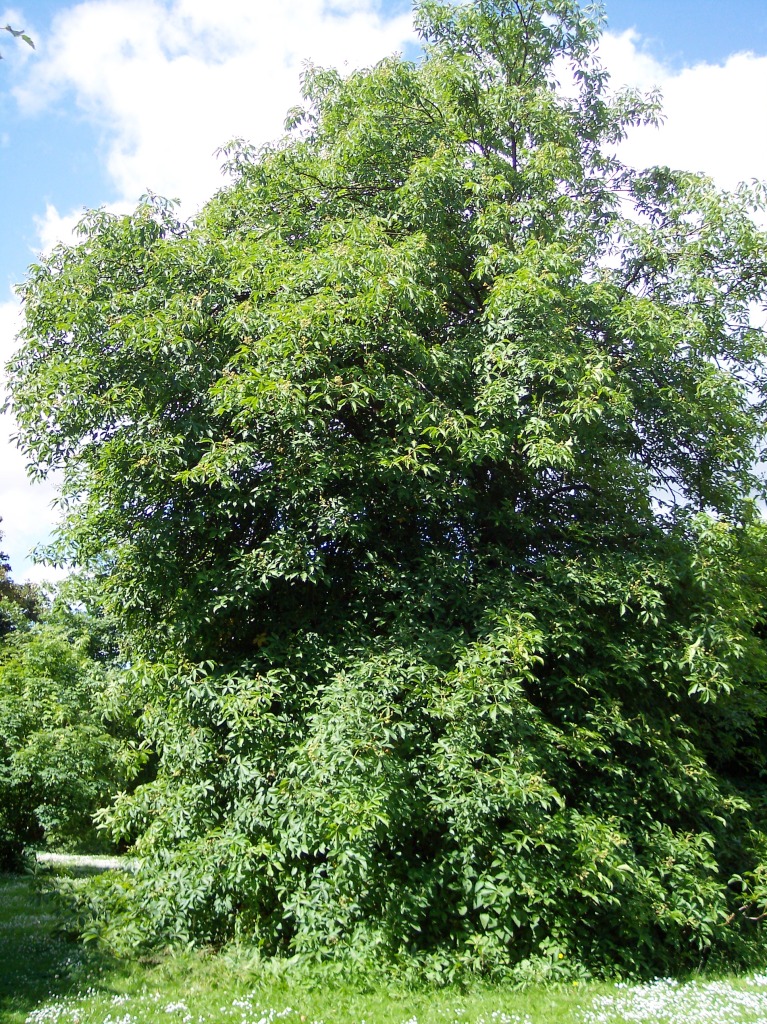
| Appearance | - Aesculus hippocastanum is a large deciduous tree with a broad, rounded crown and sturdy trunk. nps.gov
- Its leaves are opposite and palmately compound, typically containing five to seven leaflets. English Wikipedia
- Individual leaflets measure between 13 and 30 centimetres in length. English Wikipedia
- The complete compound leaf can reach 60 centimetres in width. English Wikipedia
- The leaf petiole measures between 7 and 20 centimetres long. English Wikipedia
- Fallen leaves leave horseshoe-shaped scars with seven nail-like markings on the twigs. English Wikipedia
- The tree produces upright clusters of white flowers with yellow or pink markings near their bases. English Wikipedia
- Flower clusters typically contain approximately four to five flowers. English Wikipedia
- The fruits are green spiny capsules containing one seed, although two or three seeds occasionally occur. English Wikipedia
- The seeds are glossy nut-brown and measure approximately two to four centimetres in diameter. English Wikipedia
- Mature bark is grey-brown and develops irregular plates and fissures. nps.gov
- The leaves consist of five to nine leaflets radiating from a single point. nps.gov
- The leaflets are oval-shaped, pointed at their tips, and have finely toothed edges. nps.gov
- Young foliage is light green before becoming dark green as it matures. nps.gov
- The foliage typically turns yellow or brownish-yellow during autumn. nps.gov
- The tree develops large sticky winter buds. nps.gov
| |
|---|
| Size | | - Each leaflet measures 8–16 cm in length and width. English Wikipedia
- Fifty trees measured in Jefferson County, Indiana, averaged 20.7 m in height and 84 cm in diameter at breast height. research.fs.usda.gov
- On dry habitats in eastern Oklahoma, the species grows as a shrub measuring 1.2–1.5 m tall. research.fs.usda.gov
|
|---|
| Habitat | - The species grows best in moist, well-drained soils and full sunlight, although it tolerates light shade. nps.gov
- The tree occurs in forests as well as gardens and parks. kingcounty.gov
| - The species occurs along streambanks, in upland mesic forests, and beside old fields. English Wikipedia
- The species is typically associated with calcareous areas. English Wikipedia
- The species is most frequently found along river bottoms and in streambank soils. research.fs.usda.gov
- The species most commonly grows on Alfisol soils. research.fs.usda.gov
- The species also occurs in hardwood stands on moist sites in Kentucky's limestone-sink-and-cave section of the Bluegrass region. research.fs.usda.gov
- The species can occur on drier and clayey sites, although it usually grows slowly there and rarely becomes dominant. research.fs.usda.gov
- The species develops best as an isolated individual in openings along streambanks and other moist sites. research.fs.usda.gov
|
|---|
| Diet | - The larvae of the leaf-mining moth Cameraria ohridella feed on horse chestnut leaves. English Wikipedia
| - The seeds contain tannic acid and are poisonous to humans and cattle. English Wikipedia
- The young foliage, shoots, and bark are also poisonous to some degree. English Wikipedia
- The bark and seeds contain a narcotic glucoside considered poisonous to livestock. research.fs.usda.gov
|
|---|
| Behaviour | - Bees and other pollinating insects visit the flowers to collect nectar and transfer pollen. nps.gov
- Squirrels and other animals disperse the fruits into green spaces. kingcounty.gov
| No checked fact yet |
|---|
| Reproduction | - The species produces flowers in late spring. English Wikipedia
- The flowers are hermaphroditic. English Wikipedia
- Usually between one and five fruits develop from each flower cluster. English Wikipedia
- The mature fruits split open in autumn to release their seeds. nps.gov
- The species spreads primarily through seeds but can also be propagated from cuttings. kingcounty.gov
| |
|---|
| Distribution | - The species is native to the Balkan Peninsula. nps.gov
- The IUCN assessment cited in the document restricts the species' native distribution to Albania, Bulgaria, mainland Greece, and North Macedonia. English Wikipedia
- The species has been introduced and planted in many parts of the world. English Wikipedia
- Introduced populations occur in northern Europe, including Norway and Sweden. English Wikipedia
- The species occurs in parks and cities in the northern United States and Canada. English Wikipedia
- Horse chestnut is a familiar landscape tree throughout Europe and North America. nps.gov
| - The species is native to North America. English Wikipedia
- Its natural range is concentrated in the Midwestern and lower Great Plains regions of the United States. English Wikipedia
- Its natural range extends southeast into the Black Belt of Alabama and Mississippi. English Wikipedia
- The species occurs locally in extreme southwestern Ontario, including Walpole Island in Lake St. Clair. English Wikipedia
- Its range extends from western Pennsylvania, Ohio, and southern Michigan westward to Illinois and central Iowa. research.fs.usda.gov
- Its southern distribution reaches eastern Kansas, southwestern Oklahoma, and central Texas. research.fs.usda.gov
- Its eastern distribution reaches western Arkansas, Tennessee, central Alabama, and one location in eastern Mississippi. research.fs.usda.gov
|
|---|
| Conservation | - The Bulgarian relict populations of horse chestnut are critically endangered at the national level. English Wikipedia
- The Bulgarian relict forests are protected within the Dervisha Managed Nature Reserve. English Wikipedia
- Horse chestnut is designated as a weed of concern in King County, Washington. kingcounty.gov
- The species competes with native plants and alters natural habitats in King County. kingcounty.gov
| No checked fact yet |
|---|
| Uses | - The seeds can be used to produce homemade laundry detergent. English Wikipedia
- The seeds contain saponins that produce a soap-like lather when mixed with water. nps.gov
- Horse chestnut is widely cultivated as an ornamental tree in streets and parks in temperate regions. English Wikipedia
- The species is cultivated for its spring flowers. English Wikipedia
- Horse chestnut is used as a subject for bonsai cultivation. English Wikipedia
| - Native Americans reportedly consumed the fruit after boiling it to remove tannin. English Wikipedia
- The Lenape carried the nuts in their pockets as a traditional remedy for rheumatism. English Wikipedia
- An infusion of ground nuts was traditionally mixed with sweet oil or mutton tallow for treating earaches. English Wikipedia
- Native Americans ground the nuts and used them to poison fish in streams. English Wikipedia
- The nuts were blanched to extract tannic acid for leather production. English Wikipedia
- Dried nuts were used to make necklaces. English Wikipedia
- The species has limited commercial value as sawtimber because its wood is soft and light. research.fs.usda.gov
- The species is cultivated as an ornamental tree. research.fs.usda.gov
- Extracts from the species have demonstrated anti-cancer properties. English Wikipedia
|
|---|
| Other | - The flowers provide nectar for bees and other pollinating insects. nps.gov
| No checked fact yet |
|---|