Species · Flowering plants
Horse Chestnut Aesculus hippocastanum
The scientific name of the Horse Chestnut is Aesculus hippocastanum. It is a species of flowering plant in the family Sapindaceae (soapberry family), order Sapindales.
- Scientific name
- Aesculus hippocastanum L.
- Common name
- Horse Chestnut
- Genus
- Aesculus
- Family
- Sapindaceae (Soapberry Family)
- Order
- Sapindales
- Class
- Magnoliopsida
- Red List category
- VU Vulnerable
- Recorded in
- 55 countries
- Name status
- accepted in the Catalogue of Life

Overview
The species is native to the Balkan Peninsula and has been introduced and planted in many parts of the world.
Written 26 November 2026 from the sources listed below. Each statement was checked against the passage it cites; statements that could not be supported were removed.
Appearance
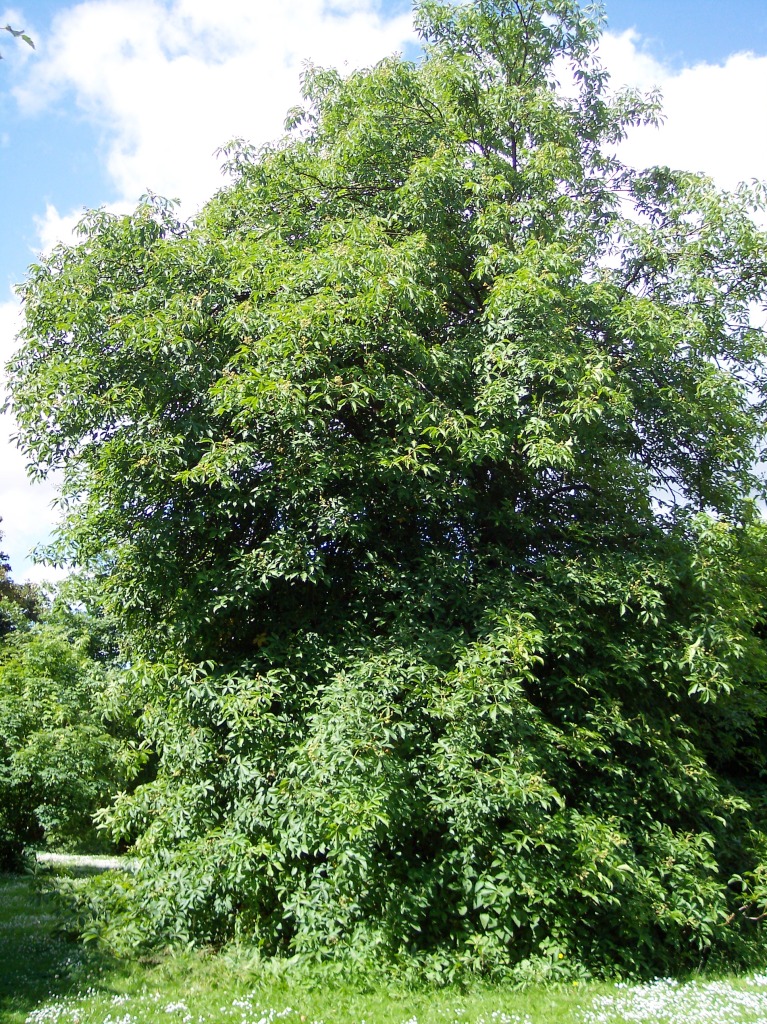
Horse Chestnut is a large deciduous tree with a broad, rounded crown and sturdy trunk. It can reach approximately 39 metres in height.[1][2]
Its leaves are opposite and palmately compound, with five to seven leaflets typically, although descriptions also give five to nine leaflets radiating from a single point. The oval-shaped leaflets have pointed tips and finely toothed edges, measure between 13 and 30 centimetres long, and form compound leaves up to 60 centimetres wide.[3][4][5][6][7]
The leaf petiole measures between 7 and 20 centimetres long. Fallen leaves leave horseshoe-shaped scars with seven nail-like markings on the twigs.[8][9]
Young foliage is light green before becoming dark green as it matures, and typically turns yellow or brownish-yellow during autumn. The tree develops large sticky winter buds.[10][11][12]
The tree produces upright clusters of white flowers with yellow or pink markings near their bases. Flower clusters typically contain approximately four to five flowers.[13][14]
The fruits are green spiny capsules containing one seed, although two or three seeds occasionally occur. The seeds are glossy nut-brown and measure approximately two to four centimetres in diameter.[15][16]
Mature bark is grey-brown and develops irregular plates and fissures.[17]
Habitat
Horse Chestnut grows best in moist, well-drained soils and full sunlight, although it tolerates light shade. It occurs in forests as well as gardens and parks.[18][19]
The species is native to the Balkan Peninsula. Its native distribution is restricted to Albania, Bulgaria, mainland Greece, and North Macedonia.[20][21]
Introduced populations occur in northern Europe, including Norway and Sweden. The species also occurs in parks and cities in the northern United States and Canada.[22][23][24]
Horse Chestnut is a familiar landscape tree throughout Europe and North America.[25]
Diet
The larvae of the leaf-mining moth Cameraria ohridella feed on Horse Chestnut leaves.[26]
Behaviour
Bees and other pollinating insects visit the flowers to collect nectar and transfer pollen. The flowers provide nectar for these insects.[27][28]
Squirrels and other animals disperse the fruits into green spaces.[29]
Reproduction and life cycle
Horse Chestnut produces flowers in late spring. The flowers are hermaphroditic.[30][31]
Usually between one and five fruits develop from each flower cluster. The mature fruits split open in autumn to release their seeds.[32][33]
The species spreads primarily through seeds but can also be propagated from cuttings.[34]
Conservation
The Bulgarian relict populations of Horse Chestnut are critically endangered at the national level. The Bulgarian relict forests are protected within the Dervisha Managed Nature Reserve.[35][36]
Horse Chestnut is designated as a weed of concern in King County, Washington. It competes with native plants and alters natural habitats there.[37][38]
Uses
Horse Chestnut is widely cultivated as an ornamental tree in streets and parks in temperate regions. It is cultivated for its spring flowers and used as a subject for bonsai cultivation.[39][40][41]
The seeds can be used to produce homemade laundry detergent. They contain saponins that produce a soap-like lather when mixed with water.[42][43]
Classification of the Horse Chestnut
| Kingdom | Plantae |
|---|---|
| Subkingdom | Pteridobiotina |
| Phylum | Tracheophyta |
| Class | Magnoliopsida |
| Order | Sapindales |
| Family | Sapindaceae (Soapberry Family) |
| Subfamily | Hippocastanoideae |
| Tribe | Hippocastaneae |
| Genus | Aesculus (Buckeye) |
| Species | Aesculus hippocastanum L. |
Where the Horse Chestnut is found
Checklists and occurrence records place Aesculus hippocastanum in 55 countries across Asia, Europe, North America and Oceania. GBIF holds 305,660 georeferenced records of it.
Countries where it is native or its origin is not stated
- Aland Islands 15
- Albania 15
- Belgium 12,532
- Bosnia and Herzegovina 35
- Bulgaria 100
- Cyprus 5
- Denmark 4,112
- Estonia 510
- Finland 364
- Greece 258
- Isle of Man 370
- Italy 317
- Kosovo 5
- Latvia 113
- Lithuania 202
- Luxembourg 606
- Moldova 8
- Monaco 1
- Montenegro 12
- North Macedonia 12
- Norway 1,739
- Poland 2,234
- Portugal 70
- Romania 100
- Russia 2,808
- Serbia 127
- Sweden 20,317
- The Netherlands 11,833
- Turkey 469
- Ukraine 1,108
Countries where it has been introduced
- Austria 3,353
- Azerbaijan
- Belarus 373
- Canada 3,050
- China 7
- Croatia 214
- Czechia 2,089
- France 30,330
- Germany 30,814
- Guernsey 9
- Hungary 210
- Ireland 1,800
- Jersey 3
- Kazakhstan 86
- Liechtenstein 16
- New Zealand 257
- San Marino 1
- Slovakia 580
- Slovenia 150
- Spain 5,597
- Switzerland 4,969
- Turkmenistan 1
- United Kingdom 154,253
- United States 7,076
- Uzbekistan 25
Regions and cities with the most records
- England, United Kingdom 130,964
- Scotland, United Kingdom 14,062
- Bavaria, Germany 11,872
- Willesden, United Kingdom 7,936
- Cricklewood, United Kingdom 7,871
- Harlesden, United Kingdom 7,849
- Shepherds Bush, United Kingdom 7,843
- London, United Kingdom 7,792
- City of Westminster, United Kingdom 7,754
- Fulham, United Kingdom 7,689
- Chalk Farm, United Kingdom 7,623
- Acton, United Kingdom 7,608
- Camden Town, United Kingdom 7,593
- Barnes, United Kingdom 7,467
- Wembley, United Kingdom 7,338
- West Ealing, United Kingdom 7,205
- Île-de-France, France 7,190
- Earlsfield, United Kingdom 7,149
- Golders Green, United Kingdom 7,051
- Streatham, United Kingdom 7,026
- Richmond, United Kingdom 6,960
- Greenford, United Kingdom 6,823
- Harrow, United Kingdom 6,797
- Islington, United Kingdom 6,795
- Mitcham, United Kingdom 6,742
- Isleworth, United Kingdom 6,734
- Southall, United Kingdom 6,601
- Archway, United Kingdom 6,591
- Highbury, United Kingdom 6,569
- Morden, United Kingdom 6,561
- Northolt, United Kingdom 6,544
- Heston, United Kingdom 6,461
- Hounslow, United Kingdom 6,457
- Shadwell, United Kingdom 6,454
- Finchley, United Kingdom 6,414
- Stepney, United Kingdom 6,329
12 more countries have a few records outside this range
These countries hold a few records of Aesculus hippocastanum but lie outside the range the checklists give for it. Such records are often zoo or garden specimens, museum material or vagrants, so the species is not counted as occurring there.
Range as the checklists state it
England [I] (England [I], Wales [I], Isle of Man [I], Scotland [I], Outer Hebrides [I], Orkney Isl. [I], Shetland Isl. [I], Isles of Scilly [I]); Ireland [I] (Ireland [I], Northern Ireland [I]); Germany [I]; Switzerland [I]; Liechtenstein [I]; Austria [I]; Czech Republic [I]; Slovakia [I]; Hungary [I]; Spain [I]; France [I]; Monaco [c]; Channel Isl. [I] (Alderney [I], Guernsey [I], Jersey [I], Sark [I]); San Marino [I]; Slovenia [I]; Croatia [I]; Bosnia & Hercegovina [I]; Montenegro; Kosovo; North Macedonia; Albania; Bulgaria; Greece (mountains of NW- and C-Greece); Belarus [I]; European Russia [I]; Kazakhstan [I]; Turkmenistan [I]; Uzbekistan [I]; Northern Caucasus [I]; Azerbaijan [I]; China [I]; New Zealand [I]; Canada [I] (British Columbia [I], New Brunswick [I], Ontario [I], Quebec [I]); USA [I] (Connecticut [I], Georgia [I], Iowa [I], Illinois [I], Indiana [I], Massachusetts [I], Maryland [I], Maine [I], Michigan [I], Minnesota [I], North Carolina [I], New Jersey [I], New York [I], Ohio [I], Oregon [I], Pennsylvania [I], Rhode Island [I], South Carolina [I], Virginia [I], West Virginia [I])
A number beside a place is its count of GBIF occurrence records. A place without a number comes from a checklist alone. Records show where a species has been observed or collected, which can include escapes and vagrants.
Common names
English
- Horse Chestnut
- European Horse Chestnut
- European Horse-chestnut
- Spanish Chestnut
- White Horse Chestnut
- Buckeye
- Common Horsechestnut
- Conker Tree
- Horse-chestnut
Names in 50 other languages
- Afrikaans
- Wildekastaiing
- Arabic
- كستناء الحصان
- Asturian
- castañal de la india
- Azerbaijani
- At şabalıdı
- Basque
- Indigaztainondo
- Belarusian
- Каштан конскі, Конскі каштан звычайны
- Bulgarian
- Обикновен конски кестен
- Catalan
- Castanyer d'Índia, Castanyer d'Índia comú
- Chinese
- ou zhou qi ye shu, 娑罗子, 欧洲七叶树, 歐洲七葉樹, 馬栗
- Croatian
- Obični divlji kesten
- Czech
- jírovec maďal, koňský kaštan
- Danish
- Almindelig hestekastanje, Hestekastanie
- Dutch
- Witte paardenkastanje
- Esperanto
- Hipokastano
- Estonian
- harilik hobukastan
- Finnish
- balkaninhevoskastanja
- French
- Marronier commun, marronnier, marronnier commun, marronnier d'Inde, marronnier d’Inde
- Galician
- Castiñeiro de Indias
- German
- Gemeine Rosskastanie, Rosskastanie, Weiße Rosskastanie, gewöhnliche Rosskastanie
- Greek
- Αίσκουλος η ιπποκαστανέα, Αγριοκαστανιά, Ιπποκαστανιά
- Hebrew
- ערמונית הסוסים
- Hungarian
- Közönséges vadgesztenye, fehér vadgesztenye
- Irish
- Crann cnó capaill
- Italian
- Ippocastano, ipposcastano
- Japanese
- セイヨウトチノキ, マロニエ
- Korean
- 가시칠엽수
- Latvian
- Parastā zirgkastaņa
- Lithuanian
- Paprastasis kaštonas
- Luxembourgish
- Käschtebam
- Macedonian
- Див костен
- Norwegian Bokmål
- hestekastanje
- Occitan
- Marronièr d'Índia
- Polish
- kasztanowiec pospolity
- Portuguese
- Castanheiro da Índia, Castanheiro-da-índia
- Romanian
- Castan porcesc, Castan sălbatic
- Russian
- kaštan konskij, Конский каштан обыкновенный
- Scottish Gaelic
- geanmchno-fhiadhaich, geanmchnothan fiadhaich
- Serbian
- Дивљи кестен
- Slovak
- pagaštan konský
- Slovenian
- Navadni divji kostanj
- Spanish
- Castaño de la India, castaño de Indias
- Swedish
- Vanlig hästkastanj, hästkastanj
- Turkish
- Beyaz Çiçekli At Kestanesi, Koca At Kestanesi, at kestanesi
- Ukrainian
- Гіркокаштан звичайний, Каштан білий, Кінський каштан звичайний
- Welsh
- Castanwydd y Meirch, Castanwydden Geffyl, Castanwydden y Meirch
- arg
- Castanyera borde
- bos
- Divlji kesten
- frr
- Hingstkastanje
- hsb
- Běły jěrowc
- srd
- Ippocastanu
Synonyms
31 other scientific names have been used for this species and are now treated as synonyms of Aesculus hippocastanum.
- Aesculus asplenifolia Loudon
- Aesculus castanea Gilib.
- Aesculus hippocastanum f. albovariegatum (Weston) Rehder
- Aesculus hippocastanum f. baumannii C.K.Schneid.
- Aesculus hippocastanum f. beaumanii (C.K.Schneid.) Dole
- Aesculus hippocastanum f. hippocastanum
- Aesculus hippocastanum f. laciniata (Leroy ex Jacques) Schelle
- Aesculus hippocastanum f. luteovariegatum (Weston) Rehder
- Aesculus hippocastanum f. memmingeri (K.Koch) Schelle
- Aesculus hippocastanum f. pendula (Puvill.) Rehder
- Aesculus hippocastanum f. pyramidalis (A.Henry) Simon-Louis ex C.K.Schneid.
- Aesculus hippocastanum f. umbraculifera (H.Jaeger) Schelle
- Aesculus hippocastanum var. albovariegatum Weston
- Aesculus hippocastanum var. argenteovariegata Loudon
- Aesculus hippocastanum var. aureovariegata Loudon
- Aesculus hippocastanum var. beaumanii C.K.Schneid.
- Aesculus hippocastanum var. flore-pleno Loudon
- Aesculus hippocastanum var. incisa Booth ex Loudon
- Aesculus hippocastanum var. laciniata Leroy ex Jacques
- Aesculus hippocastanum var. luteovariegatum Weston
- Aesculus hippocastanum var. pendula Puvill.
- Aesculus hippocastanum var. pyramidalis A.Henry
- Aesculus hippocastanum var. umbraculifera H.Jaeger
- Aesculus hippocastanum var. variegata G.Sinclair
- Aesculus hippocastanum var. variegata Loudon
- Aesculus memmingeri K.Koch
- Aesculus procera Salisb.
- Aesculus septenata Stokes
- Hippocastanum aesculus Cav.
- Hippocastanum vulgare Gaertn.
- Pawia hippocastanum (L.) Kuntze
Related species
-
 Ohio BuckeyeAesculus glabra
-
 Aesculus californica
-
 Yellow BuckeyeAesculus flava
-
 Red BuckeyeAesculus pavia
-
 Red Horse-chestnutAesculus × carnea
-
 Bottlebrush BuckeyeAesculus parviflora
-
 Indian Horse-chestnutAesculus indica
-
 Japanese Horse-chestnutAesculus turbinata
Compare
Questions and answers
What is the scientific name of the Horse Chestnut?
The scientific name of the Horse Chestnut is Aesculus hippocastanum. Written with its author, the full name is Aesculus hippocastanum L..
Which family does the Horse Chestnut belong to?
Aesculus hippocastanum belongs to the family Sapindaceae, in the order Sapindales and the class Magnoliopsida.
Where is the Horse Chestnut found?
Checklists and occurrence records place Aesculus hippocastanum in 55 countries, including Sweden, Belgium, The Netherlands, Denmark, Russia and Poland.
What is the conservation status of the Horse Chestnut?
The IUCN Red List category recorded for Aesculus hippocastanum is Vulnerable (VU).
What other names does the Horse Chestnut have?
Aesculus hippocastanum is also known in English as European Horse Chestnut, European Horse-chestnut, Spanish Chestnut, White Horse Chestnut, Buckeye and Common Horsechestnut.
Sources
Passages the profile rests on
- Aesculus hippocastanum is a large deciduous tree with a broad, rounded crown and sturdy trunk. Source passage: “Horse chestnut is a large tree with a broad, rounded crown and a sturdy trunk.” — nps.gov
- The tree can reach approximately 39 metres in height. Source passage: “Aesculus hippocastanum is a large tree, growing to about 39 m (128 ft) tall” — English Wikipedia
- Its leaves are opposite and palmately compound, typically containing five to seven leaflets. Source passage: “The leaves are opposite and palmately compound, with 5–7 leaflets” — English Wikipedia
- Individual leaflets measure between 13 and 30 centimetres in length. Source passage: “with 5–7 leaflets 13–30 cm (5–12 in) long” — English Wikipedia
- The complete compound leaf can reach 60 centimetres in width. Source passage: “making the whole leaf up to 60 cm (24 in) across” — English Wikipedia
- The leaves consist of five to nine leaflets radiating from a single point. Source passage: “Each leaf consists of 5-9 large leaflets that radiate from a single point, creating a hand-like or palm-shaped appearance.” — nps.gov
- The leaflets are oval-shaped, pointed at their tips, and have finely toothed edges. Source passage: “The leaflets are oval-shaped with pointed tips, finely toothed edges, and showcase prominent veins.” — nps.gov
- The leaf petiole measures between 7 and 20 centimetres long. Source passage: “with a 7–20 cm (3–8 in) petiole.” — English Wikipedia
- Fallen leaves leave horseshoe-shaped scars with seven nail-like markings on the twigs. Source passage: “The leaf scars, left on twigs after leaves fall, have a distinctive horseshoe shape, complete with seven "nails".” — English Wikipedia
- Young foliage is light green before becoming dark green as it matures. Source passage: “Young leaves are light green and soft before developing into large, dark green leaves that provide dense shade.” — nps.gov
- The foliage typically turns yellow or brownish-yellow during autumn. Source passage: “Horse chestnut foliage typically turns yellow or brownish-yellow in autumn.” — nps.gov
- The tree develops large sticky winter buds. Source passage: “Horse chestnut is known its large, sticky winter buds, which are among the easiest tree buds to recognize.” — nps.gov
- The tree produces upright clusters of white flowers with yellow or pink markings near their bases. Source passage: “The petals are usually white with a yellow to pink blotch at the base.” — English Wikipedia
- Flower clusters typically contain approximately four to five flowers. Source passage: “polygamomonoecious erect panicles of about 4–5 flowers bloom from jointed pedicels.” — English Wikipedia
- The fruits are green spiny capsules containing one seed, although two or three seeds occasionally occur. Source passage: “The shell is a green, spiky capsule containing one (rarely two or three) nut-like seeds called conkers or horse-chestnuts.” — English Wikipedia
- The seeds are glossy nut-brown and measure approximately two to four centimetres in diameter. Source passage: “Each conker is 2–4 cm (0.8–1.6 in) in diameter, glossy nut-brown with a whitish scar at the base.” — English Wikipedia
- Mature bark is grey-brown and develops irregular plates and fissures. Source passage: “Mature bark is gray-brown and develops irregular plates and fissures.” — nps.gov
- The species grows best in moist, well-drained soils and full sunlight, although it tolerates light shade. Source passage: “The species grows best in moist, well-drained soils, and full sun, although it can tolerate light shade.” — nps.gov
- The tree occurs in forests as well as gardens and parks. Source passage: “Horse chestnut is an ornamental tree that has grown beyond gardens and parks into forests.” — kingcounty.gov
- The species is native to the Balkan Peninsula. Source passage: “Horse chestnut is a large deciduous tree native to the Balkan Peninsula” — nps.gov
- The IUCN assessment cited in the document restricts the species' native distribution to Albania, Bulgaria, mainland Greece, and North Macedonia. Source passage: “A 2017 assessment for the IUCN Red List restricted the native distribution to the Balkan area: Albania, Bulgaria, mainland Greece and North Macedonia.” — English Wikipedia
- The species has been introduced and planted in many parts of the world. Source passage: “It has been introduced and planted around the world.” — English Wikipedia
- Introduced populations occur in northern Europe, including Norway and Sweden. Source passage: “It can be found in many parts of Europe as far north as Harstad north of the Arctic Circle in Norway, and Gästrikland in Sweden” — English Wikipedia
- The species occurs in parks and cities in the northern United States and Canada. Source passage: “as well as in many parks and cities around the northern United States and Canada such as Edmonton in Alberta.” — English Wikipedia
- Horse chestnut is a familiar landscape tree throughout Europe and North America. Source passage: “that has become a familiar feature of parks, gardens, and landscapes throughout Europe and North America.” — nps.gov
- The larvae of the leaf-mining moth Cameraria ohridella feed on horse chestnut leaves. Source passage: “whose larvae feed on horse chestnut leaves” — English Wikipedia
- Bees and other pollinating insects visit the flowers to collect nectar and transfer pollen. Source passage: “Bees and other pollinating insects frequently visit flowering horse chestnuts, transferring pollen between blossoms while collecting nectar.” — nps.gov
- The flowers provide nectar for bees and other pollinating insects. Source passage: “These blooms provide an important nectar source for bees and other pollinating insects.” — nps.gov
- Squirrels and other animals disperse the fruits into green spaces. Source passage: “The fruits are toxic to people and are often spread by squirrels and other animals who carry them into green spaces.” — kingcounty.gov
- The species produces flowers in late spring. Source passage: “In late spring, polygamomonoecious erect panicles of about 4–5 flowers bloom from jointed pedicels.” — English Wikipedia
- The flowers are hermaphroditic. Source passage: “synoecious (hermaphroditic-flowered) tree.” — English Wikipedia
- Usually between one and five fruits develop from each flower cluster. Source passage: “Usually only 1–5 fruits develop on each panicle.” — English Wikipedia
- The mature fruits split open in autumn to release their seeds. Source passage: “In autumn, mature fruits fall from the tree and split open, releasing their seeds.” — nps.gov
- The species spreads primarily through seeds but can also be propagated from cuttings. Source passage: “It spreads primarily by seed, but it is possible to grow from cuttings.” — kingcounty.gov
- The Bulgarian relict populations of horse chestnut are critically endangered at the national level. Source passage: “Bulgaria's relict horse chestnut forests are critically endangered at the national level” — English Wikipedia
- The Bulgarian relict forests are protected within the Dervisha Managed Nature Reserve. Source passage: “protected as part of the Dervisha Managed Nature Reserve.” — English Wikipedia
- Horse chestnut is designated as a weed of concern in King County, Washington. Source passage: “Horse chestnut is designated as a weed of concern in King County.” — kingcounty.gov
- The species competes with native plants and alters natural habitats in King County. Source passage: “It competes with native plants and alters natural habitat.” — kingcounty.gov
- Horse chestnut is widely cultivated as an ornamental tree in streets and parks in temperate regions. Source passage: “It is widely cultivated in streets and parks throughout the temperate world” — English Wikipedia
- The species is cultivated for its spring flowers. Source passage: “Cultivation for its spectacular spring flowers is successful in a wide range of temperate climatic conditions” — English Wikipedia
- Horse chestnut is used as a subject for bonsai cultivation. Source passage: “The horse-chestnut is a favorite subject for bonsai.” — English Wikipedia
- The seeds can be used to produce homemade laundry detergent. Source passage: “Conkers can be used to produce homemade laundry detergent.” — English Wikipedia
- The seeds contain saponins that produce a soap-like lather when mixed with water. Source passage: “The seeds contain natural compounds called saponins, which can produce a soap-like lather when mixed with water.” — nps.gov
Data
- Catalogue of Life, 2026-10-16 XR cc by
- Global Biodiversity Information Facility CC BY 4.0
- Wikidata CC0
- GeoNames CC BY 4.0
- Wikimedia Commons per image; credit shown with each image
- Within the Catalogue of Life, this name comes from Synonymic Checklists of the Vascular Plants of the World cc by
References
- L. (1753). Sp. Pl. [Linnaeus] 1: 344 (1753). where the name was published
This species in other databases
Page built on 27 November 2026. See how the catalog is made and all sources and licences.
Cite this page
ScientificNames.org. (2026). Aesculus hippocastanum (Horse Chestnut). Retrieved November 27, 2026, from https://scientificnames.org/species/aesculus-hippocastanum
“Aesculus hippocastanum (Horse Chestnut).” ScientificNames.org, 2026, scientificnames.org/species/aesculus-hippocastanum. Accessed 27 Nov. 2026.
ScientificNames.org. “Aesculus hippocastanum (Horse Chestnut).” Accessed November 27, 2026. https://scientificnames.org/species/aesculus-hippocastanum.
@misc{scientificnames_aesculus_hippocastanum_horse_chestnut,
  author = {{ScientificNames.org}},
  title = {Aesculus hippocastanum (Horse Chestnut)},
  year = {2026},
  url = {https://scientificnames.org/species/aesculus-hippocastanum},
  note = {Accessed 2026-11-27}
}