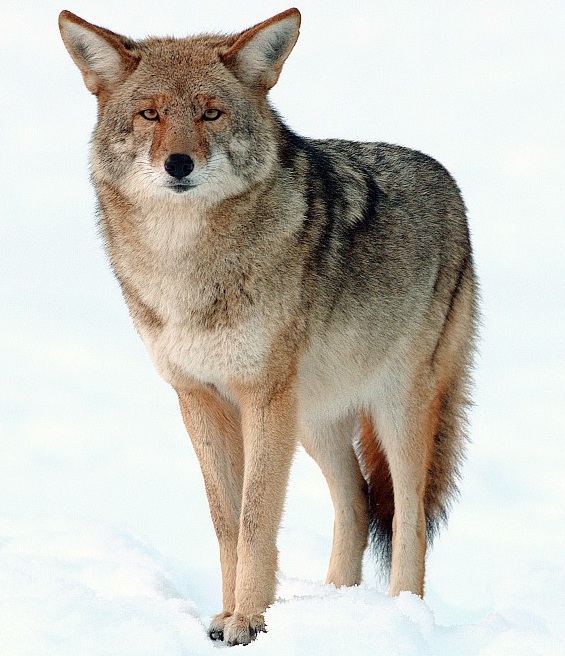
| Appearance | - The African wolf has a relatively long snout and ears and a comparatively short tail. English Wikipedia
- The African wolf's typical coat coloration ranges from yellowish to silvery grey. English Wikipedia
- The African wolf commonly has slightly reddish limbs and black speckling on its tail and shoulders. English Wikipedia
- The African wolf usually has white throat, abdominal, and facial markings. English Wikipedia
- The African wolf has amber-colored eyes. English Wikipedia
- Compared with the golden jackal, the African wolf has a more pointed muzzle and sharper, more robust teeth. English Wikipedia
- The African wolf has longer ears and a skull with a more elevated forehead than the golden jackal. English Wikipedia
- African golden wolves have coats that may be golden, pale yellow, dark tawny, or gray. animaldiversity.org
- Most African golden wolves have yellow markings and individual hairs with black, white, and tan bands. animaldiversity.org
- African golden wolves generally have tan legs, tails, the backs of their ears, and the upper surfaces of their muzzles. animaldiversity.org
- African golden wolves generally have white throats, chests, stomachs, inner leg surfaces, and undersides of their jaws. animaldiversity.org
- African golden wolves have the longest hair on their necks and tails and the shortest hair on their heads and legs. animaldiversity.org
- African golden wolves have bushy tails and develop thick undercoats during winter. animaldiversity.org
- African golden wolves in East Africa are smaller than those in West Africa. animaldiversity.org
- African golden wolves may develop a faint black saddle on their backs during certain seasons. animaldiversity.org
- Adult African golden wolves have a prominent sagittal ridge on the front of the skull that juveniles lack. animaldiversity.org
| - The coyote typically has a coat combining light gray, reddish or fulvous, black, and white coloration. English Wikipedia
- Coyotes have pointed ears, a narrow muzzle, and a bushy tail with a black tip. nps.gov
- Coyotes generally have a grey-brown coat with black-tipped hairs along their backs. nps.gov
- The coyote has longer ears and a relatively larger braincase than the gray wolf. English Wikipedia
- Coyotes carry their tails downward when walking or running. English Wikipedia
|
|---|
| Size | No checked fact yet | - Male coyotes typically weigh between 8 and 20 kg. English Wikipedia
- Female coyotes typically weigh between 7 and 18 kg. English Wikipedia
- Adult coyotes have an average total body length, including the tail, of 1.0 to 1.35 m. English Wikipedia
- The coyote's tail measures approximately 40 cm in length. English Wikipedia
- The average shoulder height of coyotes ranges from 18 to 23 inches. nps.gov
- Coyotes average approximately 20 to 35 pounds in weight according to the Jewel Cave National Monument account. nps.gov
- Northern coyote subspecies average approximately 18 kg, compared with 11.5 kg for southern Mexican subspecies. English Wikipedia
|
|---|
| Habitat | - In Algeria, African wolves inhabit Mediterranean, coastal, and hilly environments. English Wikipedia
- In Algeria, African wolves occupy hedged farmland, scrubland, pinewoods, and oak forests. English Wikipedia
- In Senegal, African wolves inhabit Sahelian savannahs and other tropical semi-arid environments. English Wikipedia
- In Egypt, African wolves occur in agricultural areas, wastelands, desert margins, rocky areas, and cliffs. English Wikipedia
- African wolves have been documented in Morocco's central Atlas Mountains. English Wikipedia
- African wolves have been recorded in the Danakil Depression desert in Eritrea. English Wikipedia
- African golden wolves have been recorded at elevations ranging from sea level to nearly 5,000 metres. animaldiversity.org
- In eastern Africa, African golden wolves primarily occupy elevations between 2,200 and 4,620 metres. animaldiversity.org
- African golden wolves occupy grasslands, coniferous temperate forests, Eucalyptus forests, mangroves, dry plateaus, savannas, deserts, and semi-arid environments. animaldiversity.org
- Grasslands appear to be the preferred habitat of African golden wolves. animaldiversity.org
- Access to water sources appears to limit the distribution of African golden wolves. animaldiversity.org
- Extremely arid regions and dune fields are identified as unsuitable habitats for African golden wolves. animaldiversity.org
| |
|---|
| Diet | - The African wolf primarily preys on invertebrates and mammals, including gazelle fawns. English Wikipedia
- The African wolf also consumes animal carcasses, human refuse, and fruit. English Wikipedia
| - Coyotes preferentially prey on Dall's sheep, white-tailed deer, eastern cottontail rabbits, and California voles. pmc.ncbi.nlm.nih.gov
- Coyotes avoid preying on small mammals, including carnivorans and arboreal species. pmc.ncbi.nlm.nih.gov
- Coyotes consume deer, rabbits, hares, rodents, birds, reptiles, amphibians, fish, and invertebrates. English Wikipedia
- Coyotes occasionally consume fruits and vegetables. English Wikipedia
- Coyotes in the southern United States may consume more frogs than coyotes in other regions. nps.gov
- Coyotes in the Yukon may consume more berries. nps.gov
- Vegetation consumption by coyotes is greatest during summer and autumn. research.fs.usda.gov
|
|---|
| Behaviour | - African wolves form monogamous and territorial pairs. English Wikipedia
- Young African wolves may remain with their parents to help raise younger offspring. English Wikipedia
- The African wolf's social organization varies according to food availability and distribution. English Wikipedia
- The African wolf's basic social unit consists of a breeding pair and their current or previous offspring. English Wikipedia
- Large groups of African wolves are uncommon and have been recorded in areas with abundant human waste. English Wikipedia
| - Coyotes can live either in family units or in loosely organized packs of unrelated individuals. English Wikipedia
- Coyotes can hunt either individually or in groups. pmc.ncbi.nlm.nih.gov
- Coyotes may form groups of five to six adults under favorable conditions. nps.gov
- Coyote packs containing more than ten animals have been observed. nps.gov
- Coyotes may establish and defend territories or survive as nonterritorial transient individuals. pmc.ncbi.nlm.nih.gov
- Coyotes characteristically produce howls that rapidly change in tone and pitch. English Wikipedia
|
|---|
| Reproduction | | |
|---|
| Distribution | - The African wolf occurs across North Africa, West Africa, the Sahel, northern East Africa, and the Horn of Africa. English Wikipedia
| - Coyotes are native to North America. English Wikipedia
- Coyotes occur throughout North and Central America. animaldiversity.org
- Coyotes have expanded their geographic range by approximately 40 percent over the past 120 years. research.fs.usda.gov
- Coyotes currently occur in every US state except Hawaii and extend as far north as the Arctic. nps.gov
- Coyotes were first sighted in eastern Panama in 2013. English Wikipedia
|
|---|
| Conservation | - The African wolf is classified as Least Concern on the IUCN Red List. English Wikipedia
| - The coyote is classified as Least Concern by the International Union for Conservation of Nature. English Wikipedia
- Human persecution is a major cause of coyote mortality. nps.gov
- Trapping for their pelts is one of the major causes of coyote mortality throughout their range. nps.gov
- Coyotes have expanded their range despite substantial persecution related to actual or perceived livestock predation. pmc.ncbi.nlm.nih.gov
|
|---|
| Similar species | - African golden wolves have smaller muzzles and premolars but larger molars than Eurasian golden jackals. animaldiversity.org
- African golden wolves have narrower and more pointed canines than Eurasian golden jackals. animaldiversity.org
- The lower third of the Eurasian golden jackal's tail is black, whereas the African golden wolf's tail is black only at the tip. animaldiversity.org
| No checked fact yet |
|---|
| Name origin | No checked fact yet | |
|---|