Species · Mammals
Coyote Canis latrans
The scientific name of the Coyote is Canis latrans. It is a species of mammal in the family Canidae (dogs), order Carnivora. The name dates from 1823.
- Scientific name
- Canis latrans Say, 1823
- Common name
- Coyote
- Genus
- Canis
- Family
- Canidae (Dogs)
- Order
- Carnivora
- Class
- Mammalia
- Red List category
- LC Least Concern
- Environment
- terrestrial
- Recorded in
- 10 countries
- Name status
- accepted in the Catalogue of Life
Overview
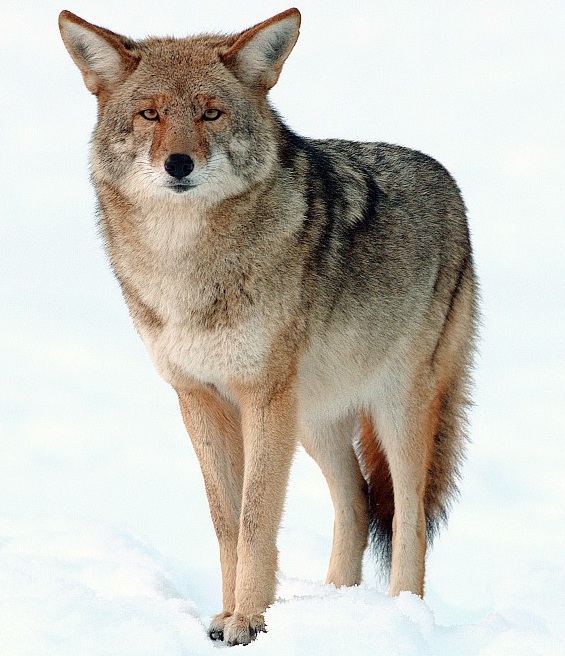
Coyotes are native to North America and inhabit environments ranging from dry tropical deciduous forests and prairies to woodlands, mountains, and urban areas. The Coyote has pointed ears, a narrow muzzle, a bushy black-tipped tail, and a coat combining gray, reddish, black, and white coloration.
Written 24 November 2026 from the sources listed below. Each statement was checked against the passage it cites; statements that could not be supported were removed.
Appearance
The Coyote typically has a coat combining light gray, reddish or fulvous, black, and white coloration. Its coat is generally grey-brown, with black-tipped hairs along the back. It has pointed ears, a narrow muzzle, and a bushy tail with a black tip.[1][2][3]
Compared with the gray wolf, the Coyote has longer ears and a relatively larger braincase. It carries its tail downward when walking or running.[4][5]
Male coyotes typically weigh between 8 and 20 kg, while females typically weigh between 7 and 18 kg. Adult coyotes have an average total body length, including the tail, of 1.0 to 1.35 m, and their tails measure approximately 40 cm.[6][7][8][9]
The average shoulder height of coyotes ranges from 18 to 23 inches. Their average weight is approximately 20 to 35 pounds according to the Jewel Cave National Monument account.[10][11]
Northern coyote subspecies average approximately 18 kg, compared with 11.5 kg for southern Mexican subspecies.[12]
Habitat
Coyotes inhabit dry tropical deciduous forests in Mexico and prairies and savannahs in the Midwestern United States. They also occupy forests, mountainous areas, high-latitude environments, rural areas, and urban environments.[13][14][15][16]
Their habitats include prairies, brushy scrublands, badlands, woodlands, and mountainous areas.[17]
Coyotes are native to North America and occur throughout North and Central America. They currently occur in every US state except Hawaii and extend as far north as the Arctic.[18][19][20]
Coyotes have expanded their geographic range by approximately 40 percent over the past 120 years. They were first sighted in eastern Panama in 2013.[21][22]
Diet
Coyotes consume deer, rabbits, hares, rodents, birds, reptiles, amphibians, fish, and invertebrates. They preferentially prey on Dall's sheep, white-tailed deer, eastern cottontail rabbits, and California voles.[23][24]
Coyotes avoid preying on small mammals, including carnivorans and arboreal species. They occasionally consume fruits and vegetables.[25][26]
Coyotes in the southern United States may consume more frogs than coyotes in other regions, while coyotes in the Yukon may consume more berries. Vegetation consumption is greatest during summer and autumn.[27][28][29]
Behaviour
Coyotes can live in family units or loosely organized packs of unrelated individuals. They may form groups of five to six adults under favorable conditions, and packs containing more than ten animals have been observed.[30][31][32]
Coyotes can hunt individually or in groups. They may establish and defend territories or survive as nonterritorial transient individuals.[33][34]
Coyotes characteristically produce howls that rapidly change in tone and pitch.[35]
Reproduction and life cycle
Coyotes have a comparatively high reproductive rate.[36]
Conservation
The Coyote is classified as Least Concern by the International Union for Conservation of Nature.[37]
Human persecution is a major cause of coyote mortality. Trapping for their pelts is one of the major causes of mortality throughout their range.[38][39]
Coyotes have expanded their range despite substantial persecution related to actual or perceived livestock predation.[40]
Classification of the Coyote
| Kingdom | Animalia |
|---|---|
| Phylum | Chordata |
| Subphylum | Vertebrata |
| Infraphylum | Gnathostomata |
| Parvphylum | Osteichthyes |
| Megaclass | Tetrapoda |
| Class | Mammalia (Mammal) |
| Subclass | Theria |
| Infraclass | Eutheria |
| Order | Carnivora (Carnivores) |
| Suborder | Caniformia (Dog-like Carnivores) |
| Family | Canidae (Dogs) |
| Genus | Canis (Dogs) |
| Species | Canis latrans Say, 1823 |
Where the Coyote is found
Checklists and occurrence records place Canis latrans in 10 countries across North America. GBIF holds 120,320 georeferenced records of it.
Countries
- Belize 9
- Canada 13,980
- Costa Rica 596
- El Salvador 14
- Guatemala 38
- Honduras 32
- Mexico 6,003
- Nicaragua 8
- Panama 37
- United States 99,603
Regions and cities with the most records
- California, United States 33,103
- Texas, United States 11,394
- Ontario, Canada 5,510
- Arizona, United States 4,173
- San Francisco, United States 3,510
- Oakland, United States 3,481
- Daly City, United States 3,359
- Glendale, United States 3,118
- Alameda, United States 3,113
- Burbank, United States 3,112
- Los Angeles, United States 3,067
- South San Francisco, United States 3,002
- Pasadena, United States 2,979
- Alhambra, United States 2,941
- Monterey Park, United States 2,824
- Alberta, Canada 2,731
- East Los Angeles, United States 2,679
- British Columbia, Canada 2,625
- New Mexico, United States 2,617
- Berkeley, United States 2,576
- Richmond, United States 2,564
- Massachusetts, United States 2,560
- Colorado, United States 2,557
- Washington, United States 2,506
- New York, United States 2,486
- Huntington Park, United States 2,278
- Oregon, United States 2,251
- Rosemead, United States 2,042
- Florence-Graham, United States 1,985
- Illinois, United States 1,976
- Wyoming, United States 1,870
- Moreno Valley, United States 1,783
- Montebello, United States 1,775
- Arcadia, United States 1,742
- Minnesota, United States 1,695
- El Monte, United States 1,636
1 more country has a few records outside this range
These countries hold a few records of Canis latrans but lie outside the range the checklists give for it. Such records are often zoo or garden specimens, museum material or vagrants, so the species is not counted as occurring there.
Range as the checklists state it
Middle America
North America
A number beside a place is its count of GBIF occurrence records. A place without a number comes from a checklist alone. Records show where a species has been observed or collected, which can include escapes and vagrants.
Common names
English
- Coyote
- American Jackal
- Black Coyote
- Brush Wolf
- Burrowing Dog
- Cased Wolf
- Cayjotte
- Cocyotie
- Eastern Coyote
- Little Wolf
- Mexican Jackal
- New World Jackal
- Northwest Coast Coyote
- Northwestern Coastal Coyote
- Prairie Wolf
- Small Wolf
- Snow Coyote
- Tweed Wolf
- White Coyote
- Yote
Names in 46 other languages
- Afrikaans
- Amerikaanse Jakkals
- Arabic
- ذئب البراري, قيوط, قيوط الساحل الشمال الغربي
- Basque
- koiote
- Belarusian
- Каёт
- Bulgarian
- Американски чакал
- Catalan
- Coiot
- Chinese
- 郊狼
- Czech
- kojot, kojot prérijní
- Esperanto
- Kojoto
- Estonian
- Ameerika Šaakal, Koiott, Preeriahunt
- Finnish
- kojootti
- French
- Coyloup de l'est, coyote
- German
- Amerikanischer Schakal, Kojote, Nordamerikanischer Präriewolf, Präriewolf, Steppenwolf
- Greek
- Κογιότ
- Hebrew
- זאב ערבות
- Hungarian
- prérifarkas
- Japanese
- アメリカジャッカル, コヨーテ
- Kazakh
- Шалғын қасқыры
- Korean
- 코요테
- Latvian
- Koijots
- Malay
- Koyote
- Norwegian Bokmål
- Prærieulv
- Polish
- Kojot Preriowy
- Portuguese
- Coiote
- Russian
- Койот
- Scottish Gaelic
- Liùgair
- Serbian
- којот
- Spanish
- Coyote
- Swedish
- Amerikansk Schakal, prärievarg
- Thai
- หมาป่าโคโยตี
- Turkish
- kır kurdu
- akz
- Ifamaɬatli
- arp
- koo'oh
- chl
- isil̃
- cho
- Nashoba Holba
- chr
- ᏧᎾᏓᏚᏗ
- esu
- Kayu
- hop
- Iisaw
- ipk
- Amaġuuraq
- lut
- sbiaw
- moh
- È:rha
- mus
- Yvhv-lanuce
- nav
- Mąʼii
- oji
- Wiisagi-ma' iingan
- was
- Géwe
- xgf
- 'iitar
Subspecies and varieties
- Canis latrans cagottis (Mexican Coyote) subspecies
- Canis latrans clepticus (San Pedro Martir Coyote) subspecies
- Canis latrans dickeyi (Salvador Coyote) subspecies
- Canis latrans frustror (South-eastern Coyote) subspecies
- Canis latrans goldmani (Belize Coyote) subspecies
- Canis latrans hondurensis (Honduras Coyote) subspecies
- Canis latrans impavidus (Durango Coyote) subspecies
- Canis latrans incolatus (Yukon Coyote) subspecies
- Canis latrans jamesi (Tiburon Island Coyote) subspecies
- Canis latrans latrans (Plains Coyote) subspecies
- Canis latrans lestes (Mountain Coyote) subspecies
- Canis latrans mearnsi (Mearns Coyote) subspecies
- Canis latrans microdon (Lower Rio Grande Coyote) subspecies
- Canis latrans ochropus (California Valley Coyote) subspecies
- Canis latrans peninsulae (Peninsula Coyote) subspecies
- Canis latrans texensis (Texan Plains Coyote) subspecies
- Canis latrans thamnos (North-eastern Coyote) subspecies
- Canis latrans umpquensis (Northwest Coast Coyote) subspecies
- Canis latrans vigilis (Colima Coyote) subspecies
Related species
- DogCanis familiaris
-
 WolfCanis lupus
-
 Golden JackalCanis aureus
- African WolfCanis lupaster
-
 Ethiopian WolfCanis simensis
- Red WolfCanis rufus
- Eastern WolfCanis lycaon
-
 Red FoxVulpes vulpes
Compare
Questions and answers
What is the scientific name of the Coyote?
The scientific name of the Coyote is Canis latrans. Written with its author, the full name is Canis latrans Say, 1823.
Which family does the Coyote belong to?
Canis latrans belongs to the family Canidae, in the order Carnivora and the class Mammalia.
Where is the Coyote found?
Checklists and occurrence records place Canis latrans in 10 countries, including United States, Canada, Mexico, Costa Rica, Guatemala and Panama.
What is the conservation status of the Coyote?
The IUCN Red List category recorded for Canis latrans is Least Concern (LC).
What other names does the Coyote have?
Canis latrans is also known in English as American Jackal, Black Coyote, Brush Wolf, Burrowing Dog, Cased Wolf and Cayjotte.
What is the Latin word for coyote?
The scientific name is Canis latrans, which translates as barking dog.[41]
Sources
Passages the profile rests on
- The coyote typically has a coat combining light gray, reddish or fulvous, black, and white coloration. Source passage: “Their fur color is predominantly light gray and red or fulvous interspersed with black and white” — English Wikipedia
- Coyotes have pointed ears, a narrow muzzle, and a bushy tail with a black tip. Source passage: “With pointed ears, a narrow muzzle, a big bushy tail with a black tip” — nps.gov
- Coyotes generally have a grey-brown coat with black-tipped hairs along their backs. Source passage: “generally coyotes can be identified by their grey-brown coat with black tipped hair on their backs” — nps.gov
- The coyote has longer ears and a relatively larger braincase than the gray wolf. Source passage: “The coyote is typically smaller than the gray wolf, but has longer ears and a relatively larger braincase” — English Wikipedia
- Coyotes carry their tails downward when walking or running. Source passage: “The coyote also carries its tail downwards when running or walking” — English Wikipedia
- Male coyotes typically weigh between 8 and 20 kg. Source passage: “The average male weighs 8 to 20 kg (18 to 44 lb)” — English Wikipedia
- Female coyotes typically weigh between 7 and 18 kg. Source passage: “the average female 7 to 18 kg (15 to 40 lb)” — English Wikipedia
- Adult coyotes have an average total body length, including the tail, of 1.0 to 1.35 m. Source passage: “Total length ranges on average from 1.0 to 1.35 m (3 ft 3 in to 4 ft 5 in)” — English Wikipedia
- The coyote's tail measures approximately 40 cm in length. Source passage: “comprising a tail length of 40 cm (16 in)” — English Wikipedia
- The average shoulder height of coyotes ranges from 18 to 23 inches. Source passage: “Height at the shoulder on average ranges from 18-23 inches” — nps.gov
- Coyotes average approximately 20 to 35 pounds in weight according to the Jewel Cave National Monument account. Source passage: “Weight averages from around 20-35 lbs.” — nps.gov
- Northern coyote subspecies average approximately 18 kg, compared with 11.5 kg for southern Mexican subspecies. Source passage: “Northern subspecies, which average 18 kg (40 lb), tend to grow larger than the southern subspecies of Mexico, which average 11.5 kg (25 lb).” — English Wikipedia
- Coyotes inhabit dry tropical deciduous forests in Mexico. Source passage: “They can persist in diverse habitats from dry tropical deciduous forests in Mexico” — pmc.ncbi.nlm.nih.gov
- Coyotes inhabit prairies and savannahs in the Midwestern United States. Source passage: “through the prairies and savannahs of the Midwest” — pmc.ncbi.nlm.nih.gov
- Coyotes occupy forests, mountainous areas, and high-latitude environments. Source passage: “to forests (Major and Sherburne 1987) into high mountains and high latitudes” — pmc.ncbi.nlm.nih.gov
- Coyotes inhabit rural and urban environments. Source passage: “and both rural and urban areas” — pmc.ncbi.nlm.nih.gov
- Coyotes occupy prairies, brushy scrublands, badlands, woodlands, and mountainous areas. Source passage: “They fit prairieland, brushy scrub country, badlands, woodlands, and mountainous areas.” — nps.gov
- Coyotes are native to North America. Source passage: “It is native to North America” — English Wikipedia
- Coyotes occur throughout North and Central America. Source passage: “They are found throughout North and Central America.” — animaldiversity.org
- Coyotes currently occur in every US state except Hawaii and extend as far north as the Arctic. Source passage: “now exist in every state in the united states except Hawaii and are found as far north as the arctic.” — nps.gov
- Coyotes have expanded their geographic range by approximately 40 percent over the past 120 years. Source passage: “Coyotes Canis latrans have expanded their geographic range by 40% in thelast 120 years” — research.fs.usda.gov
- Coyotes were first sighted in eastern Panama in 2013. Source passage: “The coyote was sighted in eastern Panama (across the Panama Canal from their home range) for the first time in 2013.” — English Wikipedia
- Coyotes preferentially prey on Dall's sheep, white-tailed deer, eastern cottontail rabbits, and California voles. Source passage: “We found that coyotes selected for Dall’s Sheep (Ovis dalli), White-tailed Deer (Odocoileus virginianus), Eastern Cottontail Rabbit (Sylvilagus floridanus), and California Vole (Microtus californicus)” — pmc.ncbi.nlm.nih.gov
- Coyotes consume deer, rabbits, hares, rodents, birds, reptiles, amphibians, fish, and invertebrates. Source passage: “its diet consists mainly of deer, rabbits, hares, rodents, birds, reptiles, amphibians, fish, and invertebrates” — English Wikipedia
- Coyotes avoid preying on small mammals, including carnivorans and arboreal species. Source passage: “coyotes avoided preying on other small mammals, including carnivorans and arboreal species.” — pmc.ncbi.nlm.nih.gov
- Coyotes occasionally consume fruits and vegetables. Source passage: “though it may also eat fruits and vegetables on occasion.” — English Wikipedia
- Coyotes in the southern United States may consume more frogs than coyotes in other regions. Source passage: “in the southern US, coyotes may eat more frogs” — nps.gov
- Coyotes in the Yukon may consume more berries. Source passage: “in the Yukon, coyotes may eat more berries.” — nps.gov
- Vegetation consumption by coyotes is greatest during summer and autumn. Source passage: “Vegetation consumption was greatest in summer and autumn.” — research.fs.usda.gov
- Coyotes can live either in family units or in loosely organized packs of unrelated individuals. Source passage: “It is highly flexible in social organization, living either in a family unit or in loosely knit packs of unrelated individuals.” — English Wikipedia
- Coyotes may form groups of five to six adults under favorable conditions. Source passage: “In the best of times, coyotes will prefer to be pack animals running in groups of 5-6 adults” — nps.gov
- Coyote packs containing more than ten animals have been observed. Source passage: “packs up 10+ animals have been noted.” — nps.gov
- Coyotes can hunt either individually or in groups. Source passage: “Coyotes can hunt in groups or as individuals across their range in North America” — pmc.ncbi.nlm.nih.gov
- Coyotes may establish and defend territories or survive as nonterritorial transient individuals. Source passage: “Coyotes can remain at sites for long periods and defend a territory, or can survive as nonterritorial transients” — pmc.ncbi.nlm.nih.gov
- Coyotes characteristically produce howls that rapidly change in tone and pitch. Source passage: “Its characteristic vocalization is a howl that changes rapidly in tone and pitch.” — English Wikipedia
- Coyotes have a comparatively high reproductive rate. Source passage: “The ability of coyotes to thrive despite human persecution reflects comparatively high reproductive rate and ecological plasticity.” — pmc.ncbi.nlm.nih.gov
- The coyote is classified as Least Concern by the International Union for Conservation of Nature. Source passage: “The coyote is listed as least concern by the International Union for Conservation of Nature” — English Wikipedia
- Human persecution is a major cause of coyote mortality. Source passage: “the main threat to coyotes over the past 150+ years has been humans.” — nps.gov
- Trapping for their pelts is one of the major causes of coyote mortality throughout their range. Source passage: “Trapping for their pelt has been and continues to be one of the greatest causes of coyote mortality across their range.” — nps.gov
- Coyotes have expanded their range despite substantial persecution related to actual or perceived livestock predation. Source passage: “This has occurred despite the species being heavily persecuted for their real or perceived predation on livestock” — pmc.ncbi.nlm.nih.gov
- The binomial name Canis latrans translates as barking dog. Source passage: “Its binomial name Canis latrans translates to "barking dog"” — English Wikipedia
Data
- Catalogue of Life, 2026-10-16 XR cc by
- Global Biodiversity Information Facility CC BY 4.0
- Wikidata CC0
- GeoNames CC BY 4.0
- Wikimedia Commons per image; credit shown with each image
- Within the Catalogue of Life, this name comes from The Integrated Taxonomic Information System cc0
References
- InJames, Account Exped. Pittsburgh to Rocky Mtns vol.1 p.168 where the name was published
- Banks, R. C., R. W. McDiarmid, and A. L. Gardner. (1987). Checklist of Vertebrates of the United States, the U.S. Territories, and Canada. Resource Publication, No. 166.
- Wilson, Don E., and DeeAnn M. Reeder, eds. (1993). Mammal Species of the World: A Taxonomic and Geographic Reference, 2nd Ed., 3rd Printing.
- Wilson, Don E., and F. Russell Cole. (2000). Common Names of Mammals of the World.
- Wilson, Don E., and DeeAnn M. Reeder, eds. (2005). Mammal Species of the World: A Taxonomic and Geographic Reference, 3rd Ed., Vols. 1 & 2.
- Sillero-Zubiri, C. / Don E. Wilson and Russell A. Mittermeier, eds. (2009). Family Canidae (Dogs). Handbook of the Mammals of the World. Vol. 1: Carnivores.
- Burgin, Connor J., Don E. Wilson, Russell A. Mittermeier, Anthony B. Rylands, et al. (2020). Illustrated Checklist of the Mammals of the World. Vol. 1. Monotremata to Rodentia.
This species in other databases
- Catalogue of Life QLXJ
- Wikidata Q44299
- iNaturalist 42051
- WoRMS urn:lsid:marinespecies.org:taxname:1506654
Page built on 24 November 2026. See how the catalog is made and all sources and licences.
Cite this page
ScientificNames.org. (2026). Canis latrans (Coyote). Retrieved November 24, 2026, from https://scientificnames.org/species/canis-latrans
“Canis latrans (Coyote).” ScientificNames.org, 2026, scientificnames.org/species/canis-latrans. Accessed 24 Nov. 2026.
ScientificNames.org. “Canis latrans (Coyote).” Accessed November 24, 2026. https://scientificnames.org/species/canis-latrans.
@misc{scientificnames_canis_latrans_coyote,
  author = {{ScientificNames.org}},
  title = {Canis latrans (Coyote)},
  year = {2026},
  url = {https://scientificnames.org/species/canis-latrans},
  note = {Accessed 2026-11-24}
}