Comparison
Philby's Partridge vs Chukar Partridge
Philby's Partridge (Alectoris philbyi) and Chukar Partridge (Alectoris chukar) both belong to the genus Alectoris (chukars) and part ways below it. Both are recorded in 3 countries.
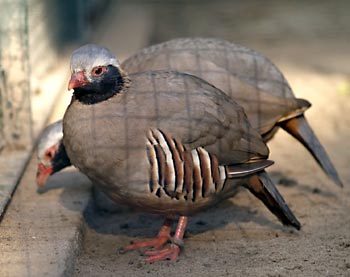
Philby's Partridge
Alectoris philbyi
F. Spangenberg (de:Benutzer:Der Irbis), CC BY-SA 3.0, via Wikimedia Commons


Chukar Partridge
Alectoris chukar
Imran Shah from Islamabad, Pakistan, CC BY-SA 2.0, via Wikimedia Commons

Side by side
| Philby's Partridge | Chukar Partridge | |
|---|---|---|
| Scientific name | Alectoris philbyi Lowe, 1934 | Alectoris chukar (J. E. Gray, 1830) |
| English name | Philby's Partridge | Chukar Partridge |
| Group | Birds | Birds |
| Class | Aves Bird | Aves Bird |
| Order | Galliformes Fowls | Galliformes Fowls |
| Family | Phasianidae Quail | Phasianidae Quail |
| Genus | Alectoris Chukars | Alectoris Chukars |
| Named in | 1934 | 1830 |
| Red List category | Least Concern | Least Concern |
| Countries on record | 4 countries | 50 countries |
| GBIF occurrence records | 366 records | 224,848 records |
Rows where the two agree are shown in grey.
Where each is found
Both recorded in 3 countries
Only Philby's Partridge (1)
Only Chukar Partridge (47)
- Afghanistan
- Armenia
- Australia
- Austria
- Azerbaijan
- Bahamas
- Belgium
- Bulgaria
- Canada
- China
- Cyprus
- Finland
- France
- Georgia
- Greece
- India
- Iran
- Iraq
- Israel
- Italy
- Jordan
- Kazakhstan
- Kyrgyzstan
- Lebanon
- Malta
- Mexico
- Mongolia
- Nepal
- New Zealand
- Norway
- Oman
- Pakistan
- Palestinian Territory
- Russia
- South Africa
- Spain
- Sweden
- Syria
- Tajikistan
- The Netherlands
- Turkey
- Turkmenistan
- Ukraine
- United Arab Emirates
- United Kingdom
- United States
- Uzbekistan
From Catalogue of Life checklists and GBIF occurrence records. A country missing from a list means no record is held, which is not proof of absence.
Checked facts
| Philby's Partridge | Chukar Partridge | |
|---|---|---|
| Appearance |
|
|
| Size |
|
|
| Habitat |
|
|
| Diet |
|
|
| Behaviour |
|
|
| Reproduction |
|
|
| Distribution |
|
|
| Conservation |
|
|
| Uses |
|
|
| Similar species |
|
|
In brief
Philby's Partridge
Alectoris philbyi is native to southwestern Saudi Arabia and northern Yemen. It is distinguished from other Alectoris species by its black cheeks and throat. Full profile
Chukar Partridge
The native range includes parts of the Middle East, Central Asia, southeastern Europe, and the western Himalayas to Nepal. It has a light brown back, grey breast, buff belly, white face, black gorget, and red legs. Full profile
Compare something else
Page built on 28 November 2026 from the data on the two species pages, where every source is listed.
Cite this page
ScientificNames.org. (2026). Philby's Partridge vs Chukar Partridge. Retrieved November 28, 2026, from https://scientificnames.org/compare/philbys-partridge-vs-chukar-partridge
“Philby's Partridge vs Chukar Partridge.” ScientificNames.org, 2026, scientificnames.org/compare/philbys-partridge-vs-chukar-partridge. Accessed 28 Nov. 2026.
ScientificNames.org. “Philby's Partridge vs Chukar Partridge.” Accessed November 28, 2026. https://scientificnames.org/compare/philbys-partridge-vs-chukar-partridge.
@misc{scientificnames_philbys_partridge_vs_chukar_partridge,
  author = {{ScientificNames.org}},
  title = {Philby's Partridge vs Chukar Partridge},
  year = {2026},
  url = {https://scientificnames.org/compare/philbys-partridge-vs-chukar-partridge},
  note = {Accessed 2026-11-28}
}