Species · Birds
Philby's Partridge Alectoris philbyi
The scientific name of the Philby's Partridge is Alectoris philbyi. It is a species of bird in the family Phasianidae (quail), order Galliformes. The name dates from 1934.
- Scientific name
- Alectoris philbyi Lowe, 1934
- Common name
- Philby's Partridge
- Genus
- Alectoris
- Family
- Phasianidae (Quail)
- Order
- Galliformes
- Class
- Aves
- Red List category
- LC Least Concern
- Recorded in
- 4 countries
- Name status
- accepted in the Catalogue of Life
Overview
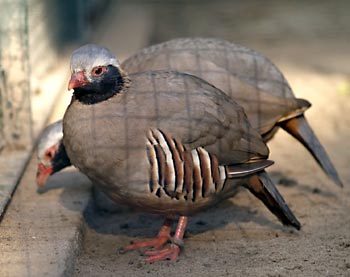
Alectoris philbyi is native to southwestern Saudi Arabia and northern Yemen. It is distinguished from other Alectoris species by its black cheeks and throat.
Written 26 November 2026 from the sources listed below. Each statement was checked against the passage it cites; statements that could not be supported were removed.
Appearance
Philby's Partridge has black cheeks and a black throat. A thin white line separates these markings from its greyish-blue head and nape.[1][2]
It has a pink beak and pink legs.[3]
Habitat
Philby's Partridge inhabits rocky slopes and sparsely vegetated land.[4][5]
It usually occurs at elevations between 1,400 and 2,700 metres.[6]
Diet
Philby's Partridge feeds on seeds, other plant material and small invertebrates.[7][8][9]
Behaviour
Philby's Partridge is a ground-dwelling bird.[10]
Reproduction and life cycle
The breeding season of Philby's Partridge extends from April through June. It lays clutches containing five to eight eggs in nests on the ground.[11][12][13]
The eggs are pale buff with pink flecking.[14]
Similar species
Philby's Partridge is related to the chukar, red-legged partridge and barbary partridges. It resembles the chukar partridge in appearance.[15][16]
Its black cheeks and throat distinguish it from other Alectoris species.[1][17]
Conservation
Philby's Partridge is classified as Least Concern by the International Union for Conservation of Nature. Its extensive geographic range is one reason for this classification, and it is considered likely to have a large total population.[18][19][20][21]
Destruction of fragile habitat in tribal areas of northern Yemen has raised concerns about the species' survival.[22]
The 2024 IUCN Red List assessment records Philby's Partridge as a recently assessed species. It was described as not currently being listed as an endangered species in the document.[23][24]
Uses
Philby's Partridge was introduced to the United States during the 1980s and is fairly common in aviculture.[25][26]
It is unlikely to become a major dietary item because it is relatively uncommon.[27]
Classification of the Philby's Partridge
| Kingdom | Animalia |
|---|---|
| Phylum | Chordata |
| Subphylum | Vertebrata |
| Infraphylum | Gnathostomata |
| Parvphylum | Osteichthyes |
| Megaclass | Tetrapoda |
| Class | Aves (Bird) |
| Order | Galliformes (Fowls) |
| Family | Phasianidae (Quail) |
| Genus | Alectoris (Chukars) |
| Species | Alectoris philbyi Lowe, 1934 |
Where the Philby's Partridge is found
Checklists and occurrence records place Alectoris philbyi in 4 countries. GBIF holds 366 georeferenced records of it.
Countries
Regions and cities with the most records
- 'Asir Region, Saudi Arabia 218
- Abha, Saudi Arabia 41
- Al Bahah Region, Saudi Arabia 37
- Al Bahah, Saudi Arabia 36
- Mecca Region, Saudi Arabia 29
- Ta’if, Saudi Arabia 25
- Ash Shafā, Saudi Arabia 20
- Al Mahwit Governorate, Yemen 16
- ‘Amrān, Yemen 15
- Sanaa Governorate, Yemen 12
- Najran Region, Saudi Arabia 8
- Najrān, Saudi Arabia 8
- Sanaa, Yemen 8
- An Nimas, Saudi Arabia 4
- Saḩar, Yemen 4
Range as the checklists state it
Europe & Northern Asia (excluding China)
A number beside a place is its count of GBIF occurrence records. A place without a number comes from a checklist alone. Records show where a species has been observed or collected, which can include escapes and vagrants.
Common names
English
- Philby's Partridge
- Philby's Rock Partridge
Names in 30 other languages
- Arabic
- حجل فيلبي
- Breton
- Klujar Philby
- Catalan
- perdiu caranegra
- Chinese
- 菲爾比氏石雞, 黑脸石鸡, 黑臉石雞
- Croatian
- crnogrla jarebica
- Czech
- orebice Philbyova
- Danish
- Sortstrubet Stenhøne
- Dutch
- Philby's Steenpatrijs
- Esperanto
- filbia perdriko
- Estonian
- mustkurk-kivikana
- Finnish
- jemeninpyy
- French
- Bartavelle de Philby, Perdrix de Philby
- German
- Philbys Steinhuhn, Philbysteinhuhn, Schwarzgesicht-Steinhuhn
- Hungarian
- Philby szirtifoglya
- Irish
- Patraisc Philbin
- Italian
- Pernice di Philby
- Japanese
- ノドグロイワシャコ
- Latvian
- Filbija irbe
- Lithuanian
- juodagurklis keklikas
- Norwegian
- svartstrupehøne
- Polish
- góropatwa czarnogardła
- Portuguese
- perdiz-de-garganta-preta, perdiz-de-papo-preto
- Russian
- Аравийский кеклик
- Serbian
- Crnolika kamenjarka
- Slovak
- kuropta púšťová
- Spanish
- Perdiz gorginegra, Perdiz gorjinegra
- Swedish
- svartstrupig berghöna
- Turkish
- Kara Boğazlı Keklik, Yemen Kınalı Kekliği
- Ukrainian
- кеклик чорногорлий
- Welsh
- petrisen graig Philby
Synonyms
One other scientific name has been used for this species and is now treated as a synonym of Alectoris philbyi.
- Alectoris philby Lowe, PR, 1934
Related species
-
 Chukar PartridgeAlectoris chukar
-
 Red-legged PartridgeAlectoris rufa
-
 Rock PartridgeAlectoris graeca
-
 Barbary PartridgeAlectoris barbara
-
 Arabian PartridgeAlectoris melanocephala
-
 Przevalski's PartridgeAlectoris magna
-
 Red JunglefowlGallus gallus
-
 Wild TurkeyMeleagris gallopavo
Compare
Questions and answers
What is the scientific name of the Philby's Partridge?
The scientific name of the Philby's Partridge is Alectoris philbyi. Written with its author, the full name is Alectoris philbyi Lowe, 1934.
Which family does the Philby's Partridge belong to?
Alectoris philbyi belongs to the family Phasianidae, in the order Galliformes and the class Aves.
Where is the Philby's Partridge found?
Checklists and occurrence records place Alectoris philbyi in 4 countries: Saudi Arabia, Yemen, Denmark and Germany.
What is the conservation status of the Philby's Partridge?
The IUCN Red List category recorded for Alectoris philbyi is Least Concern (LC).
What other names does the Philby's Partridge have?
Alectoris philbyi is also known in English as Philby's Rock Partridge.
Are there any partridges in the US?
Philby's Partridge was introduced to the United States during the 1980s.[25]
Sources
Passages the profile rests on
- Philby's Partridge has black cheeks and a black throat. Source passage: “It differs from that species in having black cheeks and throat” — English Wikipedia
- A thin white line separates the black cheeks and throat from the greyish-blue head and nape. Source passage: “a thin white line separates this from the greyish-blue head and nape.” — English Wikipedia
- Philby's Partridge has a pink beak and pink legs. Source passage: “The beak and legs are pink.” — English Wikipedia
- Philby's Partridge inhabits rocky slopes. Source passage: “It lives on rocky slopes and scantily vegetated land” — English Wikipedia
- Philby's Partridge inhabits sparsely vegetated land. Source passage: “It lives on rocky slopes and scantily vegetated land” — English Wikipedia
- Philby's Partridge usually occurs at elevations between 1,400 and 2,700 metres. Source passage: “usually at altitudes between 4,500 and 9,000 feet (1,400 and 2,700 m).” — English Wikipedia
- Philby's Partridge feeds on seeds. Source passage: “It feeds on seeds, other plant material and small invertebrates.” — English Wikipedia
- Philby's Partridge consumes plant material other than seeds. Source passage: “It feeds on seeds, other plant material and small invertebrates.” — English Wikipedia
- Philby's Partridge feeds on small invertebrates. Source passage: “It feeds on seeds, other plant material and small invertebrates.” — English Wikipedia
- Philby's Partridge is a ground-dwelling bird. Source passage: “Philby's partridge is a ground-dwelling bird.” — English Wikipedia
- The breeding season of Philby's Partridge extends from April through June. Source passage: “The breeding season lasts from April to June” — English Wikipedia
- Philby's Partridge lays clutches containing five to eight eggs. Source passage: “a clutch of five to eight eggs is laid” — English Wikipedia
- Philby's Partridge lays its eggs in nests on the ground. Source passage: “a clutch of five to eight eggs is laid in a nest on the ground.” — English Wikipedia
- The eggs of Philby's Partridge are pale buff with pink flecking. Source passage: “The eggs are pale buff flecked with pink” — English Wikipedia
- Philby's Partridge is related to the chukar, red-legged partridge and barbary partridges. Source passage: “is a relative of the chukar, red-legged partridge and barbary partridges” — inaturalist.org
- Philby's Partridge resembles the chukar partridge in appearance. Source passage: “Philby's partridge is similar in appearance to the chukar partridge” — English Wikipedia
- Philby's Partridge can be distinguished from other Alectoris species by its black cheeks and throat. Source passage: “Philby's partridge can be distinguished by its black cheeks and throat.” — English Wikipedia
- Philby's Partridge is classified as Least Concern by the International Union for Conservation of Nature. Source passage: “The International Union for Conservation of Nature has listed this species as being of "least concern"” — English Wikipedia
- The species' extensive geographic range is one reason given for its Least Concern classification. Source passage: “on the basis that it has a wide range” — English Wikipedia
- The species is considered likely to have a large total population. Source passage: “is likely to have a large total population.” — English Wikipedia
- BirdLife DataZone reports that Philby's Partridge has a large geographic range. Source passage: “This species has a large range” — datazone.birdlife.org
- Destruction of fragile habitat in tribal areas of northern Yemen has raised concerns about the species' survival. Source passage: “destruction of its fragile habitat in the tribal areas of Northern Yemen had led to concerns about the survival of this species.” — English Wikipedia
- Philby's Partridge was described as not currently being listed as an endangered species in the document. Source passage: “Although not currently listed as an endangered species” — English Wikipedia
- The 2024 IUCN Red List assessment records Philby's Partridge as a recently assessed species. Source passage: “Philby's Partridge Alectoris philbyi has most recently been assessed for The IUCN Red List of Threatened Species in 2024.” — iucnredlist.org
- Philby's Partridge was introduced to the United States during the 1980s. Source passage: “It was brought to the United States in the 1980s” — English Wikipedia
- Philby's Partridge is fairly common in aviculture. Source passage: “and is fairly common in aviculture.” — English Wikipedia
- Philby's Partridge is unlikely to become a major dietary item because it is relatively uncommon. Source passage: “However, it is relatively uncommon and is never likely to be a main dietary item.” — English Wikipedia
Data
- Catalogue of Life, 2026-10-16 XR cc by
- Global Biodiversity Information Facility CC BY 4.0
- Wikidata CC0
- GeoNames CC BY 4.0
- Wikimedia Commons per image; credit shown with each image
- Within the Catalogue of Life, this name comes from The Integrated Taxonomic Information System cc0
References
- Dickinson, Edward C., ed. (2003). The Howard and Moore Complete Checklist of the Birds of the World, 3rd Edition.
- Gill, Frank, & and Minturn Wright. (2006). Birds of the World: Recommended English Names.
- Dickinson, E. C., and J. V. Remsen Jr., eds. (2013). The Howard and Moore Complete Checklist of the Birds of the World, 4th Edition, Vol. 1 Non-Passerines.
This species in other databases
Page built on 27 November 2026. See how the catalog is made and all sources and licences.
Cite this page
ScientificNames.org. (2026). Alectoris philbyi (Philby's Partridge). Retrieved November 27, 2026, from https://scientificnames.org/species/alectoris-philbyi
“Alectoris philbyi (Philby's Partridge).” ScientificNames.org, 2026, scientificnames.org/species/alectoris-philbyi. Accessed 27 Nov. 2026.
ScientificNames.org. “Alectoris philbyi (Philby's Partridge).” Accessed November 27, 2026. https://scientificnames.org/species/alectoris-philbyi.
@misc{scientificnames_alectoris_philbyi_philbys_partridge,
  author = {{ScientificNames.org}},
  title = {Alectoris philbyi (Philby's Partridge)},
  year = {2026},
  url = {https://scientificnames.org/species/alectoris-philbyi},
  note = {Accessed 2026-11-27}
}