Comparison
Philby's Partridge vs Red-legged Partridge
Philby's Partridge (Alectoris philbyi) and Red-legged Partridge (Alectoris rufa) both belong to the genus Alectoris (chukars) and part ways below it. Both are recorded in 2 countries.
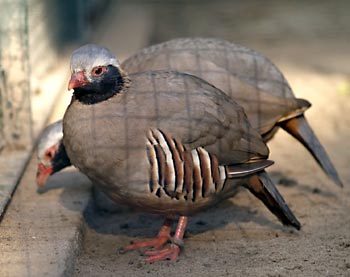
Philby's Partridge
Alectoris philbyi
F. Spangenberg (de:Benutzer:Der Irbis), CC BY-SA 3.0, via Wikimedia Commons


Side by side
| Philby's Partridge | Red-legged Partridge | |
|---|---|---|
| Scientific name | Alectoris philbyi Lowe, 1934 | Alectoris rufa (Linnaeus, 1758) |
| English name | Philby's Partridge | Red-legged Partridge |
| Group | Birds | Birds |
| Class | Aves Bird | Aves Bird |
| Order | Galliformes Fowls | Galliformes Fowls |
| Family | Phasianidae Quail | Phasianidae Quail |
| Genus | Alectoris Chukars | Alectoris Chukars |
| Named in | 1934 | 1758 |
| Red List category | Least Concern | Near Threatened |
| Countries on record | 4 countries | 23 countries |
| GBIF occurrence records | 366 records | 461,979 records |
Rows where the two agree are shown in grey.
Where each is found
Both recorded in 2 countries
Only Philby's Partridge (2)
Only Red-legged Partridge (21)
- Andorra
- Austria
- Belgium
- Czechia
- France
- Greece
- Guernsey
- Hungary
- Ireland
- Isle of Man
- Italy
- Jersey
- Norway
- Poland
- Portugal
- San Marino
- Spain
- Sweden
- Switzerland
- The Netherlands
- United Kingdom
From Catalogue of Life checklists and GBIF occurrence records. A country missing from a list means no record is held, which is not proof of absence.
Checked facts
| Philby's Partridge | Red-legged Partridge | |
|---|---|---|
| Appearance |
|
|
| Size |
| No checked fact yet |
| Habitat |
|
|
| Diet |
|
|
| Behaviour |
|
|
| Reproduction |
|
|
| Distribution |
|
|
| Conservation |
|
|
| Uses |
|
|
| Similar species |
|
|
| Other | No checked fact yet |
|
In brief
Philby's Partridge
Alectoris philbyi is native to southwestern Saudi Arabia and northern Yemen. It is distinguished from other Alectoris species by its black cheeks and throat. Full profile
Red-legged Partridge
Alectoris rufa naturally breeds in France, the Iberian Peninsula and northwestern Italy, and has become naturalised in flat areas of England and Wales. It has sandy-brown upperparts, a pale grey breast, a pinkish-buff belly, a black-streaked gorget and bold rufous and black flank markings. Full profile
Compare something else
Page built on 27 November 2026 from the data on the two species pages, where every source is listed.
Cite this page
ScientificNames.org. (2026). Philby's Partridge vs Red-legged Partridge. Retrieved November 27, 2026, from https://scientificnames.org/compare/philbys-partridge-vs-red-legged-partridge
“Philby's Partridge vs Red-legged Partridge.” ScientificNames.org, 2026, scientificnames.org/compare/philbys-partridge-vs-red-legged-partridge. Accessed 27 Nov. 2026.
ScientificNames.org. “Philby's Partridge vs Red-legged Partridge.” Accessed November 27, 2026. https://scientificnames.org/compare/philbys-partridge-vs-red-legged-partridge.
@misc{scientificnames_philbys_partridge_vs_red_legged_partridge,
  author = {{ScientificNames.org}},
  title = {Philby's Partridge vs Red-legged Partridge},
  year = {2026},
  url = {https://scientificnames.org/compare/philbys-partridge-vs-red-legged-partridge},
  note = {Accessed 2026-11-27}
}