Comparison
Red-breasted Partridge vs White-necklaced Partridge
Red-breasted Partridge (Arborophila hyperythra) and White-necklaced Partridge (Arborophila gingica) both belong to the genus Arborophila (hill-partridges) and part ways below it.


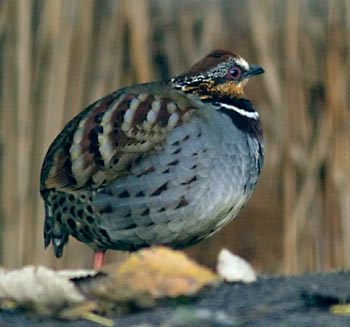
White-necklaced Partridge
Arborophila gingica
Original uploader was Der Irbis at de.wikipedia (Original text : F. Spangenberg (de:Benutzer:Der Irbis)), CC BY-SA 3.0, via Wikimedia Commons

Side by side
| Red-breasted Partridge | White-necklaced Partridge | |
|---|---|---|
| Scientific name | Arborophila hyperythra (Sharpe, 1879) | Arborophila gingica (J. F. Gmelin, 1789) |
| English name | Red-breasted Partridge | White-necklaced Partridge |
| Group | Birds | Birds |
| Class | Aves Bird | Aves Bird |
| Order | Galliformes Fowls | Galliformes Fowls |
| Family | Phasianidae Quail | Phasianidae Quail |
| Genus | Arborophila Hill-Partridges | Arborophila Hill-Partridges |
| Named in | 1879 | 1789 |
| Red List category | Least Concern | Near Threatened |
| Countries on record | 2 countries | 1 country |
| GBIF occurrence records | 3,138 records | 1,038 records |
Rows where the two agree are shown in grey.
Where each is found
Only Red-breasted Partridge (2)
Only White-necklaced Partridge (1)
From Catalogue of Life checklists and GBIF occurrence records. A country missing from a list means no record is held, which is not proof of absence.
Checked facts
| Red-breasted Partridge | White-necklaced Partridge | |
|---|---|---|
| Appearance |
|
|
| Size |
|
|
| Habitat |
|
|
| Diet |
|
|
| Behaviour |
|
|
| Reproduction |
|
|
| Distribution |
|
|
| Conservation |
|
|
| Other | No checked fact yet |
|
In brief
Red-breasted Partridge
Arborophila hyperythra is endemic to north-central Borneo, where it inhabits parts of Sabah, Sarawak, North Kalimantan and northern Central Kalimantan. It is distinguished by its bright chestnut breast, rufous cheeks and throat, and black-and-white patterned flanks. Full profile
White-necklaced Partridge
The White-necklaced Partridge is a bird in the genus Arborophila. It inhabits forests, bamboo and scrub at elevations between 150 and 1,900 m in southeastern China, with recorded distribution in Zhejiang, Jiangxi, Fujian, Guangdong and Guangxi. Adults have orange-rufous neck-sides and throat, a black gorget, a white band above the chestnut upper chest, and reddish-brown, black-spotted upperparts. Full profile
Compare something else
Page built on 27 November 2026 from the data on the two species pages, where every source is listed.
Cite this page
ScientificNames.org. (2026). Red-breasted Partridge vs White-necklaced Partridge. Retrieved November 27, 2026, from https://scientificnames.org/compare/red-breasted-partridge-vs-white-necklaced-partridge
“Red-breasted Partridge vs White-necklaced Partridge.” ScientificNames.org, 2026, scientificnames.org/compare/red-breasted-partridge-vs-white-necklaced-partridge. Accessed 27 Nov. 2026.
ScientificNames.org. “Red-breasted Partridge vs White-necklaced Partridge.” Accessed November 27, 2026. https://scientificnames.org/compare/red-breasted-partridge-vs-white-necklaced-partridge.
@misc{scientificnames_red_breasted_partridge_vs_white_necklaced_partridge,
  author = {{ScientificNames.org}},
  title = {Red-breasted Partridge vs White-necklaced Partridge},
  year = {2026},
  url = {https://scientificnames.org/compare/red-breasted-partridge-vs-white-necklaced-partridge},
  note = {Accessed 2026-11-27}
}