Species · Birds
White-necklaced Partridge Arborophila gingica
The scientific name of the White-necklaced Partridge is Arborophila gingica. It is a species of bird in the family Phasianidae (quail), order Galliformes. The name dates from 1789.
- Scientific name
- Arborophila gingica (J. F. Gmelin, 1789)
- Common name
- White-necklaced Partridge
- Genus
- Arborophila
- Family
- Phasianidae (Quail)
- Order
- Galliformes
- Class
- Aves
- Red List category
- NT Near Threatened
- Recorded in
- 1 country
- Name status
- accepted in the Catalogue of Life
Overview
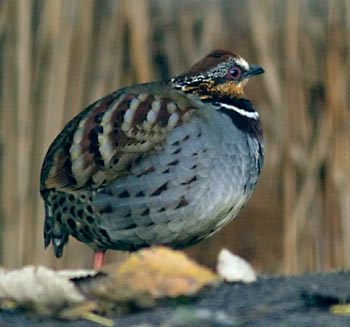
The White-necklaced Partridge is a bird in the genus Arborophila. It inhabits forests, bamboo and scrub at elevations between 150 and 1,900 m in southeastern China, with recorded distribution in Zhejiang, Jiangxi, Fujian, Guangdong and Guangxi. Adults have orange-rufous neck-sides and throat, a black gorget, a white band above the chestnut upper chest, and reddish-brown, black-spotted upperparts.
Written 26 November 2026 from the sources listed below. Each statement was checked against the passage it cites; statements that could not be supported were removed.
Appearance
Adult birds have a white forehead in the nominate subspecies, a long supercilium, orange-rufous neck-sides and throat, a black gorget, and a white band above the chestnut upper chest. Their underparts are dark grey, becoming whitish on the belly.[1][2]
The nape and back are reddish-brown with black spots, while the rump is olive-brown with black spots. The wings range in colour from greyish to buffy-brown.[3][4][5]
The species has a short grey beak, brown eyes and red legs. Females resemble males but are smaller, and juveniles have a duller breast than adults.[6][7][8]
Adults measure 25–30 cm in length and weigh approximately 253 g.[9][10]
Habitat
The White-necklaced Partridge inhabits forests, bamboo and scrub. It occurs at elevations between 150 and 1,900 m.[11][12]
The species is endemic to southeastern China. Its recorded distribution includes Zhejiang, Jiangxi, Fujian, Guangdong and Guangxi.[13][14]
Diet
The White-necklaced Partridge feeds on seeds, berries and insects.[15]
Behaviour
The species occurs in undergrowth during the day and roosts in trees.[16]
Its territorial call consists of repeated plaintive whistles, including wooop and co-qwee sounds. It calls mainly in the early morning and evening.[17][18]
Reproduction and life cycle
The breeding season extends from April to May. The species lays clutches of five to seven eggs.[19][20]
Conservation
The White-necklaced Partridge is classified as Near Threatened. Its estimated population comprises 50,000–250,000 mature birds, and its population is declining.[21][22][23]
Habitat loss caused by forest clearing, road construction and mining threatens the species. Illegal hunting is another threat.[24][25]
A captive-breeding programme for the species began in Guangzhou in 1986. The species is also classified as Near Threatened in the eBird species listing.[26][27]
Classification of the White-necklaced Partridge
| Kingdom | Animalia |
|---|---|
| Phylum | Chordata |
| Subphylum | Vertebrata |
| Infraphylum | Gnathostomata |
| Parvphylum | Osteichthyes |
| Megaclass | Tetrapoda |
| Class | Aves (Bird) |
| Order | Galliformes (Fowls) |
| Family | Phasianidae (Quail) |
| Genus | Arborophila (Hill-Partridges) |
| Species | Arborophila gingica (J. F. Gmelin, 1789) |
Where the White-necklaced Partridge is found
Checklists and occurrence records place Arborophila gingica in 1 country across Asia. GBIF holds 1,038 georeferenced records of it.
Countries
Regions and cities with the most records
- Fujian, China 686
- Fuzhou, China 264
- Zhejiang, China 137
- Guangdong, China 124
- Guangxi, China 38
- Shima, China 37
- Xiamen, China 34
- Sanming, China 20
- Jiangxi, China 16
- Licheng, China 8
- Hunan, China 7
- Nanping, China 6
- Shaowu, China 6
- Luoyang, China 5
- Quanzhou, China 4
- Ganzhou, China 3
- Jian’ou, China 3
- Jinjiang, China 3
- Ningde, China 3
2 more countries have a few records outside this range
These countries hold a few records of Arborophila gingica but lie outside the range the checklists give for it. Such records are often zoo or garden specimens, museum material or vagrants, so the species is not counted as occurring there.
Range as the checklists state it
Southern Asia
A number beside a place is its count of GBIF occurrence records. A place without a number comes from a checklist alone. Records show where a species has been observed or collected, which can include escapes and vagrants.
Common names
English
- White-necklaced Partridge
- Collared Hill Partridge
- Collared Partridge
- Rickett's Hill-partridge
- White-necklaced Hill Partridge
Names in 27 other languages
- Arabic
- حجل أبيض العنق, حجل التل المطوق
- Catalan
- perdiu forestal de Fujian
- Chinese
- 白眉山鷓鴣, 白眉山鹧鸪, 白額山鷓鴣〔白眉山鷓鴣〕
- Croatian
- bjeločela trčka
- Czech
- koroptev límcová
- Danish
- Kraveskovhøne
- Dutch
- Ricketts Bospatrijs
- Esperanto
- fuĝjana perdriko
- Estonian
- kaelus-künkakana
- Finnish
- kauluspyy
- French
- Torquéole de Sonnerat
- German
- China-Waldrebhuhn, Chinabuschwachtel, Chinesisches Waldrebhuhn
- Hungarian
- galléros hegyifogoly
- Italian
- Pernice dal collare
- Japanese
- フッケンミヤマテッケイ
- Lithuanian
- kininė krūmyninė kurapka
- Norwegian
- hvitpannehøne
- Polish
- pstropiór białoczelny
- Portuguese
- perdiz-de-fuquiém, perdiz-de-gargantilha, perdiz-montesa-de-colar
- Russian
- Китайская кустарниковая куропатка, Китайская лесная куропатка
- Serbian
- Jarebica sa belom ogrlicom
- Slovak
- kurička bieločelá
- Spanish
- Arborófila de Fujián
- Swedish
- rickettsånghöna, vitpannad sånghöna
- Turkish
- Kolyeli Dağ Kekliği
- Ukrainian
- куріпка білолоба
- Welsh
- petrisen fynydd Rickett
Synonyms
4 other scientific names have been used for this species and are now treated as synonyms of Arborophila gingica.
- Arboricola collaris Reichenow, A, 1921
- Arboricola ricketti Ogilvie-Grant, WR, 1899
- Arborophila ricketti sini Delacour, JT, 1930
- Tetrao dschindschicus Forster, JR, 1795
Subspecies and varieties
- Arborophila gingica gingica subspecies
- Arborophila gingica guangxiensis subspecies
Related species
-
 Hill PartridgeArborophila torqueola
-
 Red-billed PartridgeArborophila rubrirostris
-
 Rufous-throated PartridgeArborophila rufogularis
-
 Taiwan PartridgeArborophila crudigularis
-
 Bar-backed PartridgeArborophila brunneopectus
-
 Chestnut-breasted PartridgeArborophila mandellii
-
 Chestnut-bellied PartridgeArborophila javanica
-
 Hainan PartridgeArborophila ardens
Compare
Questions and answers
What is the scientific name of the White-necklaced Partridge?
The scientific name of the White-necklaced Partridge is Arborophila gingica. Written with its author, the full name is Arborophila gingica (J. F. Gmelin, 1789).
Which family does the White-necklaced Partridge belong to?
Arborophila gingica belongs to the family Phasianidae, in the order Galliformes and the class Aves.
Where is the White-necklaced Partridge found?
Checklists and occurrence records place Arborophila gingica in 1 country: China.
What is the conservation status of the White-necklaced Partridge?
The IUCN Red List category recorded for Arborophila gingica is Near Threatened (NT).
What other names does the White-necklaced Partridge have?
Arborophila gingica is also known in English as Collared Hill Partridge, Collared Partridge, Rickett's Hill-partridge and White-necklaced Hill Partridge.
What is the scientific name of partridge?
The scientific name of the White-necklaced Partridge is Arborophila gingica.[28][29]
What is another name for partridge?
The White-necklaced Partridge is also listed under the common name Collared Partridge by the US Fish and Wildlife Service.[30]
What do partridges eat?
The White-necklaced Partridge feeds on seeds, berries and insects.[15]
Sources
Passages the profile rests on
- Adult birds have a white forehead in the nominate subspecies, a long supercilium, orange-rufous neck-sides and throat, a black gorget, and a white band above the chestnut upper chest. Source passage: “The adult's forehead is white (in the nominate subspecies), and there is a long supercilium. The neck-sides and throat are orange-rufous. There are a black gorget and a white band above the chestnut upper chest.” — English Wikipedia
- The underparts are dark grey and become whitish on the belly. Source passage: “The underparts are dark grey, changing to whitish on the belly.” — English Wikipedia
- The nape and back are reddish-brown with black spots. Source passage: “The nape and back are reddish-brown, with black spots.” — English Wikipedia
- The rump is olive-brown with black spots. Source passage: “The rump is olive-brown and has black spots.” — English Wikipedia
- The wings range in colour from greyish to buffy-brown. Source passage: “The wings range from greyish to buffy-brown.” — English Wikipedia
- The female resembles the male but is smaller. Source passage: “The female is like the male but smaller.” — English Wikipedia
- The species has a short grey beak, brown eyes and red legs. Source passage: “The short beak is grey, the eyes are brown, and the legs are red.” — English Wikipedia
- Juvenile birds have a duller breast than adults. Source passage: “The juvenile bird has a duller breast.” — English Wikipedia
- Adults measure 25–30 cm in length. Source passage: “The white-necklaced partridge is 25–30 cm (9.8–11.8 in) long” — English Wikipedia
- The species weighs approximately 253 g. Source passage: “weighs about 253 g (8.9 oz).” — English Wikipedia
- The species inhabits forests, bamboo and scrub. Source passage: “It lives in forests, bamboo and scrub” — English Wikipedia
- The species occurs at elevations between 150 and 1,900 m. Source passage: “at elevations of 150–1,900 m (490–6,230 ft).” — English Wikipedia
- The species is endemic to southeastern China. Source passage: “It is endemic to southeastern China.” — English Wikipedia
- Its recorded distribution includes Zhejiang, Jiangxi, Fujian, Guangdong and Guangxi. Source passage: “in Zhejiang, Jiangxi, Fujian, Guangdong and Guangxi.” — English Wikipedia
- The species feeds on seeds, berries and insects. Source passage: “It eats seeds, berries and insects.” — English Wikipedia
- The species occurs in undergrowth during the day and roosts in trees. Source passage: “This partridge occurs in the undergrowth during the day and roosts in trees.” — English Wikipedia
- Its territorial call consists of repeated plaintive whistles, including wooop and co-qwee sounds. Source passage: “The territorial call is a repeated plaintive whistle, including wooop and co-qwee.” — English Wikipedia
- The species calls mainly in the early morning and evening. Source passage: “It mostly calls in the early morning and the evening.” — English Wikipedia
- The breeding season extends from April to May. Source passage: “It breeds from April to May” — English Wikipedia
- The species lays clutches of five to seven eggs. Source passage: “laying a clutch of five to seven eggs.” — English Wikipedia
- The species is classified as Near Threatened. Source passage: “it is currently assessed as a near-threatened species.” — English Wikipedia
- The estimated population comprises 50,000–250,000 mature birds. Source passage: “The population size is estimated at 50,000–250,000 mature birds.” — English Wikipedia
- The species' population is declining. Source passage: “Because of these threats, the population is declining.” — English Wikipedia
- Habitat loss caused by forest clearing, road construction and mining threatens the species. Source passage: “The species is threatened by habitat loss caused by forest clearing, construction of roads and mining.” — English Wikipedia
- Illegal hunting is another threat to the species. Source passage: “It is also hunted illegally.” — English Wikipedia
- A captive-breeding programme for the species began in Guangzhou in 1986. Source passage: “A programme to breed the species in captivity began at Guangzhou in 1986.” — English Wikipedia
- The species is classified as Near Threatened in the eBird species listing. Source passage: “Phasianidae White-necklaced Partridge Arborophila gingica NT Near Threatened.” — ebird.org
- Johann Friedrich Gmelin formally described the species in 1789 under the scientific name Tetrao gingicus. Source passage: “He placed it with the other partridge like birds in the genus Tetrao and coined the binomial name Tetrao gingicus.” — English Wikipedia
- The species is placed in the genus Arborophila. Source passage: “The white-necklaced partridge is now one of around twenty species placed in the genus Arborophila” — English Wikipedia
- The species is listed under the common name Collared Partridge by the US Fish and Wildlife Service. Source passage: “Common Name Collared Partridge Collared Hill Partridge White-necklaced Partridge” — fws.gov
Data
- Catalogue of Life, 2026-10-16 XR cc by
- Global Biodiversity Information Facility CC BY 4.0
- Wikidata CC0
- GeoNames CC BY 4.0
- Wikimedia Commons per image; credit shown with each image
- Within the Catalogue of Life, this name comes from The Integrated Taxonomic Information System cc0
References
- Dickinson, Edward C., ed. (2003). The Howard and Moore Complete Checklist of the Birds of the World, 3rd Edition.
- Gill, Frank, & and Minturn Wright. (2006). Birds of the World: Recommended English Names.
- Dickinson, E. C., and J. V. Remsen Jr., eds. (2013). The Howard and Moore Complete Checklist of the Birds of the World, 4th Edition, Vol. 1 Non-Passerines.
This species in other databases
Page built on 28 November 2026. See how the catalog is made and all sources and licences.
Cite this page
ScientificNames.org. (2026). Arborophila gingica (White-necklaced Partridge). Retrieved November 28, 2026, from https://scientificnames.org/species/arborophila-gingica
“Arborophila gingica (White-necklaced Partridge).” ScientificNames.org, 2026, scientificnames.org/species/arborophila-gingica. Accessed 28 Nov. 2026.
ScientificNames.org. “Arborophila gingica (White-necklaced Partridge).” Accessed November 28, 2026. https://scientificnames.org/species/arborophila-gingica.
@misc{scientificnames_arborophila_gingica_white_necklaced_partridge,
  author = {{ScientificNames.org}},
  title = {Arborophila gingica (White-necklaced Partridge)},
  year = {2026},
  url = {https://scientificnames.org/species/arborophila-gingica},
  note = {Accessed 2026-11-28}
}