Comparison

Arogos Skipper vs Silver-spotted Skipper

Arogos Skipper (Atrytone arogos) and Silver-spotted Skipper (Epargyreus clarus) both belong to the family Hesperiidae (skipper) and part ways below it. Both are recorded in 2 countries.

Arogos Skipper

Arogos Skipper

Atrytone arogos

ALAN SCHMIERER, CC0, via Wikimedia Commons

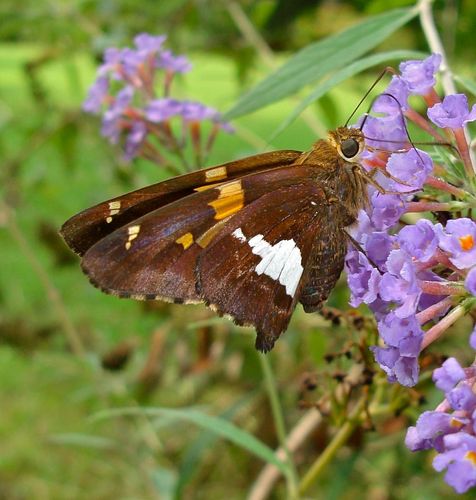
Silver-spotted Skipper

Silver-spotted Skipper

Epargyreus clarus

no rights reserved, uploaded by Elin Pierce, CC0, via iNaturalist

Side by side

Arogos SkipperSilver-spotted Skipper
Scientific nameAtrytone arogos (Boisduval & Le Conte, 1833)Epargyreus clarus (Cramer, 1775)
English nameArogos SkipperSilver-spotted Skipper
GroupInsectsInsects
ClassInsecta InsectInsecta Insect
OrderLepidopteraLepidoptera
FamilyHesperiidae SkipperHesperiidae Skipper
GenusAtrytoneEpargyreus Silverdrops
Named in18331775
Red List categoryEndangeredNot recorded
Countries on record2 countries3 countries
GBIF occurrence records1,602 records100,908 records

Rows where the two agree are shown in grey.

Where each is found

Both recorded in 2 countries

Only Silver-spotted Skipper (1)

From Catalogue of Life checklists and GBIF occurrence records. A country missing from a list means no record is held, which is not proof of absence.

Checked facts

Arogos SkipperSilver-spotted Skipper
Appearance
  • Adult Arogos Skippers have yellow wings with dark blackish-brown borders. English Wikipedia
  • The undersides of the wings are paler yellow than their upper surfaces. English Wikipedia
  • Male Arogos Skippers have narrower black wing borders than females. English Wikipedia
  • Adult eastern Arogos Skippers have triangular-shaped, golden-orange wings. floridamuseum.ufl.edu
  • Adult Arogos Skippers have white veins along the outer portions of their hindwings. ou.edu
  • The outer rims of both pairs of wings have grey or white fringes. ou.edu
Size
  • The reported wingspan of the adult butterfly ranges from 2.9 to 3.7 cm. English Wikipedia
Habitat
  • The species inhabits grasslands and prairies. English Wikipedia
  • The species also occurs in flatwoods and pine savannas. English Wikipedia
  • Eastern Arogos Skippers occupy open, grassy landscapes. floridamuseum.ufl.edu
  • The species uses lopsided Indiangrass (Sorghastrum secundum) as a larval host plant in central Florida. floridamuseum.ufl.edu
  • In Oklahoma, big bluestem is the principal larval host plant of the species. ou.edu
  • Oklahoma Arogos Skipper larvae occasionally use little bluestem as a host plant. ou.edu
  • The species inhabits fields, gardens, and forest edges. English Wikipedia
  • The species prefers open habitats containing nectar plants, including swamps, brushy areas, and riparian habitats at lower elevations. English Wikipedia
  • In the western part of its range, the species occurs primarily in mountainous locations. animaldiversity.org
Diet
  • Arogos Skipper caterpillars feed on leaves. English Wikipedia
  • Larvae feed on big bluestem, Panicum, and Calamovilfa brevipilis, among other grasses. English Wikipedia
  • Adult Arogos Skippers obtain nectar from purple vetch, Canada thistle, dogbane, stiff coreopsis, purple coneflower, green milkweed, and ox-eye daisy. English Wikipedia
  • Larvae consume leaves of plants belonging to the pea family, Fabaceae. English Wikipedia
  • Recorded larval host plants include false indigobush, American hogpeanut, groundnut, and American wisteria. English Wikipedia
  • Larvae have also been recorded feeding on kudzu, black locust, and Chinese wisteria. animaldiversity.org
  • Adults feed on nectar from various flowers, as well as mud and animal feces. English Wikipedia
  • Adults favor blue, red, pink, and purple flowers and rarely visit yellow flowers. English Wikipedia
  • Recorded adult food plants include everlasting pea, common milkweed, red clover, buttonbush, blazing star, and thistles. English Wikipedia
Behaviour
  • Male eastern Arogos Skippers perch on low vegetation near host plants while seeking females. English Wikipedia
  • Larvae construct leaf shelters using silk and may connect multiple leaves to form larger shelters. animaldiversity.org
  • Larvae generally leave their shelters only to feed or construct larger shelters. animaldiversity.org
  • Larvae can eject their waste as a defensive behaviour to reduce the attraction of parasitic wasps. animaldiversity.org
  • Threatened larvae regurgitate a greenish defensive chemical. English Wikipedia
Reproduction
  • The species undergoes five larval instar stages during development. English Wikipedia
  • Arogos Skippers overwinter as caterpillars and remain dormant until spring. ou.edu
  • After overwintering, the caterpillars complete pupation inside cocoons constructed with leaves. ou.edu
  • The species' cocoons occur in vegetation approximately three feet above the ground. ou.edu
  • Two generations occur during the growing season in the southern half of the North American Great Plains. ou.edu
  • Females generally deposit one egg on or occasionally near a host plant. English Wikipedia
  • Females have been recorded laying eggs on least snoutbean. English Wikipedia
  • Each copulation results in a female receiving a spermatophore from the male. English Wikipedia
  • After mating, females appear to reject additional males for at least some time. English Wikipedia
  • The species produces one generation annually in northern and western regions, two in eastern regions, and three to four in the Deep South. English Wikipedia
  • The last generation of the year overwinters in the pupal stage. animaldiversity.org
Distribution
  • The species occurs in the eastern and midwestern United States. English Wikipedia
  • The species has isolated populations in peninsular Florida, the Gulf Coast, southeastern North Dakota, southern Texas, and the Colorado Front Range. English Wikipedia
  • The species ranges from southern Canada through most of the United States to northern Mexico, excluding the Great Basin and western Texas. English Wikipedia
  • The species occurs throughout the United States and in southern Canada. animaldiversity.org
Conservation
  • The Arogos Skipper is classified as an endangered butterfly species in document 1. English Wikipedia
  • Habitat loss caused by expanding agriculture and urban development has reduced the species' available habitat. floridamuseum.ufl.edu
  • The Bull Creek population in central Florida is one of the remaining populations in the state. floridamuseum.ufl.edu
  • At Bull Creek, prescribed burns are conducted on a three-year cycle using smaller burn units to provide refuges for the butterfly. floridamuseum.ufl.edu
  • The North American tallgrass prairie has lost approximately 86% of its original continental extent. ou.edu
No checked fact yet
UsesNo checked fact yet
Similar species
  • The Delaware Skipper resembles the Arogos Skipper in appearance and is closely related to it. ou.edu

In brief

Arogos Skipper

The species occurs in the eastern and midwestern United States, with isolated populations in several areas. Adult Arogos Skippers have yellow wings with dark blackish-brown borders, white hindwing veins, and grey or white wing fringes. Full profile

Silver-spotted Skipper

Epargyreus clarus inhabits fields, gardens, forest edges, swamps, brushy areas, and riparian habitats at lower elevations. Full profile

Compare something else

Page built on 29 November 2026 from the data on the two species pages, where every source is listed.

Cite this page

ScientificNames.org. (2026). Arogos Skipper vs Silver-spotted Skipper. Retrieved November 29, 2026, from https://scientificnames.org/compare/arogos-skipper-vs-silver-spotted-skipper