| Appearance | - The short-eared dog has a large, fox-like head, rounded short ears, relatively short legs, and a long bushy tail. animaldiversity.org
- Its coat is thick and sleek, with dark brown, black, or gray coloration that fades to dull reddish-brown underneath. animaldiversity.org
- Its coat markings include a narrow black collar and a dark band extending along the back and tail. animaldiversity.org
- The species has a partial interdigital membrane on its paws. animaldiversity.org
- Its eyes have a reflective tapetum lucidum that is particularly visible in low-light conditions. animaldiversity.org
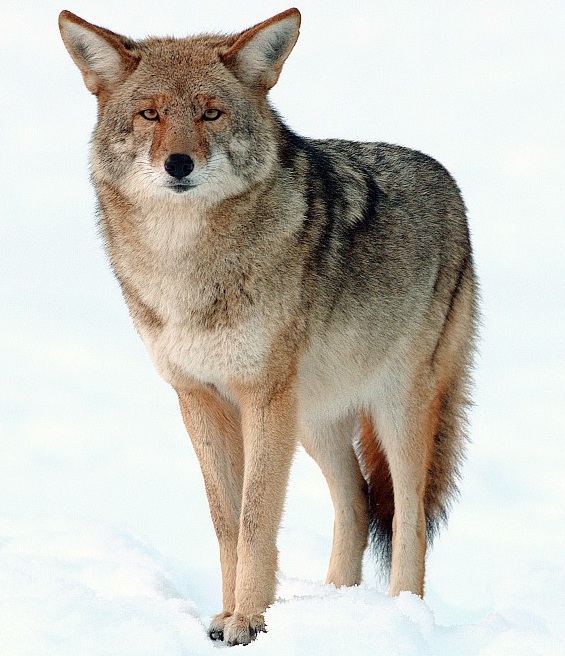
| - The coyote typically has a coat combining light gray, reddish or fulvous, black, and white coloration. English Wikipedia
- Coyotes have pointed ears, a narrow muzzle, and a bushy tail with a black tip. nps.gov
- Coyotes generally have a grey-brown coat with black-tipped hairs along their backs. nps.gov
- The coyote has longer ears and a relatively larger braincase than the gray wolf. English Wikipedia
- Coyotes carry their tails downward when walking or running. English Wikipedia
|
|---|
| Size | - The short-eared dog is a mid-sized canid and is relatively large compared with related South American foxes. animaldiversity.org
| - Male coyotes typically weigh between 8 and 20 kg. English Wikipedia
- Female coyotes typically weigh between 7 and 18 kg. English Wikipedia
- Adult coyotes have an average total body length, including the tail, of 1.0 to 1.35 m. English Wikipedia
- The coyote's tail measures approximately 40 cm in length. English Wikipedia
- The average shoulder height of coyotes ranges from 18 to 23 inches. nps.gov
- Coyotes average approximately 20 to 35 pounds in weight according to the Jewel Cave National Monument account. nps.gov
- Northern coyote subspecies average approximately 18 kg, compared with 11.5 kg for southern Mexican subspecies. English Wikipedia
|
|---|
| Habitat | - The species prefers undisturbed lowland rainforests in the Amazon region. animaldiversity.org
- Its recorded habitats include terra firme forest, swamp forest, bamboo stands, and primary succession areas along rivers. animaldiversity.org
- The species has been sighted in lowland forest bordering savanna. animaldiversity.org
- Individuals have been observed swimming in rivers, with tracks frequently recorded along riverbanks and creeks. animaldiversity.org
- The species is rarely recorded in areas with substantial human activity or disturbance. animaldiversity.org
| |
|---|
| Diet | | - Coyotes preferentially prey on Dall's sheep, white-tailed deer, eastern cottontail rabbits, and California voles. pmc.ncbi.nlm.nih.gov
- Coyotes avoid preying on small mammals, including carnivorans and arboreal species. pmc.ncbi.nlm.nih.gov
- Coyotes consume deer, rabbits, hares, rodents, birds, reptiles, amphibians, fish, and invertebrates. English Wikipedia
- Coyotes occasionally consume fruits and vegetables. English Wikipedia
- Coyotes in the southern United States may consume more frogs than coyotes in other regions. nps.gov
- Coyotes in the Yukon may consume more berries. nps.gov
- Vegetation consumption by coyotes is greatest during summer and autumn. research.fs.usda.gov
|
|---|
| Behaviour | - The species has also been photographed walking and swimming at night. animaldiversity.org
- Threatened individuals may growl, bare their teeth, and attempt to bite. animaldiversity.org
- Males produce a strong musky odor from their anal glands when startled or threatened. animaldiversity.org
- Excited individuals may erect the hairs at the tip of their tails. animaldiversity.org
- Females with pups have been observed defending their young aggressively against domestic dogs. animaldiversity.org
| - Coyotes can live either in family units or in loosely organized packs of unrelated individuals. English Wikipedia
- Coyotes can hunt either individually or in groups. pmc.ncbi.nlm.nih.gov
- Coyotes may form groups of five to six adults under favorable conditions. nps.gov
- Coyote packs containing more than ten animals have been observed. nps.gov
- Coyotes may establish and defend territories or survive as nonterritorial transient individuals. pmc.ncbi.nlm.nih.gov
- Coyotes characteristically produce howls that rapidly change in tone and pitch. English Wikipedia
|
|---|
| Reproduction | - Adults have been observed with two or three pups in dens located in hollow logs or paca burrows. animaldiversity.org
- Females have been observed with pups on rare occasions. animaldiversity.org
- Female short-eared dogs provide substantial parental investment through gestation and lactation. animaldiversity.org
| |
|---|
| Distribution | - The species is native to northern South America and occurs in the Amazon basin regions of Brazil, Peru, Ecuador, and Colombia. animaldiversity.org
- The species is recorded in Bolivia, Brazil, Colombia, Ecuador, and Peru. iucnredlist.org
| - Coyotes are native to North America. English Wikipedia
- Coyotes occur throughout North and Central America. animaldiversity.org
- Coyotes have expanded their geographic range by approximately 40 percent over the past 120 years. research.fs.usda.gov
- Coyotes currently occur in every US state except Hawaii and extend as far north as the Arctic. nps.gov
- Coyotes were first sighted in eastern Panama in 2013. English Wikipedia
|
|---|
| Conservation | - The species faces a continuing decline in the number of mature individuals. iucnredlist.org
- The species faces a continuing decline in the area, extent, or quality of its habitat. iucnredlist.org
- Invasive species and diseases are identified as threats to the short-eared dog. iucnredlist.org
- The species occurs in at least one protected area. iucnredlist.org
- Conservation sites have been identified throughout the species' range. iucnredlist.org
- Feral dogs threaten the species by facilitating the transmission of canine distemper and rabies. English Wikipedia
- Habitat degradation and tropical rainforest destruction threaten the species. English Wikipedia
| - The coyote is classified as Least Concern by the International Union for Conservation of Nature. English Wikipedia
- Human persecution is a major cause of coyote mortality. nps.gov
- Trapping for their pelts is one of the major causes of coyote mortality throughout their range. nps.gov
- Coyotes have expanded their range despite substantial persecution related to actual or perceived livestock predation. pmc.ncbi.nlm.nih.gov
|
|---|
| Similar species | - The crab-eating fox is identified as the closest living relative of the short-eared dog. English Wikipedia
| No checked fact yet |
|---|
| Name origin | No checked fact yet | |
|---|
| Other | - The short-eared dog is the only species assigned to the genus Atelocynus. English Wikipedia
| No checked fact yet |
|---|