Comparison
Green Bush Viper vs Ashe's Bush Viper
Green Bush Viper (Atheris chlorechis) and Ashe's Bush Viper (Atheris desaixi) both belong to the genus Atheris (african bush vipers) and part ways below it.

Green Bush Viper
Atheris chlorechis
The original uploader was Dawson at English Wikipedia., CC BY-SA 2.5, via Wikimedia Commons

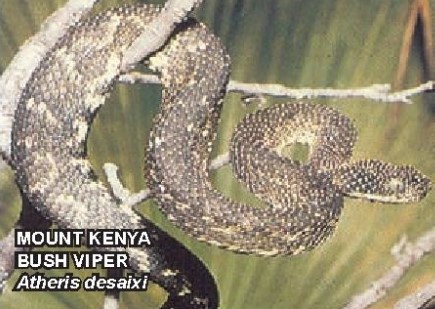
Ashe's Bush Viper
Atheris desaixi
United States Army Center for Health Promotion and Preventive Medicine, Public domain, via Wikimedia Commons

Side by side
| Green Bush Viper | Ashe's Bush Viper | |
|---|---|---|
| Scientific name | Atheris chlorechis (Pel, 1852) | Atheris desaixi Ashe, 1968 |
| English name | Green Bush Viper | Ashe's Bush Viper |
| Group | Reptiles | Reptiles |
| Class | Reptilia Reptile | Reptilia Reptile |
| Order | Squamata Snakes | Squamata Snakes |
| Family | Viperidae Viper | Viperidae Viper |
| Genus | Atheris African Bush Vipers | Atheris African Bush Vipers |
| Named in | 1852 | 1968 |
| Red List category | Least Concern | Endangered |
| Countries on record | 8 countries | 1 country |
| GBIF occurrence records | 213 records | 55 records |
Rows where the two agree are shown in grey.
Where each is found
Only Green Bush Viper (8)
Only Ashe's Bush Viper (1)
From Catalogue of Life checklists and GBIF occurrence records. A country missing from a list means no record is held, which is not proof of absence.
Checked facts
| Green Bush Viper | Ashe's Bush Viper | |
|---|---|---|
| Appearance |
|
|
| Size | No checked fact yet |
|
| Habitat |
|
|
| Diet |
|
|
| Behaviour | No checked fact yet |
|
| Reproduction |
|
|
| Distribution |
|
|
| Conservation | No checked fact yet |
|
| Other |
| No checked fact yet |
In brief
Green Bush Viper
The Green bush viper is a venomous species and the type species of the genus Atheris. It inhabits forests in West Africa. Adults have a uniform light green coloration with faint yellow paired spots along the back and heavily keeled dorsal scales. Full profile
Ashe's Bush Viper
Atheris desaixi is endemic to Kenya, where it occurs in two isolated populations near Chuka on southeastern Mount Kenya and near Igembe in the northern Nyambeni range. Adults have a greenish-black to charcoal-black body with yellow or yellowish-green speckled scale tips. Full profile
Compare something else
Page built on 27 November 2026 from the data on the two species pages, where every source is listed.
Cite this page
ScientificNames.org. (2026). Green Bush Viper vs Ashe's Bush Viper. Retrieved November 27, 2026, from https://scientificnames.org/compare/green-bush-viper-vs-ashes-bush-viper
“Green Bush Viper vs Ashe's Bush Viper.” ScientificNames.org, 2026, scientificnames.org/compare/green-bush-viper-vs-ashes-bush-viper. Accessed 27 Nov. 2026.
ScientificNames.org. “Green Bush Viper vs Ashe's Bush Viper.” Accessed November 27, 2026. https://scientificnames.org/compare/green-bush-viper-vs-ashes-bush-viper.
@misc{scientificnames_green_bush_viper_vs_ashes_bush_viper,
  author = {{ScientificNames.org}},
  title = {Green Bush Viper vs Ashe's Bush Viper},
  year = {2026},
  url = {https://scientificnames.org/compare/green-bush-viper-vs-ashes-bush-viper},
  note = {Accessed 2026-11-27}
}