Species · Reptiles
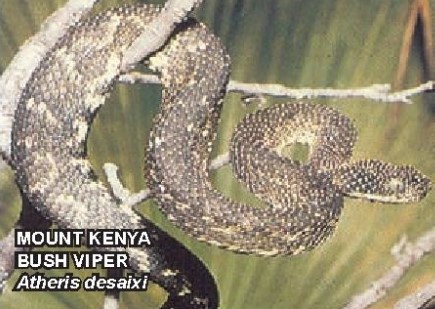
Mt Kenya Bush Viper Atheris desaixi
The scientific name of the Mt Kenya Bush Viper is Atheris desaixi. It is a species of reptile in the family Viperidae (viper), order Squamata. The name dates from 1968.
Overview
Atheris desaixi, commonly known as the Mount Kenya bush viper, Ashe's bush viper, or Desaix's bush viper, is a venomous species of viper endemic to Kenya, where only two isolated populations are known. It is known for its striking black and yellow coloration. No subspecies are currently recognized.
Classification of the Mt Kenya Bush Viper
| Kingdom | Animalia |
|---|---|
| Phylum | Chordata |
| Subphylum | Vertebrata |
| Infraphylum | Gnathostomata |
| Parvphylum | Osteichthyes |
| Megaclass | Tetrapoda |
| Class | Reptilia (Reptile) |
| Order | Squamata (Snakes) |
| Suborder | Serpentes (Snakes) |
| Infraorder | Alethinophidia |
| Family | Viperidae (Viper) |
| Subfamily | Viperinae |
| Genus | Atheris (African Bush Vipers) |
| Species | Atheris desaixi Ashe, 1968 |
Where the Mt Kenya Bush Viper is found
Checklists and occurrence records place Atheris desaixi in 1 country across Africa. GBIF holds 55 georeferenced records of it.
Countries
Regions and cities with the most records
- Chuka, Kenya 10
- Tharaka - Nithi, Kenya 10
- Meru County, Kenya 6
- Samburu County, Kenya 5
- Maua, Kenya 3
Range as the checklists state it
Kenya
A number beside a place is its count of GBIF occurrence records. A place without a number comes from a checklist alone. Records show where a species has been observed or collected, which can include escapes and vagrants.
Common names
English
- Mt Kenya Bush Viper
- Ashe's Bush Viper
- Desaix's Bush Viper
- Mount Kenya Bush Viper
- Mt. Kenya Bush Viper
Names in 3 other languages
- Chinese
- 肯亞樹蝰
- German
- Mount-Kenya-Buschviper
- Russian
- Кустарниковая гадюка
Related species
-
 African Hairy Bush ViperAtheris hispida
-
 African Bush ViperAtheris squamigera
-
 Green Bush ViperAtheris chlorechis
-
 Great Lakes Bush ViperAtheris nitschei
- Katanga Mountain Bush ViperAtheris katangensis
-
 Uzungwe Mountain Bush ViperAtheris barbouri
- Matilda's Horned ViperAtheris matildae
-
 Broadley’s Bush ViperAtheris broadleyi
Compare
Questions and answers
What is the scientific name of the Mt Kenya Bush Viper?
The scientific name of the Mt Kenya Bush Viper is Atheris desaixi. Written with its author, the full name is Atheris desaixi Ashe, 1968.
Which family does the Mt Kenya Bush Viper belong to?
Atheris desaixi belongs to the family Viperidae, in the order Squamata and the class Reptilia.
Where is the Mt Kenya Bush Viper found?
Checklists and occurrence records place Atheris desaixi in 1 country: Kenya.
What is the conservation status of the Mt Kenya Bush Viper?
The IUCN Red List category recorded for Atheris desaixi is Endangered (EN).
What other names does the Mt Kenya Bush Viper have?
Atheris desaixi is also known in English as Ashe's Bush Viper, Desaix's Bush Viper, Mount Kenya Bush Viper and Mt. Kenya Bush Viper.
Sources
Data
- Catalogue of Life, 2026-10-16 XR cc by
- Global Biodiversity Information Facility CC BY 4.0
- Wikidata CC0
- English Wikipedia CC BY-SA 4.0
- GeoNames CC BY 4.0
- Wikimedia Commons per image; credit shown with each image
- Within the Catalogue of Life, this name comes from The Reptile Database cc by
References
- Ashe, J. (1968). A new Bush Viper. J. E. Afr. Nat. Hist. Soc. Natn. Mus. 27 (1): 53-59.
- Spawls, S. (1990). Further comments on Atheris. British Herpetological Society Bulletin 34: 44-45.
- Broadley, D. G. (1998). A review of the genus Atheris Cope (Serpentes: Viperidae), with the description of a new species from Uganda. The Herpetological Journal 8: 117-135.
- Meidinger, & Robert. (1998). Erstnachzucht von Atheris desaixi Ashe, 1968, Mount-Kenya-Buschviper. Elaphe 6 (3): 15-17.
- Joger, U., & Courage, K. (1999). Are palearctic ‘rattlesnakes’ (Echis and Cerastes) monophyletic? Kaupia (Darmstadt) (8): 65-81.
- McDiarmid, R.W.; Campbell, J.A. & Touré,T.A. (1999). Snake species of the world. Vol. 1. [type catalogue]. Herpetologists’ League, 511 Pp.
- Herrmann, H. W.; Joger, U.; Lenk, P. & Wink, M. (1999). Morphological and molecular phylogenies of viperines: conflicting evidence? Kaupia (Darmstadt) (8): 21-30.
- Ernst, R., & Rödel, M. O. (2002). A new Atheris species (Serpentes: Viperidae), from Taï National Park, Ivory Coast. The Herpetological Journal 12: 55-61.
- Spawls, S.; Howell, K.; Drewes, R.C. & Ashe, J. (2002). A field guide to the reptiles of East Africa. Academic Press, 543 Pp. [Reviews in HR 34: 396 and Afr. J. Herp. 51; 147].
- Mallow, D. Ludwig, D. & Nilson, G. (2003). True Vipers: Natural History and Toxinology of Old World Vipers. Krieger, Malabar, Florida, 410 Pp. [Review in HR 35: 200, Reptilia 35: 74].
- Dobiey, M., & Vogel, G. (2007). Venomous Snakes of Africa - Giftschlangen Afrikas. Edition Chimaira, Terralog 15, 150 Pp.
- Phelps, T. (2010). Old World Vipers. Edition Chimaira, Frankfurt, 558 Pp. [Critical Review in Sauria 33 (3): 19 and HR 43: 503].
- Beolens, B., & Michael Watkins, a. M. G. (2011). The Eponym Dictionary of Reptiles. Johns Hopkins University Press, Baltimore, USA.
- Laita, & Mark. (2013). Serpentine. Abrams and PQ Blackwell, Auckland, New Zealand, 200 Unnumbered Pages.
- Menegon, M.; Loader, S.P.; Marsden, S.J.; Branch, W.R.; Davenport, T.R.B. & Ursenbacher, S. (2014). The genus Atheris (Serpentes: Viperidae) in East Africa: Phylogeny and the role of rifting and climate in shaping the current pattern of species diversity. Molecular Phylogenetics and Evolution 79: 12-22.
- Wallach, Van; Kenneth L. Williams, Jeff Boundy. (2014). Snakes of the World: A Catalogue of Living and Extinct Species. [type catalogue]. Taylor and Francis, CRC Press, 1237 Pp.
- Spawls, Steve; Kim Howell, Harald Hinkel, Michele Menegon. (2018). Field Guide to East African Reptiles. Bloomsbury, 624 Pp.
- Spawls, S., & Branch, B. (2020). The Dangerous Snakes of Africa. Bloomsbury, London, 336 Pp.
- Węgrzyn, K., Pauwels, O. S., Brecko, J., & Georgalis, G. L. (2024). Vertebral morphology and intracolumnar variation of the iconic African viperid snake Atheris (Serpentes, Viperidae). The Anatomical Record.
This species in other databases
Page built on 26 November 2026. See how the catalog is made and all sources and licences.
Cite this page
ScientificNames.org. (2026). Atheris desaixi (Mt Kenya Bush Viper). Retrieved November 26, 2026, from https://scientificnames.org/species/atheris-desaixi
“Atheris desaixi (Mt Kenya Bush Viper).” ScientificNames.org, 2026, scientificnames.org/species/atheris-desaixi. Accessed 26 Nov. 2026.
ScientificNames.org. “Atheris desaixi (Mt Kenya Bush Viper).” Accessed November 26, 2026. https://scientificnames.org/species/atheris-desaixi.
@misc{scientificnames_atheris_desaixi_mt_kenya_bush_viper,
  author = {{ScientificNames.org}},
  title = {Atheris desaixi (Mt Kenya Bush Viper)},
  year = {2026},
  url = {https://scientificnames.org/species/atheris-desaixi},
  note = {Accessed 2026-11-26}
}