Comparison

Ashe's Bush Viper vs African Bush Viper

Ashe's Bush Viper (Atheris desaixi) and African Bush Viper (Atheris squamigera) both belong to the genus Atheris (african bush vipers) and part ways below it. Both are recorded in 1 country.
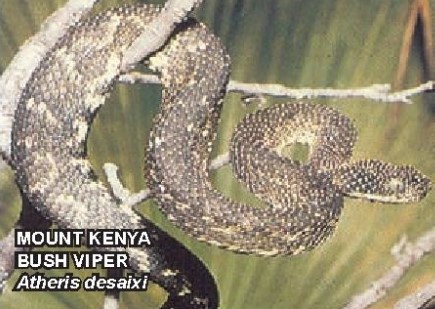
Ashe's Bush Viper

Ashe's Bush Viper

Atheris desaixi

United States Army Center for Health Promotion and Preventive Medicine, Public domain, via Wikimedia Commons

African Bush Viper

African Bush Viper

Atheris squamigera

Esquilo, CC BY-SA 3.0, via Wikimedia Commons

Side by side

Ashe's Bush ViperAfrican Bush Viper
Scientific nameAtheris desaixi Ashe, 1968Atheris squamigera Hallowell, 1854
English nameAshe's Bush ViperAfrican Bush Viper
GroupReptilesReptiles
ClassReptilia ReptileReptilia Reptile
OrderSquamata SnakesSquamata Snakes
FamilyViperidae ViperViperidae Viper
GenusAtheris African Bush VipersAtheris African Bush Vipers
Named in19681854
Red List categoryEndangeredLeast Concern
Countries on record1 country12 countries
GBIF occurrence records55 records874 records

Rows where the two agree are shown in grey.

Where each is found

Both recorded in 1 country

Only African Bush Viper (11)

From Catalogue of Life checklists and GBIF occurrence records. A country missing from a list means no record is held, which is not proof of absence.

Checked facts

Ashe's Bush ViperAfrican Bush Viper
Appearance
  • Adults have a greenish-black to charcoal-black body with yellow or yellowish-green scale tips that create a speckled appearance. English Wikipedia
  • Some yellowish markings form loops along the sides of the body, which may merge into zigzag patterns toward the rear. English Wikipedia
  • The underside is yellow or yellowish toward the front and becomes purplish-black toward the rear and beneath the tail. English Wikipedia
  • Juveniles are predominantly yellow and have a white-tipped tail. English Wikipedia
  • The dorsal scales are short and heavily keeled. English Wikipedia
  • The eyes are positioned well forward on the head. English Wikipedia
  • The species has a broad, flat head that is distinct from its neck. English Wikipedia
  • Its dorsal coloration ranges from sage green and light green to dark olive brown, with occasional yellow, reddish, or slate-gray specimens. English Wikipedia
  • Its scales have light-colored keels and may have yellow tips forming at least 30 light crossbands or chevrons. English Wikipedia
  • Its belly ranges from yellow to pale olive and may have numerous blackish spots. English Wikipedia
  • Its tail has an ivory-white tip measuring 7–12 mm in length. English Wikipedia
  • Neonates have dark olive coloration with lighter wavy bars and a paler greenish-olive belly. English Wikipedia
  • The adult color pattern develops within three to four months after birth. English Wikipedia
  • The species has a compressed body with strongly keeled scales. animaldiversity.org
  • Its typical dorsal and ventral coloration is yellowish-green. animaldiversity.org
  • Its snout is relatively short and has a rounded tip. animaldiversity.org
Size
Habitat
  • The species occurs in dense rainforest at approximately 1,600 m elevation. English Wikipedia
  • Specimens have been collected in forest clearings and along pathways approximately 2 m above the ground. English Wikipedia
  • The recorded rainforest habitat is characterized by very humid conditions. English Wikipedia
Diet
Behaviour
  • The species is arboreal and moves slowly and deliberately among branches. English Wikipedia
  • Captured individuals readily strike and struggle vigorously when held. English Wikipedia
  • The species can produce a loud hissing sound by rubbing counterlooped coils and lower serrated keeled scales together. English Wikipedia
  • Captive specimens become calmer over time and lose the described threat display. English Wikipedia
  • Captive individuals accept food during both daytime and nighttime. English Wikipedia
  • The species hunts nocturnally using ambush tactics. English Wikipedia
  • It is generally solitary except during mating periods. animaldiversity.org
  • When threatened, it raises the front portion of its body into the air and assumes a striking posture. animaldiversity.org
  • It relies on vision, touch, and smell to detect and capture prey rather than heat-sensing pit organs. animaldiversity.org
Reproduction
  • A gravid female found in the Nyambeni range reportedly gave birth to 13 offspring in August. English Wikipedia
  • Newborns from the reported litter measured 17–21 cm in total length. English Wikipedia
  • The species is viviparous and gives birth to live young. English Wikipedia
  • Females reach sexual maturity at approximately 42 months, while males mature at approximately 24 months. English Wikipedia
  • Reproduction generally occurs once annually, most often during the wet season. English Wikipedia
  • Gestation lasts approximately two months. English Wikipedia
  • A successful mating can produce up to 19 offspring, with an average litter size of seven to nine. English Wikipedia
  • Females abandon their offspring after birth, and the neonates are independently capable of survival. English Wikipedia
  • Mating most commonly occurs between 6 pm and 2 am. animaldiversity.org
Distribution
  • The species is endemic to Kenya. English Wikipedia
  • Two isolated populations are known, one in the forests near Chuka on southeastern Mount Kenya and another near Igembe in the northern Nyambeni range. English Wikipedia
  • The type locality is near Chuka in Kenya, at approximately 1,600 m elevation. English Wikipedia
  • The species is distributed across western and central Africa, extending from Ghana eastward to western Kenya and Tanzania and southward to northern Angola and Bioko Island. English Wikipedia
  • Its recorded range includes Kamanyola in Kivu, Congo, and Takamanda Forest Reserve in Cameroon. animaldiversity.org
Conservation
  • The species was listed as Endangered on the IUCN Red List as of 2019. English Wikipedia
  • International trade in the species is regulated under Appendix II of CITES. English Wikipedia
  • The species is described as endemic to western and central Africa. inaturalist.org
UsesNo checked fact yet
OtherNo checked fact yet
  • The species' venom is used to subdue and kill prey before ingestion. animaldiversity.org
  • Its venom can cause severe coagulation disorders, renal failure, and potentially life-threatening hemorrhage in humans. pmc.ncbi.nlm.nih.gov
  • There are no antivenoms specifically developed for the Atheris genus. pmc.ncbi.nlm.nih.gov
  • Its venom contains disintegrins and snake venom metalloproteinases that interfere with platelet aggregation and damage skin tissue. pmc.ncbi.nlm.nih.gov

In brief

Ashe's Bush Viper

Atheris desaixi is endemic to Kenya, where it occurs in two isolated populations near Chuka on southeastern Mount Kenya and near Igembe in the northern Nyambeni range. Adults have a greenish-black to charcoal-black body with yellow or yellowish-green speckled scale tips. Full profile

African Bush Viper

The African Bush Viper is a viviparous reptile that gives birth to live young. It is distributed across western and central Africa, from Ghana eastward to western Kenya and Tanzania and southward to northern Angola and Bioko Island. It has a compressed body, strongly keeled scales, and an ivory-white tail tip measuring 7–12 mm in length. Full profile

Compare something else

Page built on 26 November 2026 from the data on the two species pages, where every source is listed.

Cite this page

ScientificNames.org. (2026). Ashe's Bush Viper vs African Bush Viper. Retrieved November 26, 2026, from https://scientificnames.org/compare/ashes-bush-viper-vs-african-bush-viper