Comparison
Great Lakes Bush Viper vs Ashe's Bush Viper
Great Lakes Bush Viper (Atheris nitschei) and Ashe's Bush Viper (Atheris desaixi) both belong to the genus Atheris (african bush vipers) and part ways below it.


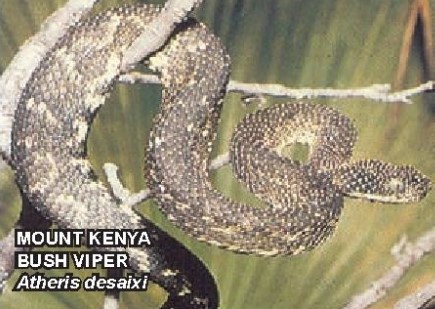
Ashe's Bush Viper
Atheris desaixi
United States Army Center for Health Promotion and Preventive Medicine, Public domain, via Wikimedia Commons

Side by side
| Great Lakes Bush Viper | Ashe's Bush Viper | |
|---|---|---|
| Scientific name | Atheris nitschei Tornier, 1902 | Atheris desaixi Ashe, 1968 |
| English name | Great Lakes Bush Viper | Ashe's Bush Viper |
| Group | Reptiles | Reptiles |
| Class | Reptilia Reptile | Reptilia Reptile |
| Order | Squamata Snakes | Squamata Snakes |
| Family | Viperidae Viper | Viperidae Viper |
| Genus | Atheris African Bush Vipers | Atheris African Bush Vipers |
| Named in | 1902 | 1968 |
| Red List category | Least Concern | Endangered |
| Countries on record | 6 countries | 1 country |
| GBIF occurrence records | 462 records | 55 records |
Rows where the two agree are shown in grey.
Where each is found
Only Great Lakes Bush Viper (6)
Only Ashe's Bush Viper (1)
From Catalogue of Life checklists and GBIF occurrence records. A country missing from a list means no record is held, which is not proof of absence.
Checked facts
| Great Lakes Bush Viper | Ashe's Bush Viper | |
|---|---|---|
| Appearance |
|
|
| Size |
|
|
| Habitat |
|
|
| Diet | No checked fact yet |
|
| Behaviour |
|
|
| Reproduction |
|
|
| Distribution |
|
|
| Conservation |
|
|
| Other |
| No checked fact yet |
In brief
Great Lakes Bush Viper
The Great Lakes Bush Viper is a venomous species. It is native to Africa and occurs in forests of the Central African Albertine Rift, southern and eastern Democratic Republic of the Congo, Uganda, Rwanda, Tanzania and Burundi. It has a relatively large and stout body. Full profile
Ashe's Bush Viper
Atheris desaixi is endemic to Kenya, where it occurs in two isolated populations near Chuka on southeastern Mount Kenya and near Igembe in the northern Nyambeni range. Adults have a greenish-black to charcoal-black body with yellow or yellowish-green speckled scale tips. Full profile
Compare something else
Page built on 29 November 2026 from the data on the two species pages, where every source is listed.
Cite this page
ScientificNames.org. (2026). Great Lakes Bush Viper vs Ashe's Bush Viper. Retrieved November 29, 2026, from https://scientificnames.org/compare/great-lakes-bush-viper-vs-ashes-bush-viper
“Great Lakes Bush Viper vs Ashe's Bush Viper.” ScientificNames.org, 2026, scientificnames.org/compare/great-lakes-bush-viper-vs-ashes-bush-viper. Accessed 29 Nov. 2026.
ScientificNames.org. “Great Lakes Bush Viper vs Ashe's Bush Viper.” Accessed November 29, 2026. https://scientificnames.org/compare/great-lakes-bush-viper-vs-ashes-bush-viper.
@misc{scientificnames_great_lakes_bush_viper_vs_ashes_bush_viper,
  author = {{ScientificNames.org}},
  title = {Great Lakes Bush Viper vs Ashe's Bush Viper},
  year = {2026},
  url = {https://scientificnames.org/compare/great-lakes-bush-viper-vs-ashes-bush-viper},
  note = {Accessed 2026-11-29}
}