Comparison
Newcastle Funnel-web Spider vs Sydney Funnel-web Spider
Newcastle Funnel-web Spider (Atrax christenseni) and Sydney Funnel-web Spider (Atrax robustus) both belong to the genus Atrax and part ways below it. Both are recorded in 1 country.
Newcastle Funnel-web Spider
Atrax christenseni
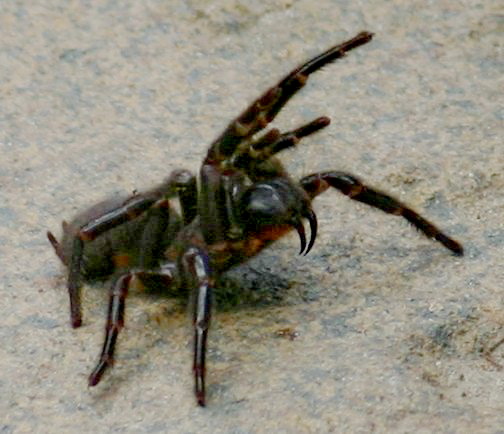

Side by side
| Newcastle Funnel-web Spider | Sydney Funnel-web Spider | |
|---|---|---|
| Scientific name | Atrax christenseni Dupérré & Smith, 2025 | Atrax robustus O. Pickard-Cambridge, 1877 |
| English name | Newcastle Funnel-web Spider | Sydney Funnel-web Spider |
| Group | Spiders and other arachnids | Spiders and other arachnids |
| Class | Arachnida Arachnid | Arachnida Arachnid |
| Order | Araneae Spider | Araneae Spider |
| Family | Atracidae Australian Funnel-web Spider | Atracidae Australian Funnel-web Spider |
| Genus | Atrax | Atrax |
| Named in | 2025 | 1877 |
| Countries on record | 1 country | 1 country |
| GBIF occurrence records | 19 records | 550 records |
Rows where the two agree are shown in grey.
Where each is found
Both recorded in 1 country
From Catalogue of Life checklists and GBIF occurrence records. A country missing from a list means no record is held, which is not proof of absence.
Checked facts
| Newcastle Funnel-web Spider | Sydney Funnel-web Spider | |
|---|---|---|
| Appearance |
|
|
| Size |
|
|
| Habitat |
|
|
| Diet | No checked fact yet |
|
| Behaviour |
|
|
| Reproduction | No checked fact yet |
|
| Lifespan | No checked fact yet |
|
| Distribution |
|
|
| Conservation |
|
|
| Uses | No checked fact yet |
|
| Similar species |
| No checked fact yet |
| Other |
| No checked fact yet |
In brief
Newcastle Funnel-web Spider
Atrax christenseni, known as the Newcastle Funnel-web Spider, is a venomous mygalomorph funnel-web spider in the family Atracidae. It occurs in the area north of Newcastle in New South Wales, Australia, with all recorded localities within a 25 km radius around Newcastle. It is distinguished by its large adult males, whose palpal tibia and embolus are extra-long compared with those of the Sydney Funnel-web and Southern Sydney Funnel-web. Full profile
Sydney Funnel-web Spider
Atrax robustus inhabits bushy suburban areas, sclerophyll forests and woodlands, primarily within approximately 100 kilometres of Sydney. It constructs silk-lined burrows with funnel-shaped entrances and radiating silk trip-lines. Full profile
Compare something else
Page built on 27 November 2026 from the data on the two species pages, where every source is listed.
Cite this page
ScientificNames.org. (2026). Newcastle Funnel-web Spider vs Sydney Funnel-web Spider. Retrieved November 27, 2026, from https://scientificnames.org/compare/newcastle-funnel-web-spider-vs-sydney-funnel-web-spider
“Newcastle Funnel-web Spider vs Sydney Funnel-web Spider.” ScientificNames.org, 2026, scientificnames.org/compare/newcastle-funnel-web-spider-vs-sydney-funnel-web-spider. Accessed 27 Nov. 2026.
ScientificNames.org. “Newcastle Funnel-web Spider vs Sydney Funnel-web Spider.” Accessed November 27, 2026. https://scientificnames.org/compare/newcastle-funnel-web-spider-vs-sydney-funnel-web-spider.
@misc{scientificnames_newcastle_funnel_web_spider_vs_sydney_funnel_web_spider,
  author = {{ScientificNames.org}},
  title = {Newcastle Funnel-web Spider vs Sydney Funnel-web Spider},
  year = {2026},
  url = {https://scientificnames.org/compare/newcastle-funnel-web-spider-vs-sydney-funnel-web-spider},
  note = {Accessed 2026-11-27}
}