Comparison

Rosy Austrofundulus vs Mangrove Rivulus

Rosy Austrofundulus (Austrofundulus transilis) and Mangrove Rivulus (Kryptolebias marmoratus) both belong to the family Rivulidae (rivulines) and part ways below it. Both are recorded in 1 country.

Rosy Austrofundulus

Austrofundulus transilis
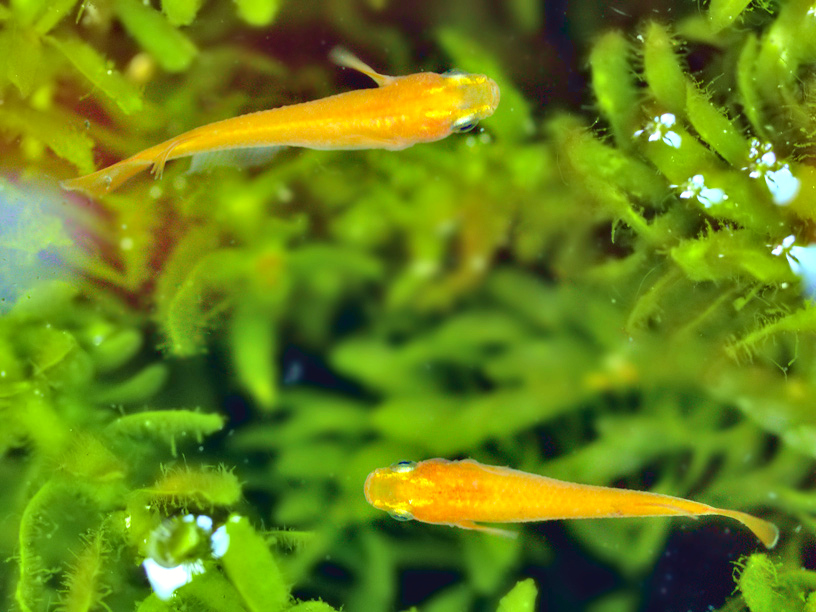
Mangrove Rivulus

Mangrove Rivulus

Kryptolebias marmoratus

Tam Tam さん https://www.flickr.com/photos/strollers/, CC BY-SA 2.0, via Wikimedia Commons

Side by side

Rosy AustrofundulusMangrove Rivulus
Scientific nameAustrofundulus transilis Myers, 1932Kryptolebias marmoratus (Poey, 1880)
English nameRosy AustrofundulusMangrove Rivulus
GroupFishesFishes
ClassTeleostei TeleostTeleostei Teleost
OrderCyprinodontiformesCyprinodontiformes
FamilyRivulidae RivulinesRivulidae Rivulines
GenusAustrofundulusKryptolebias
Named in19321880
Red List categoryLeast ConcernLeast Concern
Environmentfreshwaterbrackish, freshwater
Countries on record1 country16 countries
GBIF occurrence records35 records318 records

Rows where the two agree are shown in grey.

Where each is found

Both recorded in 1 country

Only Mangrove Rivulus (15)

From Catalogue of Life checklists and GBIF occurrence records. A country missing from a list means no record is held, which is not proof of absence.

Checked facts

Rosy AustrofundulusMangrove Rivulus
AppearanceNo checked fact yet
  • The species has an elongated, cylindrical body and a flattened head. biogeodb.stri.si.edu
  • Its sensory system is located on the upper surface of the head and consists of grooves and exposed pads rather than pores. biogeodb.stri.si.edu
  • Its body is light to dark brown, with irregular dark spots forming a checkerboard pattern along the upper side and tail base. biogeodb.stri.si.edu
  • A dark spot occurs on the body above the base of the pectoral fin. biogeodb.stri.si.edu
  • Hermaphroditic individuals have a row of silver to gold spots along their flanks. biogeodb.stri.si.edu
  • Hermaphroditic individuals have a large, dark, cream-ringed eyespot below the upper part of the tail-fin base. biogeodb.stri.si.edu
  • Males have an orangish coloration on their body sides and fins. biogeodb.stri.si.edu
  • The species has a rounded dorsal fin with 8–11 rays and a rounded anal fin with 10–13 rays. biogeodb.stri.si.edu
  • The species has a rounded tail fin containing 30–31 rays. biogeodb.stri.si.edu
  • Its body has 47–51 smooth scales along each side. biogeodb.stri.si.edu
SizeNo checked fact yet
  • Adults can reach 7.5 cm in length, although most individuals measure between 1 and 3.8 cm. English Wikipedia
HabitatNo checked fact yet
  • The species inhabits brackish and marine waters and occurs less frequently in freshwater. English Wikipedia
  • The species is closely associated with red mangroves (Rhizophora mangle). pmc.ncbi.nlm.nih.gov
  • Its preferred habitat is the red mangrove, Rhizophora mangle. floridamuseum.ufl.edu
  • The species occurs in shallow mangrove lagoons and hypersaline ponds. biogeodb.stri.si.edu
  • Its documented microhabitats include intermittently dry shallow pools, crab burrows, flooded swales, ditches, logs, mangrove leaf litter, solution holes, and anchialine caves. pmc.ncbi.nlm.nih.gov
  • The species can occur in burrows made by insects in red mangrove logs. biogeodb.stri.si.edu
DietNo checked fact yet
  • Its recorded food categories include insects, mobile benthic crustaceans, mobile benthic gastropods and bivalves, and mobile benthic worms. biogeodb.stri.si.edu
BehaviourNo checked fact yet
  • The species can survive out of water for up to 66 consecutive days. English Wikipedia
  • During terrestrial periods, individuals typically shelter inside fallen logs and breathe air through their skin. English Wikipedia
  • When jumping on land, the fish uses a movement called a tail flip, in which its head flips over its body toward its tail. English Wikipedia
  • Individuals reduce their territorial and aggressive behaviour while sheltering in insect-created tree burrows. English Wikipedia
  • The species tolerates high hydrogen sulfide concentrations and depleted dissolved oxygen in water. pmc.ncbi.nlm.nih.gov
ReproductionNo checked fact yet
  • The species consists predominantly of hermaphrodites that reproduce through self-fertilization, although males also occur. English Wikipedia
  • Hermaphroditic individuals normally fertilize their own eggs internally using sperm they produce themselves. English Wikipedia
  • The species produces eggs and sperm through meiosis. English Wikipedia
  • Its eggs are laid after internal fertilization. biogeodb.stri.si.edu
  • The eggs can continue developing outside water, but hatching is delayed until they are submerged again. English Wikipedia
  • Males typically account for 3–8% of populations in highly colonized South and Central American pools. English Wikipedia
  • Males account for approximately 20–25% of populations on offshore cays in Belize. English Wikipedia
  • Adults may cannibalize juveniles that are not their own offspring. English Wikipedia
  • The species has no pelagic larval stage. biogeodb.stri.si.edu
ConservationNo checked fact yet
  • The species is classified as Least Concern by the IUCN. English Wikipedia
  • The United States National Marine Fisheries Service considers the species a Species of Concern. English Wikipedia
  • The American Fisheries Society considers the species vulnerable. English Wikipedia
  • Development and hydrologic alteration of tidal wetlands have adversely affected the species in some parts of Florida. pmc.ncbi.nlm.nih.gov
UsesNo checked fact yet
  • The species has potential applications as a bioindicator of estuary habitats. English Wikipedia
Other
  • Austrofundulus transilis is recognized as a species in the genus Austrofundulus. English Wikipedia
  • Self-fertilization allows the species to produce genetically uniform lineages. English Wikipedia
  • The species has been used in laboratory research on epigenetic effects in genetically identical individuals. English Wikipedia
  • DNA methylation patterns at CpG sites have been investigated in adults and during development. English Wikipedia

In brief

Rosy Austrofundulus

Rosy Austrofundulus is a species in the genus Austrofundulus. Full profile

Mangrove Rivulus

Kryptolebias marmoratus inhabits brackish and marine waters, particularly red mangroves (Rhizophora mangle), and occurs less frequently in freshwater. It consists predominantly of hermaphrodites that reproduce through self-fertilization, and can survive out of water for up to 66 consecutive days. Full profile

Compare something else

Page built on 28 November 2026 from the data on the two species pages, where every source is listed.

Cite this page

ScientificNames.org. (2026). Rosy Austrofundulus vs Mangrove Rivulus. Retrieved November 28, 2026, from https://scientificnames.org/compare/rosy-austrofundulus-vs-mangrove-rivulus