Comparison

Lemon Myrtle vs Shatterwood

Lemon Myrtle (Backhousia citriodora) and Shatterwood (Backhousia sciadophora) both belong to the genus Backhousia and part ways below it. Both are recorded in 1 country.
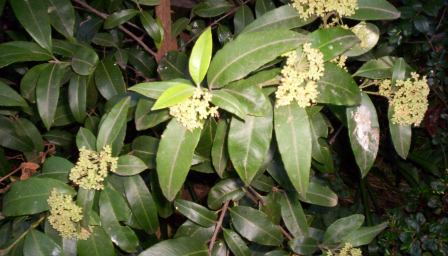
Lemon Myrtle

Lemon Myrtle

Backhousia citriodora

HelloMojo, CC BY-SA 3.0, via Wikimedia Commons

Shatterwood

Shatterwood

Backhousia sciadophora

Poyt448 Peter Woodard, Public domain, via Wikimedia Commons

Side by side

Lemon MyrtleShatterwood
Scientific nameBackhousia citriodora F.Muell.Backhousia sciadophora F.Muell.
English nameLemon MyrtleShatterwood
GroupFlowering plantsFlowering plants
ClassMagnoliopsidaMagnoliopsida
OrderMyrtalesMyrtales
FamilyMyrtaceae Myrtle FamilyMyrtaceae Myrtle Family
GenusBackhousiaBackhousia
Countries on record2 countries1 country
GBIF occurrence records314 records679 records

Rows where the two agree are shown in grey.

Where each is found

Both recorded in 1 country

Only Lemon Myrtle (1)

From Catalogue of Life checklists and GBIF occurrence records. A country missing from a list means no record is held, which is not proof of absence.

Checked facts

Lemon MyrtleShatterwood
Appearance
  • The species has evergreen, opposite, lanceolate leaves with glossy green surfaces and entire margins. English Wikipedia
  • Its flowers are creamy-white and grow in clusters at the ends of branches. English Wikipedia
  • The calyx remains after the petals fall. English Wikipedia
  • Mature trees can have a dense canopy when cultivated. English Wikipedia
Size
Habitat
  • The species is native to subtropical rainforests in central and south-eastern Queensland. English Wikipedia
  • The species grows best near its natural habitat. pmc.ncbi.nlm.nih.gov
  • The species prefers access to water but does not tolerate waterlogged root conditions. pmc.ncbi.nlm.nih.gov
  • The species is frost intolerant, and two or more nights below freezing can kill seedlings. pmc.ncbi.nlm.nih.gov
Reproduction
  • The species can be propagated using cuttings, although they are slow to establish roots. English Wikipedia
  • Seedlings undergo a slow, shrubby juvenile growth stage before developing a dominant trunk. English Wikipedia
  • Cuttings from mature trees can bypass the shrubby juvenile growth stage. English Wikipedia
  • Actively growing axillary buds, wide stems and mature leaves are indicators of successful rooting in cuttings. English Wikipedia
  • The citronellal chemotype does not consistently produce offspring of the same chemotype. pmc.ncbi.nlm.nih.gov
Distribution
  • Its natural distribution extends from Mackay to Brisbane in Queensland, Australia. English Wikipedia
  • The species is endemic to the eastern coast of Queensland, Australia. pmc.ncbi.nlm.nih.gov
  • Its documented Queensland distribution includes Eumundi, Maroochydore, Noosa and Woondum. pmc.ncbi.nlm.nih.gov
  • Its documented distribution extends to ranges west of Miriam Vale and the Mackay, Whitsunday, Townsville and Herberton regions. pmc.ncbi.nlm.nih.gov
No checked fact yet
Uses
  • Aboriginal Australians have traditionally used the species in food and as a healing plant. English Wikipedia
  • The leaves are used as dried flakes and encapsulated flavouring. English Wikipedia
  • The leaves are used to flavour shortbread, pasta and baked fish. English Wikipedia
  • The leaves are used to infuse macadamia and vegetable oils. English Wikipedia
  • The leaves are used to prepare tea and tea blends. English Wikipedia
  • The leaves can replace lemon flavouring in milk-based foods such as cheesecake, ice cream and sorbet. English Wikipedia
  • The species is cultivated in Australia for flavouring and essential oil production. pmc.ncbi.nlm.nih.gov
  • The essential oil is used as an ingredient in healthcare and cleaning products. English Wikipedia
  • The essential oil is used in soaps, lotions, skin-whitening preparations and shampoos. English Wikipedia
  • The species is cultivated as an ornamental plant. English Wikipedia
  • Commercial plantations harvest the leaves for drying as a leaf spice or distillation into essential oil. English Wikipedia
  • The timber is brittle, which accounts for the common name shatterwood. English Wikipedia
Similar species
  • Lemon myrtle is sometimes confused with lemon ironbark, which is Eucalyptus staigeriana. English Wikipedia
No checked fact yet
OtherNo checked fact yet

In brief

Lemon Myrtle

Backhousia citriodora is native to subtropical rainforests in central and south-eastern Queensland. Full profile

Shatterwood

Backhousia sciadophora grows in drier rainforest in gorges and on steep slopes. Its timber is brittle, which accounts for the common name shatterwood. Full profile

Compare something else

Page built on 29 November 2026 from the data on the two species pages, where every source is listed.

Cite this page

ScientificNames.org. (2026). Lemon Myrtle vs Shatterwood. Retrieved November 29, 2026, from https://scientificnames.org/compare/lemon-myrtle-vs-shatterwood