Species · Flowering plants
Lemon Myrtle Backhousia citriodora
The scientific name of the Lemon Myrtle is Backhousia citriodora. It is a species of flowering plant in the family Myrtaceae (myrtle family), order Myrtales.
- Scientific name
- Backhousia citriodora F.Muell.
- Common name
- Lemon Myrtle
- Genus
- Backhousia
- Family
- Myrtaceae (Myrtle Family)
- Order
- Myrtales
- Class
- Magnoliopsida
- Recorded in
- 2 countries
- Name status
- accepted in the Catalogue of Life
Overview
Backhousia citriodora is native to subtropical rainforests in central and south-eastern Queensland.
Written 26 November 2026 from the sources listed below. Each statement was checked against the passage it cites; statements that could not be supported were removed.
Appearance
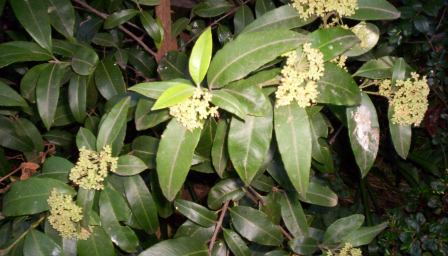
Lemon myrtle has evergreen, opposite, lanceolate leaves with glossy green surfaces and entire margins. Its flowers are creamy-white and grow in clusters at the ends of branches. The calyx remains after the petals fall.[1][2][3]
The leaves measure 4–15 cm long and 1–5 cm broad. The flowers measure 5–7 mm in diameter.[4][5]
Mature trees can have a dense canopy when cultivated.[6]
Habitat
Lemon myrtle is native to subtropical rainforests in central and south-eastern Queensland. Its natural distribution extends from Mackay to Brisbane in Queensland, Australia, and it is endemic to the eastern coast of Queensland, Australia.[7][8][9]
Its documented Queensland distribution includes Eumundi, Maroochydore, Noosa and Woondum. Its documented distribution also extends to ranges west of Miriam Vale and the Mackay, Whitsunday, Townsville and Herberton regions.[10][11]
Lemon myrtle grows best near its natural habitat. It prefers access to water but does not tolerate waterlogged root conditions.[12][13]
The species is frost intolerant, and two or more nights below freezing can kill seedlings.[14]
Reproduction and life cycle
Lemon myrtle can be propagated using cuttings, although they are slow to establish roots. Actively growing axillary buds, wide stems and mature leaves are indicators of successful rooting in cuttings.[15][16]
Seedlings undergo a slow, shrubby juvenile growth stage before developing a dominant trunk. Cuttings from mature trees can bypass this stage.[17][18]
The citronellal chemotype does not consistently produce offspring of the same chemotype.[19]
Uses
Aboriginal Australians have traditionally used lemon myrtle in food and as a healing plant. The species is cultivated in Australia for flavouring and essential oil production.[20][21]
The leaves are used as dried flakes and encapsulated flavouring. They are used to flavour shortbread, pasta and baked fish, and to infuse macadamia and vegetable oils.[22][23][24]
The leaves are used to prepare tea and tea blends. They can replace lemon flavouring in milk-based foods such as cheesecake, ice cream and sorbet.[25][26]
Steam-distilled essential oil from lemon myrtle typically contains 90–98% citral. Fresh leaves yield approximately 1–3% essential oil.[27][28]
The essential oil is used as an ingredient in healthcare and cleaning products. It is also used in soaps, lotions, skin-whitening preparations and shampoos.[29][30]
The citronellal chemotype produces an oil that can be used as an insect repellent.[31]
Lemon myrtle is cultivated as an ornamental plant. Commercial plantations harvest the leaves for drying as a leaf spice or distillation into essential oil.[32][33]
Similar species
Lemon myrtle is sometimes confused with lemon ironbark, which is Eucalyptus staigeriana.[34]
Classification of the Lemon Myrtle
| Kingdom | Plantae |
|---|---|
| Subkingdom | Pteridobiotina |
| Phylum | Tracheophyta |
| Class | Magnoliopsida |
| Order | Myrtales |
| Family | Myrtaceae (Myrtle Family) |
| Subfamily | Myrtoideae |
| Tribe | Backhousieae |
| Genus | Backhousia |
| Species | Backhousia citriodora F.Muell. |
Where the Lemon Myrtle is found
Checklists and occurrence records place Backhousia citriodora in 2 countries across Oceania. GBIF holds 314 georeferenced records of it.
Countries
Regions and cities with the most records
- Queensland, Australia 205
- New South Wales, Australia 53
- Brisbane, Australia 21
- Narangba, Australia 15
- Logan City, Australia 12
- Sunshine Coast, Australia 11
- Auckland, New Zealand 7
- Otahuhu, New Zealand 7
- Otara, New Zealand 7
- Manukau City, New Zealand 6
- Gympie, Australia 4
- Newcastle, Australia 4
- Bay of Plenty, New Zealand 3
- Coffs Harbour, Australia 3
- Gold Coast, Australia 3
- Maitland, Australia 3
- Rockhampton, Australia 3
- Rotorua, New Zealand 3
1 more country has a few records outside this range
These countries hold a few records of Backhousia citriodora but lie outside the range the checklists give for it. Such records are often zoo or garden specimens, museum material or vagrants, so the species is not counted as occurring there.
Range as the checklists state it
Australia (Queensland)
A number beside a place is its count of GBIF occurrence records. A place without a number comes from a checklist alone. Records show where a species has been observed or collected, which can include escapes and vagrants.
Common names
English
- Lemon Myrtle
- Australian Lemon Myrtle
- Lemon-scented Myrtle
- Lemon Ironwood
- Lemon-scent Backhousia
- Lemon-scent Myrtle
- Lemon-scent Verbena
- Sweet Verbena Myrtle
- Sweet Verbena-tree
Names in 4 other languages
- Chinese
- 檸檬香桃木
- Russian
- Лимонный мирт
- Slovak
- bekhausia citrónová
- Swedish
- citronmyrten
Related species
-
 Cinnamon MyrtleBackhousia myrtifolia
- Giant IronwoodBackhousia subargentea
-
 ShatterwoodBackhousia sciadophora
- Johnstone River HardwoodBackhousia bancroftii
- Brown MyrtleBackhousia leptopetala
- Backhousia angustifolia
- Backhousia hughesii
- Backhousia kingii
Compare
Questions and answers
What is the scientific name of the Lemon Myrtle?
The scientific name of the Lemon Myrtle is Backhousia citriodora. Written with its author, the full name is Backhousia citriodora F.Muell..
Which family does the Lemon Myrtle belong to?
Backhousia citriodora belongs to the family Myrtaceae, in the order Myrtales and the class Magnoliopsida.
Where is the Lemon Myrtle found?
Checklists and occurrence records place Backhousia citriodora in 2 countries: Australia and New Zealand.
What other names does the Lemon Myrtle have?
Backhousia citriodora is also known in English as Australian Lemon Myrtle, Lemon-scented Myrtle, Lemon Ironwood, Lemon-scent Backhousia, Lemon-scent Myrtle and Lemon-scent Verbena.
How big does a lemon scented myrtle grow?
Lemon myrtle can reach 6 metres in height, although individuals are often smaller. Mature trees can reach 8 metres or more.[35][36]
Are citriodora and eucalyptus the same?
Lemon myrtle is sometimes confused with lemon ironbark, which is Eucalyptus staigeriana.[34]
Are there different types of lemon myrtle trees?
Lemon myrtle has two essential oil chemotypes, citral and citronellal. The citral chemotype is more prevalent than the citronellal chemotype.[37][38]
Can you describe the lemon myrtle tree?
Lemon myrtle has evergreen, opposite, lanceolate leaves with glossy green surfaces and entire margins. Its creamy-white flowers grow in clusters at the ends of branches, and the calyx remains after the petals fall.[1][2][3]
Sources
Passages the profile rests on
- The species has evergreen, opposite, lanceolate leaves with glossy green surfaces and entire margins. Source passage: “The leaves are evergreen, opposite, lanceolate, 5–12 cm (2.0–4.7 in) long and 1.5–2.5 cm (0.6–1.0 in) broad, glossy green, with an entire margin.” — English Wikipedia
- Its flowers are creamy-white and grow in clusters at the ends of branches. Source passage: “The flowers are creamy-white, 5–7 mm (0.20–0.28 in) in diameter, produced in clusters at the ends of the branches” — English Wikipedia
- The calyx remains after the petals fall. Source passage: “After petal fall, the calyx is persistent.” — English Wikipedia
- Its leaves measure 4–15 cm long and 1–5 cm broad. Source passage: “The leaves are evergreen, opposite, lanceolate, 4–15 cm in length and 1–5 cm (0.59–0.98 in) broad” — pmc.ncbi.nlm.nih.gov
- Its flowers measure 5–7 mm in diameter. Source passage: “The flowers are creamy white, 5–7 mm (0.20–0.28 in) in diameter” — pmc.ncbi.nlm.nih.gov
- Mature trees can have a dense canopy when cultivated. Source passage: “In cultivation it rarely exceeds about 5 metres (16 ft) and usually has a dense canopy.” — English Wikipedia
- The species is native to subtropical rainforests in central and south-eastern Queensland. Source passage: “It is native to the subtropical rainforests of central and south-eastern Queensland, Australia” — English Wikipedia
- Its natural distribution extends from Mackay to Brisbane in Queensland, Australia. Source passage: “with a natural distribution from Mackay to Brisbane.” — English Wikipedia
- The species is endemic to the eastern coast of Queensland, Australia. Source passage: “B. citriodora is endemic to only the east coast of Australia in Queensland” — pmc.ncbi.nlm.nih.gov
- Its documented Queensland distribution includes Eumundi, Maroochydore, Noosa and Woondum. Source passage: “from the Sunshine Coast regions of Eumundi, Maroochydore, Noosa and Woondum” — pmc.ncbi.nlm.nih.gov
- Its documented distribution extends to ranges west of Miriam Vale and the Mackay, Whitsunday, Townsville and Herberton regions. Source passage: “to the ranges west of Miriam Vale and the Mackay, Whitsunday, Townsville and Herberton regions.” — pmc.ncbi.nlm.nih.gov
- The species grows best near its natural habitat. Source passage: “The trees grow best near their natural habitat.” — pmc.ncbi.nlm.nih.gov
- The species prefers access to water but does not tolerate waterlogged root conditions. Source passage: “The tree loves water but does not like wet feet.” — pmc.ncbi.nlm.nih.gov
- The species is frost intolerant, and two or more nights below freezing can kill seedlings. Source passage: “It is frost intolerant, with two or more nights below 0 degrees deadly to seedlings.” — pmc.ncbi.nlm.nih.gov
- The species can be propagated using cuttings, although they are slow to establish roots. Source passage: “Lemon myrtle can also be propagated from cutting, but is slow to strike.” — English Wikipedia
- Actively growing axillary buds, wide stems and mature leaves are indicators of successful rooting in cuttings. Source passage: “actively growing axillary buds, wide stems and mature leaves” — English Wikipedia
- Seedlings undergo a slow, shrubby juvenile growth stage before developing a dominant trunk. Source passage: “Seedling lemon myrtle go through a shrubby, slow juvenile growth stage, before developing a dominant trunk.” — English Wikipedia
- Cuttings from mature trees can bypass the shrubby juvenile growth stage. Source passage: “Growing cuttings from mature trees bypasses the shrubby juvenile stage.” — English Wikipedia
- The citronellal chemotype does not consistently produce offspring of the same chemotype. Source passage: “This chemotype does not breed true as seed collected from a citronellal type tree has given progeny with a 1.05:1 ratio of the citronellal:citral chemotypes” — pmc.ncbi.nlm.nih.gov
- Aboriginal Australians have traditionally used the species in food and as a healing plant. Source passage: “Aboriginal Australians have long used lemon myrtle, both in cuisine and as a healing plant.” — English Wikipedia
- The species is cultivated in Australia for flavouring and essential oil production. Source passage: “the citral chemotype is more prevalent and is cultivated in Australia for flavoring and essential oil” — pmc.ncbi.nlm.nih.gov
- The leaves are used as dried flakes and encapsulated flavouring. Source passage: “The leaf is often used as dried flakes, or in the form of an encapsulated flavour essence for enhanced shelf-life.” — English Wikipedia
- The leaves are used to flavour shortbread, pasta and baked fish. Source passage: “lemon myrtle flakes in shortbread; flavouring in pasta; whole leaf with baked fish” — English Wikipedia
- The leaves are used to infuse macadamia and vegetable oils. Source passage: “infused in macadamia or vegetable oils” — English Wikipedia
- The leaves are used to prepare tea and tea blends. Source passage: “and made into tea, including tea blends.” — English Wikipedia
- The leaves can replace lemon flavouring in milk-based foods such as cheesecake, ice cream and sorbet. Source passage: “It can also be used as a lemon flavour replacement in milk-based foods, such as cheesecake, lemon flavoured ice-cream and sorbet” — English Wikipedia
- Steam-distilled essential oil from the species typically contains 90–98% citral. Source passage: “Citral as an isolate in steam-distilled lemon myrtle oil is typically 90–98%” — pmc.ncbi.nlm.nih.gov
- Fresh leaves yield approximately 1–3% essential oil. Source passage: “oil yield 1–3% from fresh leaf” — pmc.ncbi.nlm.nih.gov
- The essential oil is used as an ingredient in healthcare and cleaning products. Source passage: “The oil is a popular ingredient in health care and cleaning products” — English Wikipedia
- The essential oil is used in soaps, lotions, skin-whitening preparations and shampoos. Source passage: “especially soaps, lotions, skin-whitening preparations and shampoos.” — English Wikipedia
- The citronellal chemotype produces an oil that can be used as an insect repellent. Source passage: “The citronellal chemotype is uncommon and can be used as an insect repellent” — pmc.ncbi.nlm.nih.gov
- The species is cultivated as an ornamental plant. Source passage: “Lemon myrtle is a cultivated ornamental plant.” — English Wikipedia
- Commercial plantations harvest the leaves for drying as a leaf spice or distillation into essential oil. Source passage: “The harvested leaves are dried for leaf spice, or distilled for the essential oil.” — English Wikipedia
- Lemon myrtle is sometimes confused with lemon ironbark, which is Eucalyptus staigeriana. Source passage: “Lemon myrtle is sometimes confused with 'lemon ironbark', which is Eucalyptus staigeriana.” — English Wikipedia
- The species can reach 6 metres in height, although individuals are often smaller. Source passage: “The species can reach 6 m (20 ft) in height, but is often smaller.” — English Wikipedia
- Mature trees can reach 8 metres or more in height. Source passage: “Mature lemon myrtle trees reach 8 m (25 ft) in height, or higher (to 30 m) when crowned, but are often smaller.” — pmc.ncbi.nlm.nih.gov
- The species has two essential oil chemotypes, citral and citronellal. Source passage: “Backhousia citriodora has two essential oil chemotypes.” — English Wikipedia
- The citral chemotype is more prevalent than the citronellal chemotype. Source passage: “The citral chemotype is more prevalent” — English Wikipedia
Data
- Catalogue of Life, 2026-10-16 XR cc by
- Global Biodiversity Information Facility CC BY 4.0
- Wikidata CC0
- GeoNames CC BY 4.0
- Wikimedia Commons per image; credit shown with each image
- Within the Catalogue of Life, this name comes from Synonymic Checklists of the Vascular Plants of the World cc by
References
- F.Muell. (1859). Fragm. [Mueller] 1: 78 (1859). where the name was published
This species in other databases
- Catalogue of Life 5VYFN
- Wikidata Q2708073
- iNaturalist 122826
- World Flora Online wfo-0000305828
- GRIN 6250
Page built on 29 November 2026. See how the catalog is made and all sources and licences.
Cite this page
ScientificNames.org. (2026). Backhousia citriodora (Lemon Myrtle). Retrieved November 29, 2026, from https://scientificnames.org/species/backhousia-citriodora
“Backhousia citriodora (Lemon Myrtle).” ScientificNames.org, 2026, scientificnames.org/species/backhousia-citriodora. Accessed 29 Nov. 2026.
ScientificNames.org. “Backhousia citriodora (Lemon Myrtle).” Accessed November 29, 2026. https://scientificnames.org/species/backhousia-citriodora.
@misc{scientificnames_backhousia_citriodora_lemon_myrtle,
  author = {{ScientificNames.org}},
  title = {Backhousia citriodora (Lemon Myrtle)},
  year = {2026},
  url = {https://scientificnames.org/species/backhousia-citriodora},
  note = {Accessed 2026-11-29}
}