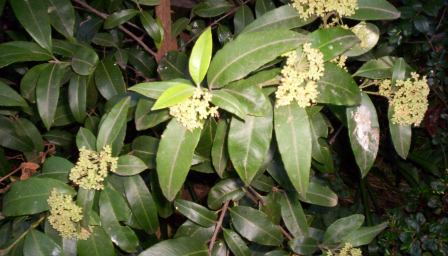
| Appearance | - The species has evergreen, opposite, lanceolate leaves with glossy green surfaces and entire margins. English Wikipedia
- Its flowers are creamy-white and grow in clusters at the ends of branches. English Wikipedia
- The calyx remains after the petals fall. English Wikipedia
- Mature trees can have a dense canopy when cultivated. English Wikipedia
| - Backhousia subargentea has a crooked, often multi-stemmed trunk with an irregular cross-section and some basal buttressing. English Wikipedia
- Its trunk can have smooth, glossy orange-brown or pinkish mauve bark, or green bark where shedding has recently occurred. English Wikipedia
- Irregular bark shedding can produce a mottled trunk resembling those of spotted gum and leopardwood. English Wikipedia
- Its leaves are opposite, simple, entire and lanceolate or broad, with fine tips. English Wikipedia
- The upper leaf surfaces are glossy dark green, while the lower surfaces are greyish fawn. English Wikipedia
- The leaves contain visible oil dots when examined with a magnifying glass. English Wikipedia
- The leaf midrib and lateral venation are visible only on the upper surface. English Wikipedia
- An intramarginal vein runs around the leaf approximately 2 mm from its edge. English Wikipedia
- Its flowers are white and densely arranged in globular heads. English Wikipedia
- Its fruit is a small, dry capsule. English Wikipedia
|
|---|
| Size | | - The species is a small to medium-sized tree that can occasionally reach 30 metres in height. English Wikipedia
- In New South Wales, the tree reaches approximately 8 metres in height and has a stem diameter of 20 cm. English Wikipedia
- Its leaves are approximately 4–8 cm long. English Wikipedia
- Its leaf stalks are approximately 5–10 mm long. English Wikipedia
- Its fruit capsules grow on stalks approximately 6–10 mm long. English Wikipedia
|
|---|
| Habitat | - The species is native to subtropical rainforests in central and south-eastern Queensland. English Wikipedia
- The species grows best near its natural habitat. pmc.ncbi.nlm.nih.gov
- The species prefers access to water but does not tolerate waterlogged root conditions. pmc.ncbi.nlm.nih.gov
- The species is frost intolerant, and two or more nights below freezing can kill seedlings. pmc.ncbi.nlm.nih.gov
| - In New South Wales, the species grows in dry rainforest thickets on hillsides near Mullumbimby. English Wikipedia
- In its New South Wales habitat, the species grows in association with shatterwood and wild quince. English Wikipedia
|
|---|
| Reproduction | - The species can be propagated using cuttings, although they are slow to establish roots. English Wikipedia
- Seedlings undergo a slow, shrubby juvenile growth stage before developing a dominant trunk. English Wikipedia
- Cuttings from mature trees can bypass the shrubby juvenile growth stage. English Wikipedia
- Actively growing axillary buds, wide stems and mature leaves are indicators of successful rooting in cuttings. English Wikipedia
- The citronellal chemotype does not consistently produce offspring of the same chemotype. pmc.ncbi.nlm.nih.gov
| |
|---|
| Distribution | - Its natural distribution extends from Mackay to Brisbane in Queensland, Australia. English Wikipedia
- The species is endemic to the eastern coast of Queensland, Australia. pmc.ncbi.nlm.nih.gov
- Its documented Queensland distribution includes Eumundi, Maroochydore, Noosa and Woondum. pmc.ncbi.nlm.nih.gov
- Its documented distribution extends to ranges west of Miriam Vale and the Mackay, Whitsunday, Townsville and Herberton regions. pmc.ncbi.nlm.nih.gov
| - The species occurs in northeastern New South Wales near Mullumbimby and in southeastern Queensland between Boonah and Imbil. English Wikipedia
- The species is native to Australia. English Wikipedia
|
|---|
| Conservation | No checked fact yet | - Backhousia subargentea is described as a rare Australian rainforest tree. English Wikipedia
|
|---|
| Uses | - Aboriginal Australians have traditionally used the species in food and as a healing plant. English Wikipedia
- The leaves are used as dried flakes and encapsulated flavouring. English Wikipedia
- The leaves are used to flavour shortbread, pasta and baked fish. English Wikipedia
- The leaves are used to infuse macadamia and vegetable oils. English Wikipedia
- The leaves are used to prepare tea and tea blends. English Wikipedia
- The leaves can replace lemon flavouring in milk-based foods such as cheesecake, ice cream and sorbet. English Wikipedia
- The species is cultivated in Australia for flavouring and essential oil production. pmc.ncbi.nlm.nih.gov
- The essential oil is used as an ingredient in healthcare and cleaning products. English Wikipedia
- The essential oil is used in soaps, lotions, skin-whitening preparations and shampoos. English Wikipedia
- The species is cultivated as an ornamental plant. English Wikipedia
- Commercial plantations harvest the leaves for drying as a leaf spice or distillation into essential oil. English Wikipedia
| - The species has potential as an ornamental tree, although its rarity is a limitation. English Wikipedia
|
|---|
| Similar species | - Lemon myrtle is sometimes confused with lemon ironbark, which is Eucalyptus staigeriana. English Wikipedia
| |
|---|
| Other | | No checked fact yet |
|---|