Comparison

Bactris acanthocarpoides vs Peach Palm

Bactris acanthocarpoides (Bactris acanthocarpoides) and Peach Palm (Bactris gasipaes) both belong to the genus Bactris (bactris palm) and part ways below it. Both are recorded in 5 countries.
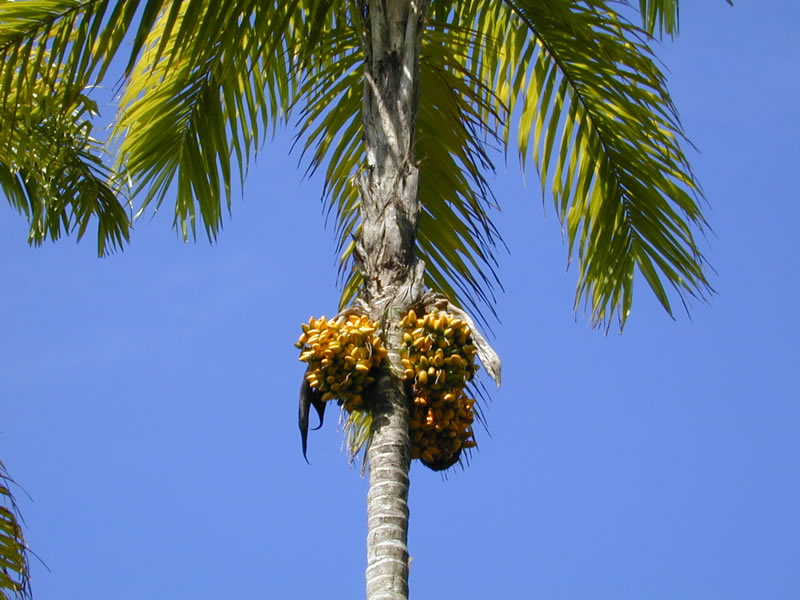
Peach Palm

Peach Palm

Bactris gasipaes

Unknown author, Public domain, via Wikimedia Commons

Side by side

Bactris acanthocarpoidesPeach Palm
Scientific nameBactris acanthocarpoides Barb.Rodr.Bactris gasipaes Kunth
English nameNot recordedPeach Palm
GroupFlowering plantsFlowering plants
ClassLiliopsidaLiliopsida
OrderArecalesArecales
FamilyArecaceae PalmArecaceae Palm
GenusBactris Bactris PalmBactris Bactris Palm
Countries on record5 countries18 countries
GBIF occurrence records189 records2,102 records

Rows where the two agree are shown in grey.

Where each is found

Both recorded in 5 countries

Only Peach Palm (13)

From Catalogue of Life checklists and GBIF occurrence records. A country missing from a list means no record is held, which is not proof of absence.

Checked facts

Bactris acanthocarpoidesPeach Palm
Appearance
  • Bactris acanthocarpoides is a tree characterized by spiny stems, compound leaves, and yellow to red fruits. English Wikipedia
  • Its spiny stems grow in clumps containing two to six stems. English Wikipedia
  • The plant bears six to fifteen leaves with scattered black spines. English Wikipedia
  • Each compound leaf has twenty to forty pinnae on either side. English Wikipedia
  • The inflorescences develop on stems measuring 8–15 centimetres long. English Wikipedia
  • The female flowers have a cup-shaped calyx measuring 1–1.5 millimetres long. English Wikipedia
  • The female flowers possess an urn-shaped corolla that is 3–5 millimetres long and spiny. English Wikipedia
  • Its fruits are densely clustered and obovoid, with soft spines and yellow to red coloration. English Wikipedia
  • The fruit mesocarp is starchy and its endocarp is obovoid. English Wikipedia
  • The species typically grows in clusters of several stems, although individual plants may have a single stem. English Wikipedia
  • Its stems generally bear stiff black spines arranged in circular rows. English Wikipedia
  • Its leaves are pinnate. English Wikipedia
  • Its ripe fruits have red, yellow, or orange rinds depending on the variety. English Wikipedia
  • Its fruit is a drupe containing edible pulp surrounding a single seed. English Wikipedia
  • The species has a clustered growth form with between one and fifteen trunks. pmc.ncbi.nlm.nih.gov
  • Its trunks have a smooth appearance and visible internodes, with rings of black thorns. pmc.ncbi.nlm.nih.gov
Size
Habitat
  • Wild populations grow in well-drained soils, including acidic and nutrient-poor soils. English Wikipedia
  • Wild plants occur in disturbed ecosystems, riverbanks, and gaps in primary forests. English Wikipedia
  • The species grows in tropical climates receiving approximately 2,000 to 5,000 millimetres of annual precipitation. English Wikipedia
  • Its reported growing climates have annual mean temperatures exceeding 24 degrees Celsius. English Wikipedia
  • Commercial cultivation is recommended at elevations between sea level and 800 metres. English Wikipedia
  • A population occurs at elevations reaching 1,800 metres in Colombia. pmc.ncbi.nlm.nih.gov
DietNo checked fact yet
ReproductionNo checked fact yet
  • The species is predominantly outcrossing, although self-fertilization has also been observed. English Wikipedia
  • Insects, particularly small curculionid beetles, are the principal pollinators. English Wikipedia
  • Pollination by curculionid beetles occurs over distances of approximately 100 to 500 metres. English Wikipedia
  • Wind and gravity can also transport the species' pollen. English Wikipedia
  • Fruit production generally begins three to five years after planting. English Wikipedia
Distribution
  • The species is native to northern Brazil, French Guiana, Guyana, and Suriname. English Wikipedia
  • The species is native to tropical forests of Central and South America. English Wikipedia
  • Its native range includes the Amazon basin and humid lowlands of the Neotropics. pmc.ncbi.nlm.nih.gov
  • The species has been introduced to Australia, Indonesia, Malaysia, Réunion Island, and Hawaii. pmc.ncbi.nlm.nih.gov
  • Wild and cultivated populations occur in Central America, Venezuela, and the Pacific lowlands of Colombia and Ecuador. English Wikipedia
Conservation
  • The IUCN classified the species as Least Concern in 2018. English Wikipedia
  • The species has a large population and faces no major threats. English Wikipedia
  • A food-plant survey describes the tree as threatened due to habitat loss. academia.edu
  • Wild populations are threatened by deforestation associated mainly with agricultural expansion and forest conversion to savannah. English Wikipedia
  • Forest fragmentation isolates populations and may reduce reproduction through inbreeding depression. English Wikipedia
  • The species faces threats caused by human activities. pmc.ncbi.nlm.nih.gov
UsesNo checked fact yet
Other
  • The species has two accepted varieties, Bactris gasipaes var. chichagui and Bactris gasipaes var. gasipaes. pmc.ncbi.nlm.nih.gov
  • The wild chichagui variety generally has smaller and oilier fruits than the cultivated gasipaes variety. pmc.ncbi.nlm.nih.gov

In brief

Bactris acanthocarpoides

The species grows in lowland rainforests and near streams in the wet tropical biome, at elevations of 200–260 metres. It is characterized by clumped spiny stems, compound leaves and densely clustered yellow to red fruits with soft spines. Full profile

Peach Palm

Bactris gasipaes is native to tropical forests of Central and South America, including the Amazon basin and humid lowlands of the Neotropics. It typically grows in clusters of spiny stems, has pinnate leaves, and produces edible fruits with red, yellow, or orange rinds. Full profile

Compare something else

Page built on 27 November 2026 from the data on the two species pages, where every source is listed.

Cite this page

ScientificNames.org. (2026). Bactris acanthocarpoides vs Peach Palm. Retrieved November 27, 2026, from https://scientificnames.org/compare/bactris-acanthocarpoides-vs-peach-palm