Species · Flowering plants
Peach Palm Bactris gasipaes
The scientific name of the Peach Palm is Bactris gasipaes. It is a species of flowering plant in the family Arecaceae (palm), order Arecales.
- Scientific name
- Bactris gasipaes Kunth
- Common name
- Peach Palm
- Genus
- Bactris
- Family
- Arecaceae (Palm)
- Order
- Arecales
- Class
- Liliopsida
- Recorded in
- 18 countries
- Name status
- accepted in the Catalogue of Life
Overview
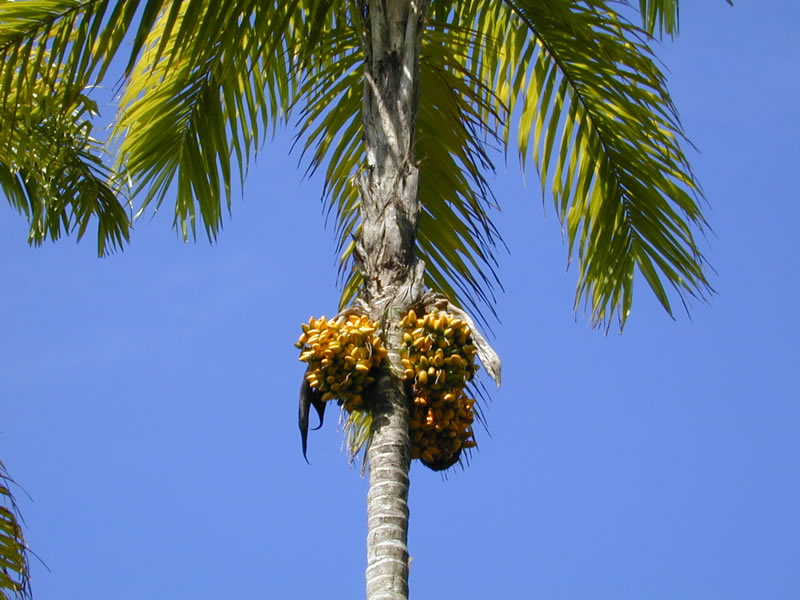
Bactris gasipaes is native to tropical forests of Central and South America, including the Amazon basin and humid lowlands of the Neotropics. It typically grows in clusters of spiny stems, has pinnate leaves, and produces edible fruits with red, yellow, or orange rinds.
Written 26 November 2026 from the sources listed below. Each statement was checked against the passage it cites; statements that could not be supported were removed.
Similar species
The species has two accepted varieties, Bactris gasipaes var. chichagui and Bactris gasipaes var. gasipaes. The wild chichagui variety generally has smaller and oilier fruits than the cultivated gasipaes variety.[1][2]
Appearance
Peach Palm typically grows in clusters of several stems, although individual plants may have a single stem. Its clustered growth form has between one and fifteen trunks, which have a smooth appearance, visible internodes, and rings of black thorns.[3][4][5]
Its stems generally bear stiff black spines arranged in circular rows. Its leaves are pinnate.[6][7]
Its ripe fruits have red, yellow, or orange rinds depending on the variety. Each fruit is a drupe containing edible pulp surrounding a single seed.[8][9]
Its stems can reach approximately 20 centimetres in thickness. Mature plants can typically reach 20 metres or more in height, with reported trunk heights ranging from six to twenty metres.[10][11][12]
Its pinnate leaves measure approximately three metres in length, and its leaf petioles are approximately one metre long. Its fruits measure approximately four to six centimetres long and three to five centimetres wide.[13][14][15]
Habitat
Wild populations grow in well-drained soils, including acidic and nutrient-poor soils. Wild plants occur in disturbed ecosystems, riverbanks, and gaps in primary forests.[16][17]
The species grows in tropical climates receiving approximately 2,000 to 5,000 millimetres of annual precipitation. Its reported growing climates have annual mean temperatures exceeding 24 degrees Celsius.[18][19]
Commercial cultivation is recommended at elevations between sea level and 800 metres. A population occurs at elevations reaching 1,800 metres in Colombia.[20][21]
The species is native to tropical forests of Central and South America, including the Amazon basin and humid lowlands of the Neotropics. Wild and cultivated populations occur in Central America, Venezuela, and the Pacific lowlands of Colombia and Ecuador.[22][23][24]
The species has been introduced to Australia, Indonesia, Malaysia, Réunion Island, and Hawaii.[25]
Diet
Peach Palm fruits are edible but require cooking before consumption. The fruit contains starchy and oily components.[26][27]
Reproduction and life cycle
The species is predominantly outcrossing, although self-fertilization has also been observed. Insects, particularly small curculionid beetles, are its principal pollinators.[28][29]
Pollination by curculionid beetles occurs over distances of approximately 100 to 500 metres. Wind and gravity can also transport the species' pollen.[30][31]
Fruit production generally begins three to five years after planting.[32]
Conservation
Wild populations are threatened by deforestation associated mainly with agricultural expansion and forest conversion to savannah. The species also faces threats caused by human activities.[33][34]
Forest fragmentation isolates populations and may reduce reproduction through inbreeding depression.[35]
Uses
Peach Palm is cultivated for its edible fruits and hearts of palm. Its trunk is used as a source of timber.[36][37]
The species has traditionally been used for medicinal purposes, including the use of its roots. Its leaves have been used for thatching and basketry, and its spines have historically been used to make needles.[38][39][40]
Its dense timber has been used to manufacture bows, arrows, fishing poles, harpoons, and building materials. The species was domesticated approximately 4,000 years ago.[41][42]
Classification of the Peach Palm
| Kingdom | Plantae |
|---|---|
| Subkingdom | Pteridobiotina |
| Phylum | Tracheophyta |
| Class | Liliopsida |
| Order | Arecales |
| Family | Arecaceae (Palm) |
| Genus | Bactris (Bactris Palm) |
| Species | Bactris gasipaes Kunth |
Where the Peach Palm is found
Checklists and occurrence records place Bactris gasipaes in 18 countries across North America and South America. GBIF holds 2,102 georeferenced records of it.
Countries where it is native or its origin is not stated
- Bolivia 123
- Brazil 243
- Colombia 722
- Costa Rica 97
- Ecuador 588
- French Guiana 45
- Guadeloupe 3
- Guyana 8
- Honduras 9
- Martinique 3
- Nicaragua 8
- Panama 58
- Peru 130
- Suriname 3
- United States 20
- Venezuela 35
Countries where it has been introduced
Regions and cities with the most records
- Santo Domingo de los Tsáchilas, Ecuador 198
- Santo Domingo de los Colorados, Ecuador 142
- Antioquia, Colombia 137
- Napo, Ecuador 74
- La Paz Department, Bolivia 67
- Valle del Cauca Department, Colombia 55
- Tena, Ecuador 50
- Los Ríos, Ecuador 42
- Putumayo Department, Colombia 41
- Chocó, Colombia 38
- Pichincha, Ecuador 36
- Madre de Dios, Peru 34
- Zamora Chinchipe, Ecuador 34
- Boyacá, Colombia 31
- Amazonas, Brazil 28
- Cundinamarca, Colombia 28
- Orellana Province, Ecuador 28
- Puerto Asís, Colombia 28
- Santander Department, Colombia 28
- Santa Cruz Department, Bolivia 26
- Morona-Santiago Province, Ecuador 25
- Casanare Department, Colombia 24
- Acre, Brazil 23
- Manabí, Ecuador 21
- Pastaza Province, Ecuador 21
- Sevilla, Colombia 21
- Limón Province, Costa Rica 20
- Loreto, Peru 20
- Zarzal, Colombia 20
- La Guajira Department, Colombia 19
- Alajuela Province, Costa Rica 17
- Puntarenas Province, Costa Rica 17
- Roldanillo, Colombia 17
- Sucumbíos, Ecuador 17
- Bolívar, Colombia 16
- Norte de Santander Department, Colombia 16
4 more countries have a few records outside this range
These countries hold a few records of Bactris gasipaes but lie outside the range the checklists give for it. Such records are often zoo or garden specimens, museum material or vagrants, so the species is not counted as occurring there.
A number beside a place is its count of GBIF occurrence records. A place without a number comes from a checklist alone. Records show where a species has been observed or collected, which can include escapes and vagrants.
Common names
English
- Peach Palm
- Peach-palm
Names in 14 other languages
- Chinese
- 桃果椰子, 桃棕, 桃椰, 桃椰子, 桃榈
- Czech
- baktris broskvová
- Danish
- ferskenpalme
- Dutch
- Perzikpalm
- French
- Palmier pêche
- German
- Pfirsichpalme
- Hungarian
- barackpálma
- Polish
- Palma brzoskwiniowa
- Portuguese
- Palmito-da-Amazônia, Pirajá, Pirajá-pupunha, Pupunha, Pupunha-marajá, Pupunheira
- Russian
- Персиковая пальма
- Slovak
- baktra broskyňová
- Spanish
- Chonta duro, Pejibaye, Pijuayo
- Swedish
- persikopalm
- cjp
- Diká
Synonyms
One other scientific name has been used for this species and is now treated as a synonym of Bactris gasipaes.
- Guilielma gasipaes (Kunth) L.H.Bailey
Subspecies and varieties
- Bactris gasipaes var. chichagui variety
- Bactris gasipaes var. gasipaes (Peach Palm) variety
Related species
-
 Lata PalmBactris major
-
 Bactris maraja
-
 Tobago CaneBactris guineensis
-
 Bactris setosa
-
 Bactris mexicana
- Prickly PalmBactris plumeriana
- Prickly PoleBactris jamaicana
- Bactris cubensis
Compare
Questions and answers
What is the scientific name of the Peach Palm?
The scientific name of the Peach Palm is Bactris gasipaes. Written with its author, the full name is Bactris gasipaes Kunth.
Which family does the Peach Palm belong to?
Bactris gasipaes belongs to the family Arecaceae, in the order Arecales and the class Liliopsida.
Where is the Peach Palm found?
Checklists and occurrence records place Bactris gasipaes in 18 countries, including Colombia, Ecuador, Brazil, Peru, Bolivia and Costa Rica.
What other names does the Peach Palm have?
Bactris gasipaes is also known in English as Peach-palm.
Where does peach palm grow?
Peach Palm is native to tropical forests of Central and South America, including the Amazon basin and humid lowlands of the Neotropics. Wild and cultivated populations occur in Central America, Venezuela, and the Pacific lowlands of Colombia and Ecuador. It has also been introduced to Australia, Indonesia, Malaysia, Réunion Island, and Hawaii.[22][23][25][24]
Are peach palms edible?
Peach Palm fruits are edible but require cooking before consumption. The species is also cultivated for its hearts of palm.[26][36]
Where do peach palms grow?
Peach Palm grows in tropical forests of Central and South America, including the Amazon basin and humid lowlands of the Neotropics. Wild populations occur in disturbed ecosystems, riverbanks, and gaps in primary forests, while cultivated and wild populations occur in Central America, Venezuela, and the Pacific lowlands of Colombia and Ecuador.[17][22][23][24]
Sources
Passages the profile rests on
- The species has two accepted varieties, Bactris gasipaes var. chichagui and Bactris gasipaes var. gasipaes. Source passage: “There are two accepted varieties of the species: Bactris gasipaes var. chichagui (H. Karst.) A.J. Hend. [12], and Bactris gasipaes var. gasipaes” — pmc.ncbi.nlm.nih.gov
- The wild chichagui variety generally has smaller and oilier fruits than the cultivated gasipaes variety. Source passage: “The chichagui variety is mostly wild with smaller, oilier fruit, and the gasipaes variety is cultivated, with larger and starchier fruit” — pmc.ncbi.nlm.nih.gov
- The species typically grows in clusters of several stems, although individual plants may have a single stem. Source passage: “grows erect, with a single slender stem or, more often, several stems that are up to eight inches (20 cm) thick, in a cluster” — English Wikipedia
- The species has a clustered growth form with between one and fifteen trunks. Source passage: “The species is characterized by being cespitose, i.e., several trunks (one to fifteen)” — pmc.ncbi.nlm.nih.gov
- Its trunks have a smooth appearance and visible internodes, with rings of black thorns. Source passage: “smooth in appearance, with evident internodes, surrounded by a ring of black thorns” — pmc.ncbi.nlm.nih.gov
- Its stems generally bear stiff black spines arranged in circular rows. Source passage: “generally armed with stiff, black spines in circular rows from the base to the summit.” — English Wikipedia
- Its leaves are pinnate. Source passage: “The leaves are pinnate, 3 metres (9.8 ft) long” — English Wikipedia
- Its ripe fruits have red, yellow, or orange rinds depending on the variety. Source passage: “The rind (epicarp) of the fruit can be red, yellow, or orange when the fruit is ripe, depending on the variety of the palm.” — English Wikipedia
- Its fruit is a drupe containing edible pulp surrounding a single seed. Source passage: “The fruit is a drupe with edible pulp surrounding the single seed” — English Wikipedia
- Its stems can reach approximately 20 centimetres in thickness. Source passage: “several stems that are up to eight inches (20 cm) thick” — English Wikipedia
- Mature plants can typically reach 20 metres or more in height. Source passage: “It can typically grow to 20 metres (66 ft) or taller.” — English Wikipedia
- The species has reported trunk heights ranging from six to twenty metres. Source passage: “with heights from six to twenty meters” — pmc.ncbi.nlm.nih.gov
- Its pinnate leaves measure approximately three metres in length. Source passage: “The leaves are pinnate, 3 metres (9.8 ft) long” — English Wikipedia
- Its leaf petioles are approximately one metre long. Source passage: “on a 1 metre (3.3 ft) long petiole.” — English Wikipedia
- Its fruits measure approximately four to six centimetres long and three to five centimetres wide. Source passage: “4–6 cm long and 3–5 cm broad.” — English Wikipedia
- Wild populations grow in well-drained soils, including acidic and nutrient-poor soils. Source passage: “The peach palm grows wild in well-drained soils with various physical and chemical conditions, including acid and poor soils” — English Wikipedia
- Wild plants occur in disturbed ecosystems, riverbanks, and gaps in primary forests. Source passage: “Wild peach palm trees can be found in disturbed ecosystems, on river banks and in primary forest gaps.” — English Wikipedia
- The species grows in tropical climates receiving approximately 2,000 to 5,000 millimetres of annual precipitation. Source passage: “annual precipitation between 2,000 and 5,000 millimetres (79 and 197 in)” — English Wikipedia
- Its reported growing climates have annual mean temperatures exceeding 24 degrees Celsius. Source passage: “annual mean temperatures exceeding 24 °C.” — English Wikipedia
- Commercial cultivation is recommended at elevations between sea level and 800 metres. Source passage: “The recommended altitude for commercial cultivation ranges from 0 to 800 metres (0 to 2,625 ft) asl.” — English Wikipedia
- A population occurs at elevations reaching 1,800 metres in Colombia. Source passage: “with one population up to 1800 m above sea level in Colombia.” — pmc.ncbi.nlm.nih.gov
- The species is native to tropical forests of Central and South America. Source passage: “Bactris gasipaes is a species of palm native to the tropical forests of Central and South America.” — English Wikipedia
- Its native range includes the Amazon basin and humid lowlands of the Neotropics. Source passage: “B. gasipaes currently extends throughout the Amazon basin and other humid lowlands of the neotropics” — pmc.ncbi.nlm.nih.gov
- Wild and cultivated populations occur in Central America, Venezuela, and the Pacific lowlands of Colombia and Ecuador. Source passage: “Its wild and domesticated populations can be found in Central America, in the Pacific lowlands of Colombia and Ecuador, in Venezuela” — English Wikipedia
- The species has been introduced to Australia, Indonesia, Malaysia, Réunion Island, and Hawaii. Source passage: “The species has been introduced to countries such as Australia, Indonesia, Malaysia, Reunion island, and Hawaii” — pmc.ncbi.nlm.nih.gov
- The fruits are edible but require cooking before consumption. Source passage: “The fruits are edible and nutritious but need to be cooked for 30 minutes to five hours.” — English Wikipedia
- The fruit contains starchy and oily components. Source passage: “for its starchy and oily fruits” — English Wikipedia
- The species is predominantly outcrossing, although self-fertilization has also been observed. Source passage: “Peach palm is a predominantly outcrossing species, though self-fertilization has also been observed.” — English Wikipedia
- Insects, particularly small curculionid beetles, are the principal pollinators. Source passage: “Pollination is carried out mainly by insects, especially by small curculionid beetles” — English Wikipedia
- Pollination by curculionid beetles occurs over distances of approximately 100 to 500 metres. Source passage: “over distances between 100 and 500 m.” — English Wikipedia
- Wind and gravity can also transport the species' pollen. Source passage: “Wind and gravity can also function as pollen vectors.” — English Wikipedia
- Fruit production generally begins three to five years after planting. Source passage: “Fruit production starts between three and five years after planting” — English Wikipedia
- Wild populations are threatened by deforestation associated mainly with agricultural expansion and forest conversion to savannah. Source passage: “wild populations are threatened by deforestation, driven mainly by agricultural expansion and the transition of forest to savannah.” — English Wikipedia
- The species faces threats caused by human activities. Source passage: “Although abundant, the species faces anthropogenic threats.” — pmc.ncbi.nlm.nih.gov
- Forest fragmentation isolates populations and may reduce reproduction through inbreeding depression. Source passage: “Many populations are now isolated by increasing forest fragmentation, which will lead to decreased reproduction via inbreeding depression” — English Wikipedia
- The species is cultivated for its edible fruits and hearts of palm. Source passage: “Peach palms are also cultivated for the heart of palm” — English Wikipedia
- Its trunk is used as a source of timber. Source passage: “the trunk can make valuable timber.” — English Wikipedia
- The species has traditionally been used for medicinal purposes, including the use of its roots. Source passage: “the pre-Columbian uses of the tree included the roots as medicine.” — English Wikipedia
- Its leaves have been used for thatching and basketry. Source passage: “the leaves for thatch and basketry.” — English Wikipedia
- Its spines have historically been used to make needles. Source passage: “the spines for needles” — English Wikipedia
- Its dense timber has been used to manufacture bows, arrows, fishing poles, harpoons, and building materials. Source passage: “It is a durable material for bows, arrows, fishing poles, harpoons and building material” — English Wikipedia
- The species was domesticated approximately 4,000 years ago. Source passage: “domesticated around 4000 years ago” — pmc.ncbi.nlm.nih.gov
Data
- Catalogue of Life, 2026-10-16 XR cc by
- Global Biodiversity Information Facility CC BY 4.0
- Wikidata CC0
- GeoNames CC BY 4.0
- Wikimedia Commons per image; credit shown with each image
- Within the Catalogue of Life, this name comes from The World Checklist of Vascular Plants (WCVP) cc by
References
- F.W.H.A.von Humboldt, A.J.A.Bonpland & C.S.Kunth, Nov. Gen. Sp. 1: 302 (1816) where the name was published
This species in other databases
- Catalogue of Life 5VZXW
- Wikidata Q790172
- iNaturalist 85315
- World Flora Online wfo-0000307252
- GRIN 418541
Page built on 26 November 2026. See how the catalog is made and all sources and licences.
Cite this page
ScientificNames.org. (2026). Bactris gasipaes (Peach Palm). Retrieved November 26, 2026, from https://scientificnames.org/species/bactris-gasipaes
“Bactris gasipaes (Peach Palm).” ScientificNames.org, 2026, scientificnames.org/species/bactris-gasipaes. Accessed 26 Nov. 2026.
ScientificNames.org. “Bactris gasipaes (Peach Palm).” Accessed November 26, 2026. https://scientificnames.org/species/bactris-gasipaes.
@misc{scientificnames_bactris_gasipaes_peach_palm,
  author = {{ScientificNames.org}},
  title = {Bactris gasipaes (Peach Palm)},
  year = {2026},
  url = {https://scientificnames.org/species/bactris-gasipaes},
  note = {Accessed 2026-11-26}
}