Comparison
Bactris campestris vs Peach Palm
Bactris campestris (Bactris campestris) and Peach Palm (Bactris gasipaes) both belong to the genus Bactris (bactris palm) and part ways below it. Both are recorded in 7 countries.
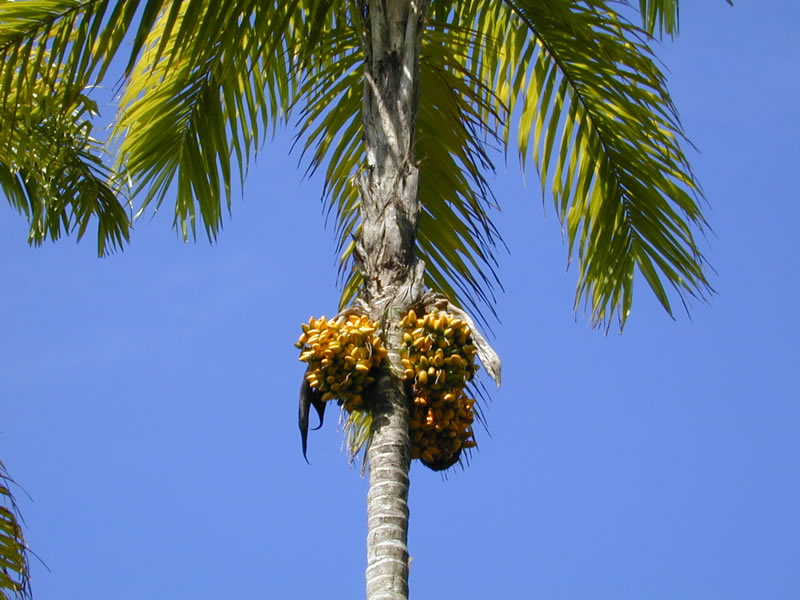

Side by side
| Bactris campestris | Peach Palm | |
|---|---|---|
| Scientific name | Bactris campestris Poepp. | Bactris gasipaes Kunth |
| English name | Not recorded | Peach Palm |
| Group | Flowering plants | Flowering plants |
| Class | Liliopsida | Liliopsida |
| Order | Arecales | Arecales |
| Family | Arecaceae Palm | Arecaceae Palm |
| Genus | Bactris Bactris Palm | Bactris Bactris Palm |
| Countries on record | 7 countries | 18 countries |
| GBIF occurrence records | 432 records | 2,102 records |
Rows where the two agree are shown in grey.
Where each is found
Both recorded in 7 countries
Only Peach Palm (11)
From Catalogue of Life checklists and GBIF occurrence records. A country missing from a list means no record is held, which is not proof of absence.
Checked facts
| Bactris campestris | Peach Palm | |
|---|---|---|
| Appearance |
|
|
| Size |
|
|
| Habitat |
|
|
| Diet | No checked fact yet |
|
| Reproduction |
|
|
| Distribution |
|
|
| Conservation | No checked fact yet |
|
| Uses |
|
|
| Other | No checked fact yet |
|
In brief
Bactris campestris
Bactris campestris Poepp. is a spiny palm that grows in small clumps containing multiple stems. It grows in savannas and low-stature forests on white sands at low elevations. Its fruits are red or orange-red and measure 0.5–1 centimetre in diameter. Full profile
Peach Palm
Bactris gasipaes is native to tropical forests of Central and South America, including the Amazon basin and humid lowlands of the Neotropics. It typically grows in clusters of spiny stems, has pinnate leaves, and produces edible fruits with red, yellow, or orange rinds. Full profile
Compare something else
Page built on 28 November 2026 from the data on the two species pages, where every source is listed.
Cite this page
ScientificNames.org. (2026). Bactris campestris vs Peach Palm. Retrieved November 28, 2026, from https://scientificnames.org/compare/bactris-campestris-vs-peach-palm
“Bactris campestris vs Peach Palm.” ScientificNames.org, 2026, scientificnames.org/compare/bactris-campestris-vs-peach-palm. Accessed 28 Nov. 2026.
ScientificNames.org. “Bactris campestris vs Peach Palm.” Accessed November 28, 2026. https://scientificnames.org/compare/bactris-campestris-vs-peach-palm.
@misc{scientificnames_bactris_campestris_vs_peach_palm,
  author = {{ScientificNames.org}},
  title = {Bactris campestris vs Peach Palm},
  year = {2026},
  url = {https://scientificnames.org/compare/bactris-campestris-vs-peach-palm},
  note = {Accessed 2026-11-28}
}