Comparison

Baja California Killifish vs Mummichog

Baja California Killifish (Fundulus lima) and Mummichog (Fundulus heteroclitus) both belong to the genus Fundulus (topminnows) and part ways below it. Both are recorded in 2 countries.

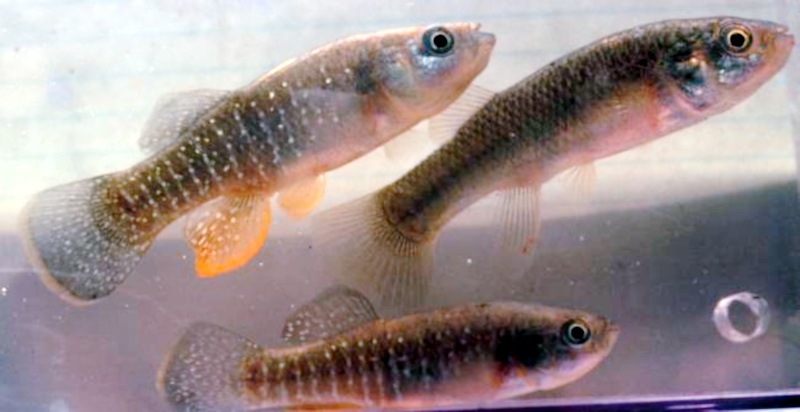
Mummichog

Mummichog

Fundulus heteroclitus

NOAA, Public domain, via Wikimedia Commons

Side by side

Baja California KillifishMummichog
Scientific nameFundulus lima Vaillant, 1894Fundulus heteroclitus (Linnaeus, 1766)
English nameBaja California KillifishMummichog
GroupFishesFishes
ClassTeleostei TeleostTeleostei Teleost
OrderCyprinodontiformesCyprinodontiformes
FamilyFundulidae FundulinesFundulidae Fundulines
GenusFundulus TopminnowsFundulus Topminnows
Named in18941766
Red List categoryEndangeredLeast Concern
Environmentfreshwaterbrackish, freshwater, marine
Countries on record2 countries7 countries
GBIF occurrence records155 records15,113 records

Rows where the two agree are shown in grey.

Where each is found

Both recorded in 2 countries

Only Mummichog (5)

From Catalogue of Life checklists and GBIF occurrence records. A country missing from a list means no record is held, which is not proof of absence.

Checked facts

Baja California KillifishMummichog
AppearanceNo checked fact yet
  • The species has an elongated, thick body and a deep caudal peduncle. English Wikipedia
  • Its mouth is upturned, and its lower jaw protrudes when the mouth is closed. English Wikipedia
  • Its pectoral and tail fins are rounded. English Wikipedia
  • Males have larger dorsal and anal fins than females. English Wikipedia
  • Its coloration is generally olive-brown or olive-green and may vary with the surrounding background. English Wikipedia
  • Males develop dark olive-green backs, steel-blue sides with approximately 15 silvery bars, and yellow or orange-yellow undersides during reproduction. English Wikipedia
  • Females are generally paler than males and lack their characteristic body bars and intense yellow belly coloration. English Wikipedia
SizeNo checked fact yet
Habitat
  • Fundulus lima occurs in oases, springs, ponds, and creeks. English Wikipedia
  • Fundulus lima inhabits clear-water environments with low salinity and relatively slow water flows. English Wikipedia
  • The substrates in habitats occupied by Fundulus lima consist of bedrock, sand, and gravel. English Wikipedia
  • Fundulus lima inhabits river drainage systems. pubmed.ncbi.nlm.nih.gov
  • The species inhabits brackish and coastal waters, including estuaries and salt marshes. English Wikipedia
  • Its coastal habitats include muddy creeks, tidal channels, eelgrass or cordgrass beds, and sheltered shorelines. English Wikipedia
  • The species occurs in coastal rivers but seldom beyond the tidal limit. English Wikipedia
  • Tidal creeks are a preferred habitat, alongside saltwater marshes, estuaries, and sheltered shores with submerged eelgrass. animaldiversity.org
  • Submerged vegetation is a common feature of the habitats used by this species for spawning and feeding. animaldiversity.org
Diet
  • Fundulus lima consumes diatoms, insect larvae, and fish scales during the dry season. English Wikipedia
  • Fundulus lima mainly consumes insect larvae, filamentous algae, and ostracods during the rainy season. English Wikipedia
  • The dietary composition of Fundulus lima varies seasonally. English Wikipedia
  • The species is an omnivore without a stomach. English Wikipedia
  • Its recorded food includes diatoms, amphipods, other crustaceans, molluscs, fish eggs, small fish, insect larvae, and eelgrass. English Wikipedia
  • Its diet includes phytoplankton, molluscs, crustaceans, insect larvae, eelgrass, and smaller fish. animaldiversity.org
BehaviourNo checked fact yet
  • Individuals form dense shoals that can contain several hundred fish. English Wikipedia
  • During northern winters, individuals move into upstream tidal pools and burrow into mud to depths of up to 20 cm. English Wikipedia
  • Some individuals move into deeper waters during freezing winter conditions rather than burrowing into sediment. animaldiversity.org
  • The species can survive several hours in moist air outside water by breathing air directly. English Wikipedia
  • Adults can use aquatic surface respiration when dissolved oxygen falls to approximately 1 mg/L. English Wikipedia
ReproductionNo checked fact yet
  • The spawning season extends from spring through fall. English Wikipedia
  • Southern populations can spawn up to eight times in a single season. English Wikipedia
  • Spawning occurs most frequently during high tides associated with new or full moons. English Wikipedia
  • Female fish attract males by turning onto their sides near the bottom and flicking their tails. English Wikipedia
  • Mummichog eggs are pale yellow, strongly adhesive, and approximately 2 mm in diameter. English Wikipedia
  • A female can deposit up to 740 eggs during a spawning event. English Wikipedia
  • Eggs may be attached to vegetation, algal mats, empty mussel shells, sand, or mud. English Wikipedia
  • Eggs develop while exposed to moist air and hatch when subsequent high spring tides submerge them. English Wikipedia
  • Northern subspecies eggs possess adhesive chorionic fibrils that are absent from southern subspecies eggs. English Wikipedia
  • Most individuals reach sexual maturity at approximately two years of age and 3.8 cm in length. English Wikipedia
  • Newly hatched larvae are approximately 7 mm long. animaldiversity.org
  • Larvae remain in the intertidal zone for six to eight weeks after hatching. animaldiversity.org
Distribution
  • Fundulus lima is native to the Baja California Peninsula region of northwestern Mexico. English Wikipedia
  • The type locality of Fundulus lima is San Ignacio de Caracamande in central Baja California. English Wikipedia
No checked fact yet
Conservation
  • Introduced populations of the species are considered a significant ecological concern in the European Union. English Wikipedia
UsesNo checked fact yet
  • The species has been used in attempts to control mosquito populations by consuming mosquito larvae. English Wikipedia
  • The species is commonly used in research on stress biology, thermal physiology, and toxicology. English Wikipedia
Similar speciesNo checked fact yet
  • The mummichog closely resembles the banded killifish (Fundulus diaphanus), and the two species have been reported to interbreed. English Wikipedia
Other
  • Mummichogs are nonmigratory and typically occupy home ranges smaller than 1,000 m. pmc.ncbi.nlm.nih.gov

In brief

Baja California Killifish

The Baja California Killifish (Fundulus lima Vaillant, 1894) is a fish in the family Fundulidae, order Cyprinodontiformes, and class Teleostei. It is native to the Baja California Peninsula region of northwestern Mexico and inhabits river drainage systems. Its diet varies seasonally, with different main food items consumed during the dry and rainy seasons. Full profile

Mummichog

Fundulus heteroclitus inhabits brackish and coastal waters, including estuaries, salt marshes and tidal creeks. It can survive several hours in moist air outside water by breathing air directly. Full profile

Compare something else

Page built on 28 November 2026 from the data on the two species pages, where every source is listed.

Cite this page

ScientificNames.org. (2026). Baja California Killifish vs Mummichog. Retrieved November 28, 2026, from https://scientificnames.org/compare/baja-california-killifish-vs-mummichog