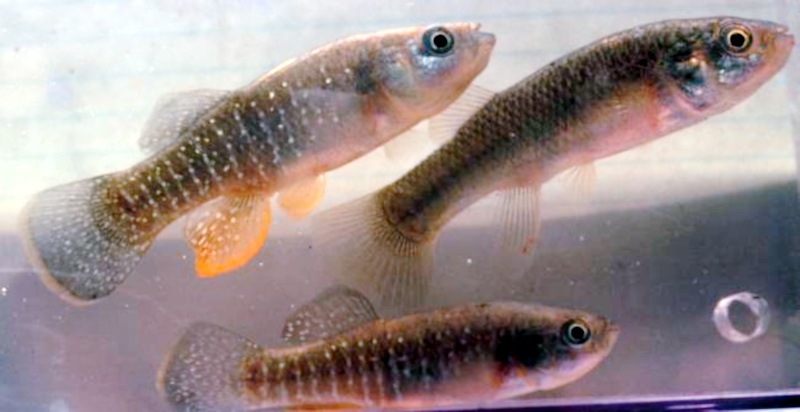
| Appearance | - The fish has a narrow, elongated bluish-gray or olive-colored body with a darker back and white or yellowish undersides. English Wikipedia
- The sides of the fish have between 12 and 20 vertical bands. English Wikipedia
- Females generally have thin, distinct black bands that often do not extend across the full width of the body. English Wikipedia
- Males have silvery, less distinct bands that are positioned closer together than those of females. English Wikipedia
- Breeding males develop yellow pectoral and pelvic fins and a bright blue patch on the anal fin. English Wikipedia
- The fish has rounded fins, a blunt snout, a small upward-facing mouth and a projecting lower jaw. English Wikipedia
- The species lacks a lateral line and has 39–43 scales in the lateral series. English Wikipedia
- The dorsal fin has 10–13 rays, the anal fin has 9–11 rays and the pelvic fins have six rays. English Wikipedia
- Breeding males develop bright bluish-green bars, a yellow throat and yellow fins. invasions.si.edu
| - The species has an elongated, thick body and a deep caudal peduncle. English Wikipedia
- Its mouth is upturned, and its lower jaw protrudes when the mouth is closed. English Wikipedia
- Its pectoral and tail fins are rounded. English Wikipedia
- Males have larger dorsal and anal fins than females. English Wikipedia
- Its coloration is generally olive-brown or olive-green and may vary with the surrounding background. English Wikipedia
- Males develop dark olive-green backs, steel-blue sides with approximately 15 silvery bars, and yellow or orange-yellow undersides during reproduction. English Wikipedia
- Females are generally paler than males and lack their characteristic body bars and intense yellow belly coloration. English Wikipedia
|
|---|
| Size | | |
|---|
| Habitat | - The fish commonly inhabits shallow, quiet areas of clear lakes, ponds, rivers and estuaries with sandy, gravelly or muddy bottoms and abundant aquatic vegetation. English Wikipedia
- The species primarily inhabits freshwater streams and lakes but can also occur in brackish water. English Wikipedia
- The fish inhabits shallow freshwater and brackish environments across temperatures ranging from 6 to 38 °C. invasions.si.edu
- The species generally prefers shallow lake and pond margins and sluggish streams near dense vegetation. invasions.si.edu
- The fish can tolerate salinities up to 70 PSU under laboratory conditions, although it does not usually occur above 20 PSU. invasions.si.edu
- The species may be unable to reproduce at salinities above 10 PSU. invasions.si.edu
| - The species inhabits brackish and coastal waters, including estuaries and salt marshes. English Wikipedia
- Its coastal habitats include muddy creeks, tidal channels, eelgrass or cordgrass beds, and sheltered shorelines. English Wikipedia
- The species occurs in coastal rivers but seldom beyond the tidal limit. English Wikipedia
- Tidal creeks are a preferred habitat, alongside saltwater marshes, estuaries, and sheltered shores with submerged eelgrass. animaldiversity.org
- Submerged vegetation is a common feature of the habitats used by this species for spawning and feeding. animaldiversity.org
|
|---|
| Diet | - Adult fish feed on insects, insect nymphs, mollusks, turbellarians and small crustaceans. English Wikipedia
- Mosquito larvae are a common food source for the species. English Wikipedia
- Smaller individuals feed on chironomid larvae, cladocerans, copepods and midge larvae. English Wikipedia
- The fish feeds at all levels of the water column. English Wikipedia
- The species feeds on insect larvae and microcrustaceans. invasions.si.edu
- Plant material found in the fish's gut may have been consumed incidentally. invasions.si.edu
| - The species is an omnivore without a stomach. English Wikipedia
- Its recorded food includes diatoms, amphipods, other crustaceans, molluscs, fish eggs, small fish, insect larvae, and eelgrass. English Wikipedia
- Its diet includes phytoplankton, molluscs, crustaceans, insect larvae, eelgrass, and smaller fish. animaldiversity.org
|
|---|
| Behaviour | - Adult fish commonly travel in groups of three to six individuals, while juveniles form groups of eight to twelve. English Wikipedia
- The fish often swims in schools just below the water surface. invasions.si.edu
- Fish exposed to predatory stimuli form larger shoals for increased protection. English Wikipedia
- Hungry individuals are more likely to leave a shoal than well-fed individuals. English Wikipedia
- The fish often seeks refuge when frightened by a predator. English Wikipedia
- The species commonly feeds during the afternoon. English Wikipedia
| - Individuals form dense shoals that can contain several hundred fish. English Wikipedia
- During northern winters, individuals move into upstream tidal pools and burrow into mud to depths of up to 20 cm. English Wikipedia
- Some individuals move into deeper waters during freezing winter conditions rather than burrowing into sediment. animaldiversity.org
- The species can survive several hours in moist air outside water by breathing air directly. English Wikipedia
- Adults can use aquatic surface respiration when dissolved oxygen falls to approximately 1 mg/L. English Wikipedia
|
|---|
| Reproduction | - The species reproduces through external fertilization, with eggs bearing adhesive threads that attach them to plants. English Wikipedia
- A female can lay between 50 and 100 eggs during a spawning sequence. English Wikipedia
- A female may produce several egg clutches during a single summer. English Wikipedia
- The eggs hatch within 10–12 days, depending on water temperature. English Wikipedia
- The species reaches sexual maturity at approximately one year of age. English Wikipedia
| - The spawning season extends from spring through fall. English Wikipedia
- Southern populations can spawn up to eight times in a single season. English Wikipedia
- Spawning occurs most frequently during high tides associated with new or full moons. English Wikipedia
- Female fish attract males by turning onto their sides near the bottom and flicking their tails. English Wikipedia
- Mummichog eggs are pale yellow, strongly adhesive, and approximately 2 mm in diameter. English Wikipedia
- A female can deposit up to 740 eggs during a spawning event. English Wikipedia
- Eggs may be attached to vegetation, algal mats, empty mussel shells, sand, or mud. English Wikipedia
- Eggs develop while exposed to moist air and hatch when subsequent high spring tides submerge them. English Wikipedia
- Northern subspecies eggs possess adhesive chorionic fibrils that are absent from southern subspecies eggs. English Wikipedia
- Most individuals reach sexual maturity at approximately two years of age and 3.8 cm in length. English Wikipedia
- Newly hatched larvae are approximately 7 mm long. animaldiversity.org
- Larvae remain in the intertidal zone for six to eight weeks after hatching. animaldiversity.org
|
|---|
| Conservation | - The Newfoundland population was designated a vulnerable species under Canadian legislation in January 2005. English Wikipedia
- The Newfoundland population was assigned special concern status because of its geographic isolation and limited potential for range expansion. English Wikipedia
- Habitat degradation associated with industrial development, motorized watercraft and aquatic vegetation removal threatens the species. English Wikipedia
| - Introduced populations of the species are considered a significant ecological concern in the European Union. English Wikipedia
|
|---|
| Uses | | - The species has been used in attempts to control mosquito populations by consuming mosquito larvae. English Wikipedia
- The species is commonly used in research on stress biology, thermal physiology, and toxicology. English Wikipedia
|
|---|
| Similar species | - The banded killifish resembles the mummichog in habitat preference and appearance. English Wikipedia
- The banded killifish can be distinguished from the mummichog by its thin dark bars, whereas the mummichog has thin light bars. English Wikipedia
| - The mummichog closely resembles the banded killifish (Fundulus diaphanus), and the two species have been reported to interbreed. English Wikipedia
|
|---|
| Other | No checked fact yet | - Mummichogs are nonmigratory and typically occupy home ranges smaller than 1,000 m. pmc.ncbi.nlm.nih.gov
|
|---|