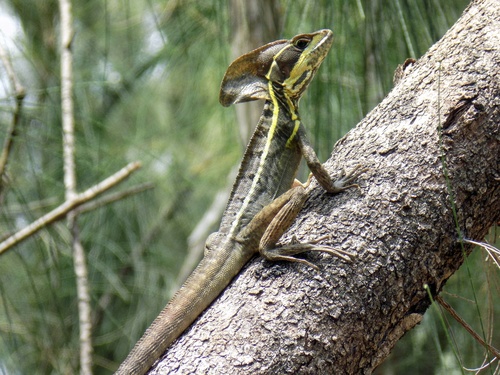
| Appearance | - The brown basilisk has brown or olive-brown coloration with black crossbands, usually located on its flanks and dorsal crest. English Wikipedia
- A white stripe extends from the eyes to the rear legs. English Wikipedia
- The species has a three-part dorsal crest extending across its head, back, and tail. English Wikipedia
- Male brown basilisks have larger crests than females. English Wikipedia
- The brown basilisk has long toes equipped with sharp claws. English Wikipedia
- Both sexes have dark dorsal bars and variably distinct yellowish dorsolateral lines. animaldiversity.org
- The lips and underside of the brown basilisk are light-colored. animaldiversity.org
- Young brown basilisks have particularly prominent coloration patterns. animaldiversity.org
- The species has long, slender limbs and tails, fringed toes, and a laterally compressed tail. animaldiversity.org
- Adult males have a large flaplike crest supported by flexible cartilage that extends from the back of the head to the neck. animaldiversity.org
- Females have a folded hood outlining the back of the head and a lower vertebral crest than males. animaldiversity.org
- Male brown basilisks have more elongated snouts than females. animaldiversity.org
| - The western basilisk has an olive-green body and a reddish-brown underbelly. English Wikipedia
- The throat of the western basilisk is white to yellow. English Wikipedia
- The western basilisk has a small crest on its back resembling that of juvenile common basilisks. English Wikipedia
- The western basilisk may have a narrow white stripe or a row of white dots on each side of its body. English Wikipedia
- Adult male western basilisks have a round flap or crest on the head. English Wikipedia
|
|---|
| Size | - Male brown basilisks can reach 61 centimetres in total length, including the tail. English Wikipedia
- Female brown basilisks are smaller than males. English Wikipedia
- Brown basilisks weigh approximately 200–600 grams. English Wikipedia
- Adult brown basilisks can reach approximately 1.5–2.5 feet in length. lamar.edu
- Sexual maturity can be reached when individuals measure approximately 9–10 centimetres. animaldiversity.org
| - Male western basilisks can reach approximately 77.5 cm in total length, including the tail. English Wikipedia
- Female western basilisks can reach approximately 63.5 cm in total length. English Wikipedia
|
|---|
| Habitat | - The brown basilisk inhabits tropical and subtropical wet, moist, and dry forests. animaldiversity.org
- The species occurs in dense vegetation along the margins of water bodies. animaldiversity.org
- Brown basilisks inhabit areas near inland streams in various forest types, generally below 800 metres elevation. lamar.edu
- The species can inhabit bushes, lower tree branches, and thickets, as well as ground-level environments. animaldiversity.org
- At night, brown basilisks sleep in vine-covered thickets or on low bushes. animaldiversity.org
| - The western basilisk inhabits forests at elevations ranging from 0 to 1,600 m. English Wikipedia
|
|---|
| Diet | - Brown basilisks feed primarily on insects and sometimes consume fallen berries. animaldiversity.org
- The species consumes grasshoppers, scorpions, freshwater shrimp, and small lizards or snakes. lamar.edu
- Brown basilisks also consume fallen berries and fruit. lamar.edu
| No checked fact yet |
|---|
| Behaviour | - Brown basilisks are active during daylight hours. English Wikipedia
- The species can run across still water when startled. animaldiversity.org
- Smaller brown basilisks can run approximately 10–20 metres across water without sinking. English Wikipedia
- Young brown basilisks can generally run farther across water than older individuals. English Wikipedia
- When escaping danger across water, brown basilisks open the skin flaps on their hind toes to increase surface area. English Wikipedia
- Brown basilisks are capable of climbing, running, and swimming. animaldiversity.org
- The species relies mainly on alertness and speed to escape predators. animaldiversity.org
- Brown basilisks may vigorously lash their tails when captured or threatened. animaldiversity.org
- Brown basilisks commonly bask on sunny, hot rocks during daylight. lamar.edu
- Brown basilisks can remain underwater for up to 30 minutes while escaping terrestrial predators. lamar.edu
| No checked fact yet |
|---|
| Reproduction | - Female brown basilisks lay approximately 2–18 eggs per clutch, five to eight times annually. English Wikipedia
- Brown basilisk eggs hatch after approximately three months. English Wikipedia
- Newly hatched brown basilisks weigh approximately 2 grams. English Wikipedia
- Females lay between three and twelve eggs from May through August in secluded, moisture-retaining nesting sites, usually holes along canal banks. animaldiversity.org
- Eggs generally hatch between 55 and 65 days after being laid. animaldiversity.org
- Female brown basilisks provide no parental care after laying their eggs. animaldiversity.org
- Brown basilisks may reproduce throughout the year, although male reproductive activity peaks during the dry season. English Wikipedia
- Male brown basilisks exhibit peak insemination or copulation activity at the beginning of the rainy season. English Wikipedia
- Brown basilisks can reach sexual maturity before one year of age. animaldiversity.org
- Hatchlings may reach sexual maturity in as little as three months during the wet season. animaldiversity.org
| No checked fact yet |
|---|
| Distribution | - The brown basilisk is native to Mexico, Central America, and adjacent northwestern Colombia. English Wikipedia
| - The western basilisk is native to western Colombia and western Ecuador. English Wikipedia
- The western basilisk is endemic to northwestern South America. English Wikipedia
- The western basilisk has been introduced to Gorgona Island in Colombia. English Wikipedia
- Reports of the western basilisk occurring in Central America are mistaken and refer to young common basilisks. English Wikipedia
|
|---|
| Conservation | - The brown basilisk is not classified as an endangered species in the cited document. lamar.edu
- Increasing capture for the pet trade has placed pressure on local brown basilisk populations in tropical ecosystems. lamar.edu
| - The western basilisk is considered common and not threatened. English Wikipedia
- The introduction of the western basilisk to Gorgona Island threatens native species living there, including the endemic blue anole. English Wikipedia
|
|---|
| Uses | - Brown basilisks help regulate invertebrate and small rodent populations in their adult stage. lamar.edu
- Brown basilisks serve as an important food source for many tropical bird species and terrestrial mammals. lamar.edu
| No checked fact yet |
|---|
| Other | - The brown basilisk is also known as the Jesus Christ lizard because of its ability to run across water. animaldiversity.org
| - The western basilisk is also known as the red-headed basilisk. English Wikipedia
- The western basilisk is classified as a large lizard in the family Corytophanidae. English Wikipedia
|
|---|