Species · Reptiles
Western Basilisk Basiliscus galeritus
The scientific name of the Western Basilisk is Basiliscus galeritus. It is a species of reptile in the family Corytophanidae (helmet lizards), order Squamata. The name dates from 1851.
- Scientific name
- Basiliscus galeritus Duméril, 1851
- Common name
- Western Basilisk
- Genus
- Basiliscus
- Family
- Corytophanidae (Helmet Lizards)
- Order
- Squamata
- Class
- Reptilia
- Red List category
- LC Least Concern
- Recorded in
- 4 countries
- Name status
- accepted in the Catalogue of Life

Overview
The western basilisk (Basiliscus galeritus), also known as the red-headed basilisk, is a large species of lizard in the family Corytophanidae. The species is endemic to northwestern South America.
Classification of the Western Basilisk
| Kingdom | Animalia |
|---|---|
| Phylum | Chordata |
| Subphylum | Vertebrata |
| Infraphylum | Gnathostomata |
| Parvphylum | Osteichthyes |
| Megaclass | Tetrapoda |
| Class | Reptilia (Reptile) |
| Order | Squamata (Snakes) |
| Suborder | Iguania (Iguanas) |
| Family | Corytophanidae (Helmet Lizards) |
| Genus | Basiliscus (Basilisks) |
| Species | Basiliscus galeritus Duméril, 1851 |
Where the Western Basilisk is found
Checklists and occurrence records place Basiliscus galeritus in 4 countries across North America and South America. GBIF holds 3,730 georeferenced records of it.
Countries
Regions and cities with the most records
- Santander Department, Colombia 1,461
- Antioquia, Colombia 449
- Pichincha, Ecuador 220
- Chocó, Colombia 208
- Valle del Cauca Department, Colombia 187
- Esmeraldas, Ecuador 106
- Boyacá, Colombia 69
- Santo Domingo de los Tsáchilas, Ecuador 65
- Buenaventura, Colombia 64
- Caldas Department, Colombia 60
- Buenaventura, Colombia 50
- Girón, Colombia 49
- Cundinamarca, Colombia 41
- Nariño, Colombia 37
- Tolima Department, Colombia 32
- Cauca Department, Colombia 31
- Bucaramanga, Colombia 30
- Carchi, Ecuador 29
- Bolívar, Colombia 24
- Floridablanca, Colombia 24
- Piedecuesta, Colombia 24
- Imbabura, Ecuador 22
- Meta Department, Colombia 19
- Quibdó, Colombia 18
- Quindío Department, Colombia 18
- La Dorada, Colombia 15
- Santo Domingo de los Colorados, Ecuador 15
- Huila Department, Colombia 14
- Palmira, Colombia 14
- Cimitarra, Colombia 13
- Armenia, Colombia 12
- Chimborazo Province, Ecuador 12
- Juan Díaz, Panama 12
- Panama City, Panama 12
- Panamá, Panama 12
- San Miguelito, Panama 12
Range as the checklists state it
Colombia (in rainforest, forested and areas related to small rivers in Choco Biogeographic Región, Cauca river valley in Antioquia, Caldas, Quindio; Magdalena River Valley in forested wet areas through Tolima), Ecuador, Panama
A number beside a place is its count of GBIF occurrence records. A place without a number comes from a checklist alone. Records show where a species has been observed or collected, which can include escapes and vagrants.
Common names
English
- Western Basilisk
Names in 6 other languages
- Czech
- bazilišek kohoutí
- French
- Basilic de l'Ouest, Basilic à tête rouge
- German
- Ekuadorbasilisk
- Japanese
- ギザギザバシリスク
- Russian
- Хохлатый василиск
- Spanish
- Basilisco de cabeza roja, Lagarto Jesucristo de Cabeza Roja, Toloque sudamericano de cabeza roja
Synonyms
One other scientific name has been used for this species and is now treated as a synonym of Basiliscus galeritus.
- Ptenosaura seemanni Gray, 1852
Related species
-
 Common BasiliskBasiliscus basiliscus
-
 Plumed BasiliskBasiliscus plumifrons
-
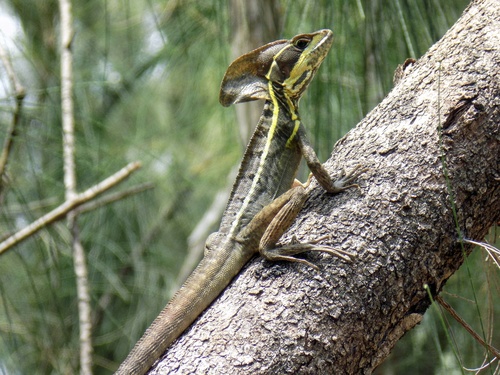 Brown BasiliskBasiliscus vittatus
-
 Smooth Helmeted IguanaCorytophanes cristatus
-
 Eastern Casquehead IguanaLaemanctus longipes
- Julio’s Casquehead IguanaLaemanctus julioi
-
 Hernandez’s Helmeted BasiliskCorytophanes hernandesii
-
 Serrated Casquehead IguanaLaemanctus serratus
Compare
Questions and answers
What is the scientific name of the Western Basilisk?
The scientific name of the Western Basilisk is Basiliscus galeritus. Written with its author, the full name is Basiliscus galeritus Duméril, 1851.
Which family does the Western Basilisk belong to?
Basiliscus galeritus belongs to the family Corytophanidae, in the order Squamata and the class Reptilia.
Where is the Western Basilisk found?
Checklists and occurrence records place Basiliscus galeritus in 4 countries: Colombia, Ecuador, Panama and Costa Rica.
What is the conservation status of the Western Basilisk?
The IUCN Red List category recorded for Basiliscus galeritus is Least Concern (LC).
Sources
Data
- Catalogue of Life, 2026-10-16 XR cc by
- Global Biodiversity Information Facility CC BY 4.0
- Wikidata CC0
- English Wikipedia CC BY-SA 4.0
- GeoNames CC BY 4.0
- Wikimedia Commons per image; credit shown with each image
- Within the Catalogue of Life, this name comes from The Reptile Database cc by
References
- Duméril, A.M.C. & A. H. A. Duméril. (1851). Catalogue méthodique de la collection des reptiles du Muséum d’Histoire Naturelle de Paris. Gide et Baudry/Roret, Paris, 224 Pp.
- Gray, J. E. (1852). Description of several new genera of reptiles, principally from the collection of H.M.S. Herald. Ann. Mag. Nat. Hist. (2) 10: 437-440.
- Günther, A. (1860). Third list of the col-blooded vertebrata collected by Mr. Fraser in Ecuador. Proc. Zool. Soc. London 1860: 233-240.
- Boulenger, G. A. (1885). Catalogue of the lizards in the British Museum (Natural History). Vol. 2, Second edition. London, Xiii+497 Pp.
- Taylor, E. H. (1956). A review of the lizards of Costa Rica. Univ. Kansas Sci. Bull. 38 (Part 1): 3-322.
- Maturana, H. R. (1962). A study of the species of the genus Basiliscus. Bull. Mus. Comp. Zool. Harvard 128: 1-34.
- Peters, James A. & Donoso-Barros, Roberto. (1970). Catalogue of the Neotropical Squamata: Part II. Lizards and Amphisbaenians. Bull. US Natl. Mus. 297: 293 Pp.
- Lang, M. (1989). Phylogenetic and Biogeographic Patterns of Basiliscine Iguanians (Reptilia: Squamata: “Iguanidae”). Bonner Zool. Monogr. 28: 1-172.
- Vargas-S., F. & Bolanos-L., M.E. (1999). Presencia de reptiles en la región de Anchicayá, pacifico colombiano, a través de un gradiente de deforestación. Caldasia 21 (2): 235-238.
- Páez, V.P. et al. (2002). Guía de campo de algunas especies de anfibios y reptiles de Antioquia. Universidad de Antioquia,.
- Vieira, G. H. C., Colli, G. R., & Báo, S. N. (2005). Phylogenetic relationships of corytophanid lizards (Iguania, Squamata, Reptilia) based on partitioned and total evidence analyses of sperm morphology, gross morphology, and DNA data. Zoologica Scripta 34 (6): 605-625.
- Köhler, G. (2008). Reptiles of Central America. 2nd Ed. Herpeton-Verlag, 400 Pp.
- Cortés Gómez, Angela María; Anyelet Valencia Aguilar, Diana Marcela Torres Domínguez, Lina María García Calderón, Diego Fernando Villaquirán Martínez, Andrea del Pilar Cáceres Franco, Fernando Castro Herrera. (2010). Guía de los anfibios y reptiles. Área en conservación de la microcuenca Quebrada Pericos. [Valle de Cauca, Colombia]. Corporación Autónoma Regional Del Valle Del Cauca, Santiago de Cali: CVC, 37 Pp.
- Ríos, E.E.; C.F. Hurtado P., J.T. Rengifo M., and F. Castro Herrera. (2011). LAGARTOS EN COMUNIDADES NATURALES DE DOS LOCALIDADES EN LA REGIÓN DEL CHOCÓ DE COLOMBIA. Herpetotropicos 5 (2): 85-92.
- Wirth, & Michael. (2012). Basilisken. Spektakuläre Vertreter der Leguane. Terraria-Elaphe 2012 (2): 14-32.
- CASTRO-HERRERA, F., & ANYELET VALENCIA-AGUILAR, D. V.-M. (2012). Diversidad de Anfibios y Reptiles del Parque Nacional Natural Isla Gorgona. Universidad Del Valle, Santiago de Cali, Valle Del Cauca, 112 Pp.
- Arteaga AF, & Bustamante-Enríquez LM and Guayasamin JM. (2013). The Amphibians and Reptiles of Mindo. http://www.tropicalherping.com.
- Valencia-Zuleta A, Jaramillo-Martínez AF, Echeverry-Bocanegra A, Viáfara-Vega R, Hernández-Córdoba O, Cardona-Botero VE, Gutiérrez-Zúñiga J, Castro-Herrera F. (2014). Conservation status of the herpetofauna, protected areas, and current problems in Valle del Cauca, Colombia. Amphibian & Reptile Conservation 8 (2): 1–18 (E87).
- Restrepo A, Molina-Zuluaga C, Hurtado JP, Marín CM, & Daza JM. (2017). Amphibians and reptiles from two localities in the northern Andes of Colombia. Check List 13 (4): 203-237.
- Carvajal-Cogollo, Juan E. (2019). CAPÍTULO III TAXONOMÍA, SISTEMÁTICA Y ZOOGEOGRAFÍA DE REPTILES. In: Vargas-Salinas et al., Biología de los anfbios y reptiles en el bosque seco tropical del norte de Colombia. Tunja: Editorial UPTC.
- Torres-Carvajal O, Pazmiño-Otamendi G, Salazar-Valenzuela D. (2019). Reptiles of Ecuador: a resource-rich portal, with a dynamic checklist and photographic guides. Amphibian & Reptile Conservation 13 (1): [General Section]: 209–229 (E178).
- Pinto-Erazo, M. A., Calderón-Espinosa, M. L., Medina-Rangel, G. F., & Méndez-Galeano, M. A. (2020). Herpetofauna from two municipalities of southwestern Colombia. Biota Colombiana 21(1): 41-57. DOI: 10.21068/C2020.V21n01a04.
- Rodriguez-Miranda, L. A., Lozano-Aguilar, L. E., Altamirano-Benavides, M., & Méndez-De la Cruz, F. R. (2021). Thermal ecophysiology of Basiliscus galeritus (Squamata: Corytophanidae) in two populations at different altitudes: Does the crest participate actively in thermoregulation?. Journal of Thermal Biology, 102980.
- ZULUAGA ISAZA, JUAN CAMILO; SERGIO ESCOBAR LASSO & CRISTHIAN LONDOÑO QUICENO. (2022). When running on water isn’t enough, you can dive: Field observation of diving behaviour as antipredator strategy of the Western Basilisk Basiliscus galeritus Duméril 1851. Reptiles & Amphibians 29(1): 52–54.
- Cuadrado, S. S., Loor, Y. A., Zambrano, R. H., & Narváez, A. E. (2023). Species Composition and Ecology of Diurnal Herpetofauna in Agroecosystems of the Ecuadorian Chocó. South American Journal of Herpetology, 29(1), 66-76.
This species in other databases
Page built on 26 November 2026. See how the catalog is made and all sources and licences.
Cite this page
ScientificNames.org. (2026). Basiliscus galeritus (Western Basilisk). Retrieved November 26, 2026, from https://scientificnames.org/species/basiliscus-galeritus
“Basiliscus galeritus (Western Basilisk).” ScientificNames.org, 2026, scientificnames.org/species/basiliscus-galeritus. Accessed 26 Nov. 2026.
ScientificNames.org. “Basiliscus galeritus (Western Basilisk).” Accessed November 26, 2026. https://scientificnames.org/species/basiliscus-galeritus.
@misc{scientificnames_basiliscus_galeritus_western_basilisk,
  author = {{ScientificNames.org}},
  title = {Basiliscus galeritus (Western Basilisk)},
  year = {2026},
  url = {https://scientificnames.org/species/basiliscus-galeritus},
  note = {Accessed 2026-11-26}
}