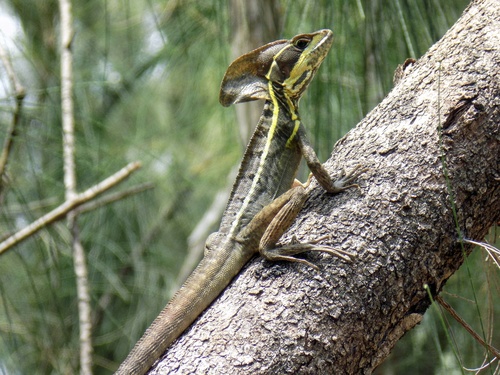
| Appearance | - The brown basilisk has brown or olive-brown coloration with black crossbands, usually located on its flanks and dorsal crest. English Wikipedia
- A white stripe extends from the eyes to the rear legs. English Wikipedia
- The species has a three-part dorsal crest extending across its head, back, and tail. English Wikipedia
- Male brown basilisks have larger crests than females. English Wikipedia
- The brown basilisk has long toes equipped with sharp claws. English Wikipedia
- Both sexes have dark dorsal bars and variably distinct yellowish dorsolateral lines. animaldiversity.org
- The lips and underside of the brown basilisk are light-colored. animaldiversity.org
- Young brown basilisks have particularly prominent coloration patterns. animaldiversity.org
- The species has long, slender limbs and tails, fringed toes, and a laterally compressed tail. animaldiversity.org
- Adult males have a large flaplike crest supported by flexible cartilage that extends from the back of the head to the neck. animaldiversity.org
- Females have a folded hood outlining the back of the head and a lower vertebral crest than males. animaldiversity.org
- Male brown basilisks have more elongated snouts than females. animaldiversity.org
| - Adults have bright green bodies, yellow eyes, and small bluish spots along the dorsal ridge. English Wikipedia
- Adult males have three prominent crests on their heads, backs, and tails, whereas females have only a head crest. English Wikipedia
- Juveniles have less conspicuous coloration and lack the characteristic crests. English Wikipedia
- The species has a lighter green underbelly than the rest of its bright green body. English Wikipedia
- Its head is triangular when viewed from the side. English Wikipedia
- Its eyes are generally round, with round pupils and yellow irises. English Wikipedia
- Its skin is covered mainly by small granular scales. English Wikipedia
- Its hind legs are longer than its front limbs. English Wikipedia
|
|---|
| Size | - Male brown basilisks can reach 61 centimetres in total length, including the tail. English Wikipedia
- Female brown basilisks are smaller than males. English Wikipedia
- Brown basilisks weigh approximately 200–600 grams. English Wikipedia
- Adult brown basilisks can reach approximately 1.5–2.5 feet in length. lamar.edu
- Sexual maturity can be reached when individuals measure approximately 9–10 centimetres. animaldiversity.org
| - The species has an average snout-to-vent length of approximately 25 cm. English Wikipedia
- Its total length, including the tail, can reach approximately 91 cm. English Wikipedia
- Newly hatched juveniles average approximately 43 mm in snout-to-vent length and weigh about 2 grams. English Wikipedia
- Adult specimens can run across water at approximately 2.14 m/s. English Wikipedia
|
|---|
| Habitat | - The brown basilisk inhabits tropical and subtropical wet, moist, and dry forests. animaldiversity.org
- The species occurs in dense vegetation along the margins of water bodies. animaldiversity.org
- Brown basilisks inhabit areas near inland streams in various forest types, generally below 800 metres elevation. lamar.edu
- The species can inhabit bushes, lower tree branches, and thickets, as well as ground-level environments. animaldiversity.org
- At night, brown basilisks sleep in vine-covered thickets or on low bushes. animaldiversity.org
| |
|---|
| Diet | - Brown basilisks feed primarily on insects and sometimes consume fallen berries. animaldiversity.org
- The species consumes grasshoppers, scorpions, freshwater shrimp, and small lizards or snakes. lamar.edu
- Brown basilisks also consume fallen berries and fruit. lamar.edu
| - The species is omnivorous and consumes both animal matter and vegetation. English Wikipedia
- Its animal prey includes insects and worms. English Wikipedia
- Its plant food includes fruits, seeds, flowers, and leaves. English Wikipedia
- It also hunts fish, rodents, small birds, nonvenomous snakes, lizards, amphibians, crustaceans, and spiders. English Wikipedia
- Brown crickets, black crickets, and locusts are among its typical foods. English Wikipedia
|
|---|
| Behaviour | - Brown basilisks are active during daylight hours. English Wikipedia
- The species can run across still water when startled. animaldiversity.org
- Smaller brown basilisks can run approximately 10–20 metres across water without sinking. English Wikipedia
- Young brown basilisks can generally run farther across water than older individuals. English Wikipedia
- When escaping danger across water, brown basilisks open the skin flaps on their hind toes to increase surface area. English Wikipedia
- Brown basilisks are capable of climbing, running, and swimming. animaldiversity.org
- The species relies mainly on alertness and speed to escape predators. animaldiversity.org
- Brown basilisks may vigorously lash their tails when captured or threatened. animaldiversity.org
- Brown basilisks commonly bask on sunny, hot rocks during daylight. lamar.edu
- Brown basilisks can remain underwater for up to 30 minutes while escaping terrestrial predators. lamar.edu
| |
|---|
| Reproduction | - Female brown basilisks lay approximately 2–18 eggs per clutch, five to eight times annually. English Wikipedia
- Brown basilisk eggs hatch after approximately three months. English Wikipedia
- Newly hatched brown basilisks weigh approximately 2 grams. English Wikipedia
- Females lay between three and twelve eggs from May through August in secluded, moisture-retaining nesting sites, usually holes along canal banks. animaldiversity.org
- Eggs generally hatch between 55 and 65 days after being laid. animaldiversity.org
- Female brown basilisks provide no parental care after laying their eggs. animaldiversity.org
- Brown basilisks may reproduce throughout the year, although male reproductive activity peaks during the dry season. English Wikipedia
- Male brown basilisks exhibit peak insemination or copulation activity at the beginning of the rainy season. English Wikipedia
- Brown basilisks can reach sexual maturity before one year of age. animaldiversity.org
- Hatchlings may reach sexual maturity in as little as three months during the wet season. animaldiversity.org
| - Females lay between five and fifteen eggs per clutch in warm, damp sand or soil. English Wikipedia
- Eggs hatch after approximately eight to ten weeks. English Wikipedia
- Females may produce multiple clutches, with up to four or five clutches during one breeding season. English Wikipedia
- Juvenile males begin developing their characteristic large crests after approximately six months or later. English Wikipedia
|
|---|
| Lifespan | No checked fact yet | |
|---|
| Distribution | - The brown basilisk is native to Mexico, Central America, and adjacent northwestern Colombia. English Wikipedia
| - The species is native to Central America. English Wikipedia
- Its native range extends from southern Mexico to northern Colombia. English Wikipedia
- Its documented range may extend across the Atlantic versant from eastern Honduras to western Panama. English Wikipedia
- The species has also been sighted along the Pacific coast of southwestern Costa Rica. English Wikipedia
|
|---|
| Conservation | - The brown basilisk is not classified as an endangered species in the cited document. lamar.edu
- Increasing capture for the pet trade has placed pressure on local brown basilisk populations in tropical ecosystems. lamar.edu
| - Agroforestry systems incorporating trees are described as necessary for preserving the species. English Wikipedia
|
|---|
| Uses | - Brown basilisks help regulate invertebrate and small rodent populations in their adult stage. lamar.edu
- Brown basilisks serve as an important food source for many tropical bird species and terrestrial mammals. lamar.edu
| No checked fact yet |
|---|
| Other | - The brown basilisk is also known as the Jesus Christ lizard because of its ability to run across water. animaldiversity.org
| |
|---|