Species · Reptiles
Plumed Basilisk Basiliscus plumifrons
The scientific name of the Plumed Basilisk is Basiliscus plumifrons. It is a species of reptile in the family Corytophanidae (helmet lizards), order Squamata. The name dates from 1875.
- Scientific name
- Basiliscus plumifrons Cope, 1875
- Common name
- Plumed Basilisk
- Genus
- Basiliscus
- Family
- Corytophanidae (Helmet Lizards)
- Order
- Squamata
- Class
- Reptilia
- Red List category
- LC Least Concern
- Environment
- terrestrial
- Recorded in
- 5 countries
- Name status
- accepted in the Catalogue of Life

Overview
Basiliscus plumifrons inhabits Central America, with a native range extending from southern Mexico to northern Colombia. It is distinguished by its bright green body and the prominent head, back, and tail crests of adult males.
Written 26 November 2026 from the sources listed below. Each statement was checked against the passage it cites; statements that could not be supported were removed.
Appearance
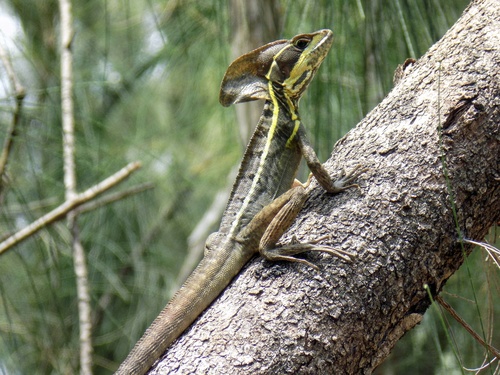
Adults have bright green bodies, lighter green underbellies, yellow eyes, and small bluish spots along the dorsal ridge. Their eyes are generally round, with round pupils and yellow irises.[1][2][3]
Adult males have three prominent crests on their heads, backs, and tails, whereas females have only a head crest. Juveniles have less conspicuous coloration and lack the characteristic crests.[4][5]
The head is triangular when viewed from the side, and the skin is covered mainly by small granular scales. The hind legs are longer than the front limbs.[6][7][8]
The average snout-to-vent length is approximately 25 cm, and total length, including the tail, can reach approximately 91 cm. Newly hatched juveniles average approximately 43 mm in snout-to-vent length and weigh about 2 grams.[9][10][11]
The species is identified as the most brightly colored of the four basilisk species.[12]
Habitat
The Plumed Basilisk inhabits hot, humid rainforests containing streams, rivers, or other water bodies. It prefers moist lowlands in mature forests with running streams.[13][14]
It is arboreal and diurnally active, occurring both in trees and on boulders near water. Its preferred temperature is approximately 31.7 °C.[15][16][17]
It occurs in rivers, streams, ponds, lakes, beaches, and seashores in Central America.[18]
Its documented range may extend across the Atlantic versant from eastern Honduras to western Panama. It has also been sighted along the Pacific coast of southwestern Costa Rica.[19][20]
Diet
The Plumed Basilisk is omnivorous and consumes both animal matter and vegetation. Its animal prey includes insects and worms, while its plant food includes fruits, seeds, flowers, and leaves.[21][22][23]
It also hunts fish, rodents, small birds, nonvenomous snakes, lizards, amphibians, crustaceans, and spiders. Brown crickets, black crickets, and locusts are among its typical foods.[24][25]
Behaviour
The Plumed Basilisk can run short distances across water using its feet and tail for support. This movement is bipedal and relies on its hind legs.[26][27]
It commonly runs across water to escape predators when threatened. Adult specimens can run across water at approximately 2.14 m/s.[28][29]
The species can remain underwater for up to an hour and can sprint on its hind legs.[30][31]
Males defend territories that may contain several females. The species is highly territorial and aggressive.[32][33]
Reproduction and life cycle
Females lay between five and fifteen eggs per clutch in warm, damp sand or soil. Eggs hatch after approximately eight to ten weeks.[34][35]
Females may produce multiple clutches, with up to four or five clutches during one breeding season. Juvenile males begin developing their characteristic large crests after approximately six months or later.[36][37]
Conservation
Agroforestry systems incorporating trees are described as necessary for preserving the Plumed Basilisk.[38]
Classification of the Plumed Basilisk
| Kingdom | Animalia |
|---|---|
| Phylum | Chordata |
| Subphylum | Vertebrata |
| Infraphylum | Gnathostomata |
| Parvphylum | Osteichthyes |
| Megaclass | Tetrapoda |
| Class | Reptilia (Reptile) |
| Order | Squamata (Snakes) |
| Suborder | Iguania (Iguanas) |
| Family | Corytophanidae (Helmet Lizards) |
| Genus | Basiliscus (Basilisks) |
| Species | Basiliscus plumifrons Cope, 1875 |
Where the Plumed Basilisk is found
Checklists and occurrence records place Basiliscus plumifrons in 5 countries across North America. GBIF holds 5,398 georeferenced records of it.
Countries
Regions and cities with the most records
- Limón Province, Costa Rica 1,836
- Alajuela Province, Costa Rica 1,494
- Heredia Province, Costa Rica 1,015
- Cartago Province, Costa Rica 242
- Turrialba, Costa Rica 241
- Siquirres, Costa Rica 123
- Quesada, Costa Rica 121
- Guápiles, Costa Rica 115
- Río San Juan Department, Nicaragua 111
- Paraíso, Costa Rica 79
- Bocas del Toro Province, Panama 64
- Changuinola, Panama 48
- Cartago, Costa Rica 45
- Gracias a Dios Department, Honduras 41
- Guanacaste Province, Costa Rica 38
- Puntarenas Province, Costa Rica 33
- San José, Costa Rica 29
- Limón, Costa Rica 27
- San Diego, Costa Rica 26
- Patarrá, Costa Rica 22
- Curridabat, Costa Rica 21
- Guadalupe, Costa Rica 21
- Atlántida Department, Honduras 20
- San José, Costa Rica 20
- San Vicente de Moravia, Costa Rica 20
- Tela, Honduras 20
- San Vicente, Costa Rica 19
- San Pedro, Costa Rica 18
- Purral, Costa Rica 17
- San Miguel, Costa Rica 17
- San Rafael Arriba, Costa Rica 16
- Olancho Department, Honduras 15
- San Juan de Dios, Costa Rica 14
- Heredia, Costa Rica 13
- San José, Costa Rica 13
- San Rafael, Costa Rica 13
Range as the checklists state it
Honduras, Panama, Costa Rica, Nicaragua
A number beside a place is its count of GBIF occurrence records. A place without a number comes from a checklist alone. Records show where a species has been observed or collected, which can include escapes and vagrants.
Common names
English
- Plumed Basilisk
- Double Crested Basilisk
- Emerald Basilisk
- Green Basiisk
- Green Basilisk
- Green Crested Basilisk
- Jesus Christ Lizard
Names in 15 other languages
- Chinese
- 雙冠蜥, 雙嵴冠蜥
- Czech
- bazilišek zelený
- Danish
- Grøn Basilisk
- Dutch
- Kroonbasilisk
- French
- Basilic vert, Basilic à deux crêtes
- German
- Stirnlappenbasilisk
- Hungarian
- homloklebenyes baziliszkusz
- Italian
- Basilisco crestato, Basilisco piumato
- Japanese
- グリーンバシリスク
- Polish
- bazyliszek płatkogłowy
- Portuguese
- Basilisco-verde
- Russian
- Василиск двухгребневый
- Slovenian
- zeleni bazilisk
- Spanish
- Basilisco Verde, Basilisco esmeralda, Toloque verde
- Ukrainian
- Василіск шоломоносний
Related species
-
 Common BasiliskBasiliscus basiliscus
-
 Brown BasiliskBasiliscus vittatus
-
 Western BasiliskBasiliscus galeritus
-
 Smooth Helmeted IguanaCorytophanes cristatus
-
 Eastern Casquehead IguanaLaemanctus longipes
- Julio’s Casquehead IguanaLaemanctus julioi
-
 Hernandez’s Helmeted BasiliskCorytophanes hernandesii
-
 Serrated Casquehead IguanaLaemanctus serratus
Compare
Questions and answers
What is the scientific name of the Plumed Basilisk?
The scientific name of the Plumed Basilisk is Basiliscus plumifrons. Written with its author, the full name is Basiliscus plumifrons Cope, 1875.
Which family does the Plumed Basilisk belong to?
Basiliscus plumifrons belongs to the family Corytophanidae, in the order Squamata and the class Reptilia.
Where is the Plumed Basilisk found?
Checklists and occurrence records place Basiliscus plumifrons in 5 countries: Costa Rica, Nicaragua, Panama, Honduras and United States.
What is the conservation status of the Plumed Basilisk?
The IUCN Red List category recorded for Basiliscus plumifrons is Least Concern (LC).
What other names does the Plumed Basilisk have?
Basiliscus plumifrons is also known in English as Double Crested Basilisk, Emerald Basilisk, Green Basiisk, Green Basilisk, Green Crested Basilisk and Jesus Christ Lizard.
What is the average lifespan of a Plumed Basilisk?
The average life span in captivity is up to ten years.[39]
What food does a basilisk eat?
The Plumed Basilisk is omnivorous. It eats insects, worms, fish, rodents, small birds, nonvenomous snakes, lizards, amphibians, crustaceans, spiders, fruits, seeds, flowers, and leaves.[21][22][23][24]
Sources
Passages the profile rests on
- Adults have bright green bodies, yellow eyes, and small bluish spots along the dorsal ridge. Source passage: “Adults are brilliant green, with bright yellow eyes, and small bluish spots along the dorsal ridge.” — English Wikipedia
- The species has a lighter green underbelly than the rest of its bright green body. Source passage: “The underbelly of this lizard is typically a lighter shade of green than the bright green that is shown throughout its body.” — English Wikipedia
- Its eyes are generally round, with round pupils and yellow irises. Source passage: “The B. plumifrons mostly have round eyes, round pupils, and yellow irises.” — English Wikipedia
- Adult males have three prominent crests on their heads, backs, and tails, whereas females have only a head crest. Source passage: “Males have three crests: one on the head, one on the back, and one on the tail, while females have only the head crest.” — English Wikipedia
- Juveniles have less conspicuous coloration and lack the characteristic crests. Source passage: “Juveniles are less conspicuously colored, and lack the characteristic crests.” — English Wikipedia
- Its head is triangular when viewed from the side. Source passage: “Its head is triangular from side view or profile, with openings for ears.” — English Wikipedia
- Its skin is covered mainly by small granular scales. Source passage: “Small granular scales comprise the main covering for their skin.” — English Wikipedia
- Its hind legs are longer than its front limbs. Source passage: “The length of the hind legs are longer than the front limbs as the hind legs are used for water running.” — English Wikipedia
- The species has an average snout-to-vent length of approximately 25 cm. Source passage: “The plumed basilisk is the largest basilisk species, with an average snout-to-vent length (SVL) of 10 inches (25 cm).” — English Wikipedia
- Its total length, including the tail, can reach approximately 91 cm. Source passage: “Including the tail, it can reach 3 feet (91 cm) in total length.” — English Wikipedia
- Newly hatched juveniles average approximately 43 mm in snout-to-vent length and weigh about 2 grams. Source passage: “averaging only 43 mm (1.7 in) SVL (Snout-to-Vent Length) and weighing only about 2 grams (0.071 oz).” — English Wikipedia
- The species is identified as the most brightly colored of the four basilisk species. Source passage: “Of the four basilisk species, the green crested basilisk is the most brightly colored.” — nationalzoo.si.edu
- The species inhabits hot, humid rainforests containing streams, rivers, or other water bodies. Source passage: “B. plumifrons inhabits hot, humid rainforests that contain streams, rivers or other water bodies.” — English Wikipedia
- It prefers moist lowlands in mature forests with running streams. Source passage: “Moist lowlands of wet, mature forest, with running streams are their preferred environments.” — English Wikipedia
- The species is arboreal and diurnally active. Source passage: “B. plumifrons is arboreal (preferential to tree landscape for their habitat), and diurnally active (active during the day).” — English Wikipedia
- The species occurs both in trees and on boulders near water. Source passage: “This species is unique in that it is both arboreal and aquatic and can be found in large numbers in both trees and perched on boulders near bodies of water.” — English Wikipedia
- Its preferred temperature is approximately 31.7 °C. Source passage: “The temperature preference of B. plumifrons is between 31.7 ± 0.5 °C (89.1 ± 0.9 °F).” — English Wikipedia
- It occurs in rivers, streams, ponds, lakes, beaches, and seashores in Central America. Source passage: “B. plumifrons are aquatic lizards, found in high prevalence and widespread in Central American inland rivers, streams, ponds, and lakes, in addition to beaches and seashores.” — English Wikipedia
- Its documented range may extend across the Atlantic versant from eastern Honduras to western Panama. Source passage: “there is evidence to suggest that it occupies land across the Atlantic versant spanning eastern Honduras to western Panama.” — English Wikipedia
- The species has also been sighted along the Pacific coast of southwestern Costa Rica. Source passage: “Additionally, B. plumifrons have been sighted along the Pacific coast in southwestern Costa Rica.” — English Wikipedia
- The species is omnivorous and consumes both animal matter and vegetation. Source passage: “B. plumifrons are an omnivorous species, their diet is inclusive of both animals and vegetation.” — English Wikipedia
- Its animal prey includes insects and worms. Source passage: “they choose to eat a large variety of insects and worms.” — English Wikipedia
- Its plant food includes fruits, seeds, flowers, and leaves. Source passage: “While they are capable of consuming vegetation (such as fruits, seeds, flowers, and leaves)” — English Wikipedia
- It also hunts fish, rodents, small birds, nonvenomous snakes, lizards, amphibians, crustaceans, and spiders. Source passage: “they do hunt smaller sized animals such as fish, small mammals (such as rodents), small birds, small nonvenomous snakes, smaller species of lizards, amphibians, and invertebrates (crustaceans, such as freshwater shrimp and crayfish, and spiders)” — English Wikipedia
- Brown crickets, black crickets, and locusts are among its typical foods. Source passage: “They typically consume brown crickets, black crickets, and locusts.” — English Wikipedia
- The species can run short distances across water using its feet and tail for support. Source passage: “B. plumifrons is able to run short distances across the water using both its feet and tail for support” — English Wikipedia
- Its water-running movement is bipedal and relies on its hind legs. Source passage: “B. plumifrons run bipedally (applying the use of both hind legs)” — English Wikipedia
- Adult specimens can run across water at approximately 2.14 m/s. Source passage: “Typically the adult B. plumifrons is able to run across water at a speed of 2.14 m/s (7.0 ft/s)” — English Wikipedia
- It commonly runs across water to escape predators when threatened. Source passage: “They use this strategy most commonly when they are in fear or under duress.” — English Wikipedia
- It can remain underwater for up to an hour. Source passage: “It is also an excellent swimmer and can stay underwater for up to an hour.” — English Wikipedia
- The species can sprint on its hind legs. Source passage: “These lizards can sprint on their hind legs and ...” — nationalzoo.si.edu
- Males defend territories that may contain several females. Source passage: “Male plumed basilisks are territorial; a single male may defend a territory that several females inhabit, with which he mates.” — English Wikipedia
- The species is highly territorial and aggressive. Source passage: “This lizard is extraordinarily territorial and is known for its aggressive behaviour” — English Wikipedia
- Females lay between five and fifteen eggs per clutch in warm, damp sand or soil. Source passage: “Females lay five to fifteen eggs at a time in warm, damp sand or soil.” — English Wikipedia
- Eggs hatch after approximately eight to ten weeks. Source passage: “The eggs hatch after eight to ten weeks” — English Wikipedia
- Females may produce multiple clutches, with up to four or five clutches during one breeding season. Source passage: “it is common for plumed basilisk females to lay multiple clutches within a given season and this event will occur up to four or five times during a given breeding season.” — English Wikipedia
- Juvenile males begin developing their characteristic large crests after approximately six months or later. Source passage: “The juvenile males would start to develop the large crests which are characteristic of the male B. plumifrons after six month or up to more than one year” — English Wikipedia
- Agroforestry systems incorporating trees are described as necessary for preserving the species. Source passage: “Agroforestry systems, with the integration of forest life (trees), is necessary for the preservation of the B. plumifrons species.” — English Wikipedia
- The average life span in captivity is up to ten years. Source passage: “Average Life Span In Captivity: Up to 10 years” — nationalgeographic.com
- Its native range extends from southern Mexico to northern Colombia. Source passage: “The plumed basilisk's native range spans southern Mexico and northern Colombia.” — English Wikipedia
Data
- Catalogue of Life, 2026-10-16 XR cc by
- Global Biodiversity Information Facility CC BY 4.0
- Wikidata CC0
- GeoNames CC BY 4.0
- Wikimedia Commons per image; credit shown with each image
- Within the Catalogue of Life, this name comes from The Reptile Database cc by
References
- Cope, E. D. (1875). On the Batrachia and Reptilia of Costa Rica with notes on the herpetology and ichthyology of Nicaragua and Peru. Journal of the Academy of Natural Sciences of Philadelphia N.S. (2) 8: 93-183 [Sometimes Said to Be Published 1876 but See Murphy et Al. 2007 for Clarification]].
- Boulenger, G. A. (1885). Catalogue of the lizards in the British Museum (Natural History). Vol. 2, Second edition. London, Xiii+497 Pp.
- Taylor, E. H. (1956). A review of the lizards of Costa Rica. Univ. Kansas Sci. Bull. 38 (Part 1): 3-322.
- Maturana, H. R. (1962). A study of the species of the genus Basiliscus. Bull. Mus. Comp. Zool. Harvard 128: 1-34.
- Hirth, H. F. (1963). Food of Basiliscus plumifrons on a Tropical Strand. Herpetologica 18 (4): 276-277.
- Laerm, J. (1974). A functional analysis of morphological variation and differential niche utilization in basilisk lizards. Ecology 55 (2): 404-411.
- Perron, S. (1974). Erfolgreiche Haltung und Nachzucht von Basiliscus basiliscus und Basiliscus plumifrons (Sauria, Iguanidae). Salamandra 10 (2): 61-65.
- Abraham, G. (1982). Das Portrait: Basiliscus plumifrons - Stirnlappenbasilisk. Sauria 4 (2): 1-2.
- Rese, & Rolf. (1987). Basiliscus plumifrons COPE, 1876. Sauria 9 (3) Suppl.: 087–088.
- Lang, M. (1989). Phylogenetic and Biogeographic Patterns of Basiliscine Iguanians (Reptilia: Squamata: “Iguanidae”). Bonner Zool. Monogr. 28: 1-172.
- Kober, I. (1998). Stirnlappenbasilisken im Terrarium. Elaphe 6 (3): 9-14.
- Köhler, G. (2000). Reptilien und Amphibien Mittelamerikas, Bd 1: Krokodile, Schildkröten, Echsen. Herpeton Verlag, Offenbach, 158 Pp.
- Bonetti, & Mathilde. (2002). 100 Sauri. Mondadori (Milano), 192 Pp.
- Savage, J. M. (2002). The Amphibians and Reptiles of Costa Rica: A Herpetofauna Between Two Continents, Between Two Seas. University of Chicago Press, 934 Pp. [Review in Copeia 2003 (1): 205].
- Kuhn, M., & Schmidt, D. (2003). Parthenogenese beim Dunklen Tigerpython (Python molurus bivittatus). Reptilia (Münster) 8 (44): 78-82.
- Kober, I. (2004). Der Stirnlappenbasilisk, Basiliscus plumifrons. Natur Und Tier Verlag (Münster), 64 Pp.
- Vieira, G. H. C., Colli, G. R., & Báo, S. N. (2005). Phylogenetic relationships of corytophanid lizards (Iguania, Squamata, Reptilia) based on partitioned and total evidence analyses of sperm morphology, gross morphology, and DNA data. Zoologica Scripta 34 (6): 605-625.
- MURPHY R. W., SMITH A. and NGO A. (2007). The versions of Cope’s Batrachia and Reptilia of Costa Rica. Bibliotheca Herpetologica 7 (1):
- Köhler, G. (2008). Reptiles of Central America. 2nd Ed. Herpeton-Verlag, 400 Pp.
- Leptien, R., & Werning, H. (2009). Exoten-Tagebuch. [introduced reptiles in Florida]. Draco 10 (37): 44-54.
- Lewis, T. R., & Grant, P. B. C. (2009). Communal behaviour by Basiliscus plumifrons (Cope 1876) in a Manicaria swamp forest, northeast Costa Rica. Boletín de La Asociación Herpetológica Española 20: 35-37.
- Werning, H. (2010). Ein Stück Natur im Wohnzimmer. Reptilia (Münster) 15 (84): 16-23.
- Henderson, C. L. (2010). Mammals, Amphibians, and Reptiles of Costa Rica - A field guide. University of Texas Press, Austin, 198 Pp.
- Wirth, & Michael. (2012). Basilisken. Spektakuläre Vertreter der Leguane. Terraria-Elaphe 2012 (2): 14-32.
- Kober, & Ingo. (2012). Basiliscus plumifrons, der Stirnlappenbasilisk: Erfahrungen aus 20 Jahren Haltung und Vermehrung im Terrarium. Teil 1: Einrichtung und Technik. Terraria-Elaphe 2012 (2): 36-45.
This species in other databases
- Catalogue of Life 5WD9W
- Wikidata Q753071
- iNaturalist 33119
- WoRMS urn:lsid:marinespecies.org:taxname:1750707
- ITIS 683025
Page built on 27 November 2026. See how the catalog is made and all sources and licences.
Cite this page
ScientificNames.org. (2026). Basiliscus plumifrons (Plumed Basilisk). Retrieved November 27, 2026, from https://scientificnames.org/species/basiliscus-plumifrons
“Basiliscus plumifrons (Plumed Basilisk).” ScientificNames.org, 2026, scientificnames.org/species/basiliscus-plumifrons. Accessed 27 Nov. 2026.
ScientificNames.org. “Basiliscus plumifrons (Plumed Basilisk).” Accessed November 27, 2026. https://scientificnames.org/species/basiliscus-plumifrons.
@misc{scientificnames_basiliscus_plumifrons_plumed_basilisk,
  author = {{ScientificNames.org}},
  title = {Basiliscus plumifrons (Plumed Basilisk)},
  year = {2026},
  url = {https://scientificnames.org/species/basiliscus-plumifrons},
  note = {Accessed 2026-11-27}
}