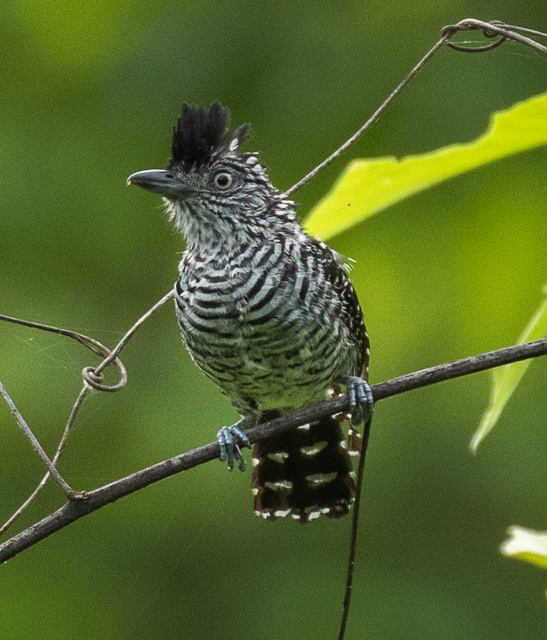
| Appearance | - Both sexes have a crest, a very long and wide tail, and a long gray bill with a hooked tip. English Wikipedia
- Adult males of the nominate subspecies have a black forehead, crown, and crest. English Wikipedia
- Adult males of the nominate subspecies have black-and-white barring on their backs, wings, and tails. English Wikipedia
- Adult males of the nominate subspecies have neutral gray faces, napes, throats, and underparts. English Wikipedia
- Adult females have a rufous crest with some black feather tips. English Wikipedia
- Adult females have cinnamon-buff and dark-brown barring on their backs, wings, and tails. English Wikipedia
- Adult females have mostly olive-colored faces, napes, throats, and underparts, becoming yellowish around the crissum. English Wikipedia
- The subspecies B. c. argentina is smaller than the nominate subspecies. English Wikipedia
- Male B. c. argentina individuals have fewer wing and tail bars than males of the nominate subspecies. English Wikipedia
- Female B. c. argentina individuals have less black on their crests and slightly paler upperparts than nominate females. English Wikipedia
- Female B. c. argentina individuals have warmer-colored underparts than nominate females. English Wikipedia
- The subspecies B. c. excubitor is paler overall than B. c. argentina. English Wikipedia
| - Both sexes possess a bushy crest and exhibit pronounced sexual dimorphism. English Wikipedia
- Adult males of the nominate subspecies have predominantly black-and-white barred plumage. English Wikipedia
- Adult females of the nominate subspecies have cinnamon-rufous crests and upperparts. English Wikipedia
- Adults of both sexes have pale yellow irises, black upper mandibles, bluish-gray lower mandibles, and lead-gray legs and feet. English Wikipedia
- Juvenile males have black and light yellowish-brown barring. English Wikipedia
|
|---|
| Size | | |
|---|
| Habitat | - The species generally occupies the understorey to mid-storey of its habitats. English Wikipedia
- In the Atlantic Forest, the species occurs in humid evergreen forest near sea level and in elfin forest at elevations of approximately 2,200 m. English Wikipedia
- In the Atlantic Forest, the species is almost always associated with large bamboo stands. English Wikipedia
- In the Andes, the species inhabits montane forest at elevations reaching 2,600 m. English Wikipedia
- In the Andes, the species primarily occupies dense vegetation along ravines and streams. English Wikipedia
- At lower elevations in Argentina, Bolivia, and Paraguay, the species inhabits stunted woodlands of the semi-arid Gran Chaco. English Wikipedia
- In the Gran Chaco, the species favors dense thorny thickets. English Wikipedia
| - The Coiba Island subspecies inhabits tropical deciduous forest. English Wikipedia
- The Tobago subspecies inhabits mature humid forest. English Wikipedia
- The eastern Brazilian subspecies T. d. capistratus primarily inhabits caatinga and restinga. English Wikipedia
- In eastern Colombia, the species frequently occurs on river islands. English Wikipedia
- In Ecuador, northern Peru, and much of Brazilian Amazonia, the species occurs almost exclusively on river islands. English Wikipedia
- In southern Bolivia, Paraguay, and Argentina, its habitats include savanna, scrub, secondary forest, and riverine belts. English Wikipedia
- In Mexico, Central America, and Colombia, the species occurs from sea level to approximately 1,500 m elevation. English Wikipedia
- In Venezuela, the species reaches elevations of 2,000 m, although most records are below 1,250 m. English Wikipedia
- In Ecuador, the species occurs only below 250 m elevation. English Wikipedia
|
|---|
| Diet | | - Its diet consists primarily of mature and larval insects, supplemented by other arthropods, small lizards, fruit, and seeds. English Wikipedia
- The species also feeds on prey escaping army ant swarms. English Wikipedia
|
|---|
| Behaviour | - The species is presumed to remain in its range throughout the year. English Wikipedia
- The species may make local movements in response to bamboo die-off. English Wikipedia
- The species usually forages alone or in pairs. English Wikipedia
- The species generally forages below approximately 5 m above the ground, although it may forage as high as 15 m. English Wikipedia
- The species does not participate in mixed-species feeding flocks. English Wikipedia
- The species searches for prey by hopping and making short flights. English Wikipedia
- The species captures prey by reaching from a perch toward leaves, stems, and branches. English Wikipedia
| - The species remains resident throughout its geographical range year-round. English Wikipedia
- Individuals typically forage in closely associated pairs within dense foliage from ground level to approximately 3 m, occasionally reaching 10 m. English Wikipedia
- The species almost never participates in mixed-species feeding flocks. English Wikipedia
- It captures prey by rapidly stabbing at leaves, stems, branches, and trunks. English Wikipedia
- Both sexes sing while stretching their necks, bowing forward, and pumping their tails up and down. English Wikipedia
|
|---|
| Reproduction | - The breeding season varies geographically but generally occurs between October and December. English Wikipedia
- The species builds a large, untidy cup nest from plant fibers and leaves. English Wikipedia
- The nest is typically placed in a branch fork among dense vegetation, approximately 1.5–3 m above the ground. English Wikipedia
- The usual clutch consists of two eggs. English Wikipedia
- The eggs are whitish and marked with darkish and reddish patterns. English Wikipedia
| - The species is monogamous, and breeding pairs vigorously defend territories throughout the year. English Wikipedia
- Territory sizes measured in one study ranged from approximately 2,500 to 4,200 square metres. English Wikipedia
- Breeding has been recorded in every month of the year somewhere within the species' range. English Wikipedia
- In Trinidad and Tobago, the species apparently breeds throughout the year. English Wikipedia
- The nest is an open, tightly woven cup with thin walls constructed from fungal and vegetable fibers, vines, grasses, and twigs. English Wikipedia
- The nest is generally suspended by its rim from a branch fork at heights reaching 10 m above the ground. English Wikipedia
- Both sexes participate in nest construction. English Wikipedia
- The usual clutch contains two eggs, although clutches of three have been reported in Trinidad. English Wikipedia
- Both parents incubate eggs during daylight, while only the female incubates at night. English Wikipedia
- A Costa Rican study recorded an incubation period of 13 days after the second egg was laid. English Wikipedia
- Studies in multiple countries recorded a period of 10–13 days between hatching and fledging. English Wikipedia
- Both parents brood and feed the nestlings. English Wikipedia
|
|---|
| Distribution | - The species has a geographically disjunct distribution. English Wikipedia
- The nominate subspecies occurs in southeastern Brazil, from southern Espírito Santo and southwestern São Paulo south to central Rio Grande do Sul, and extends into Misiones Province in northeastern Argentina. English Wikipedia
- The subspecies B. c. excubitor occurs only in western Santa Cruz Department in central Bolivia. English Wikipedia
- The subspecies B. c. argentina occurs in the Bolivian departments of Santa Cruz, Chuquisaca, and Tarija. English Wikipedia
- The subspecies B. c. argentina occurs in the Argentine provinces of Jujuy, Salta, and Tucumán. English Wikipedia
- The subspecies B. c. argentina occurs in western Paraguay's Boquerón and Presidente Hayes departments. English Wikipedia
| - The species occurs in Mexico, every Central American country, Trinidad and Tobago, and all mainland South American countries except Chile and Uruguay. English Wikipedia
- One accepted occurrence record exists from southern Texas. English Wikipedia
- The subspecies T. d. intermedius occurs from San Luis Potosí and Tamaulipas in east-central Mexico south through Central America to Costa Rica and possibly Panama. English Wikipedia
- The subspecies T. d. nesiotes occurs on the Pearl Islands in the Gulf of Panama. English Wikipedia
- The subspecies T. d. eremnus occurs on Coiba Island off western Panama. English Wikipedia
|
|---|
| Conservation | | - The IUCN classifies the species as Least Concern. English Wikipedia
- The estimated population comprises at least 50 million mature individuals and is considered stable. English Wikipedia
- Deforestation, habitat destruction, and habitat fragmentation are identified as challenges to the species' survival. English Wikipedia
|
|---|
| Name origin | No checked fact yet | - The specific epithet doliatus derives from Neo-Latin and means barred. English Wikipedia
|
|---|
| Other | - The species' song begins with a short trill followed by rapidly delivered notes that increase in strength and pitch before leveling out and slowing. English Wikipedia
- The species produces a long, raspy, downward-inflected snarl that is often repeated rapidly. English Wikipedia
- The species also produces short, even sequences of abrupt loud notes. English Wikipedia
| No checked fact yet |
|---|