Species · Birds
Giant Antshrike Batara cinerea
The scientific name of the Giant Antshrike is Batara cinerea. It is a species of bird in the family Thamnophilidae (antbird), order Passeriformes. The name dates from 1819.
- Scientific name
- Batara cinerea (Vieillot, 1819)
- Common name
- Giant Antshrike
- Genus
- Batara
- Family
- Thamnophilidae (Antbird)
- Order
- Passeriformes
- Class
- Aves
- Red List category
- LC Least Concern
- Recorded in
- 4 countries
- Name status
- accepted in the Catalogue of Life

Overview
Batara cinerea occurs in southeastern Brazil, Bolivia, Argentina, and western Paraguay.
Written 26 November 2026 from the sources listed below. Each statement was checked against the passage it cites; statements that could not be supported were removed.
Appearance
Adults measure 27–35 cm in length and weigh between 100 and 155 g. Both sexes have a crest, a very long and wide tail, and a long gray bill with a hooked tip.[1][2][3]
Adult males of the nominate subspecies have a black forehead, crown, and crest, with black-and-white barring on their backs, wings, and tails. Their faces, napes, throats, and underparts are neutral gray.[4][5][6]
Adult females have a rufous crest with some black feather tips and cinnamon-buff and dark-brown barring on their backs, wings, and tails. Their faces, napes, throats, and underparts are mostly olive-colored, becoming yellowish around the crissum.[7][8][9]
The subspecies B. c. argentina is smaller than the nominate subspecies. Males have fewer wing and tail bars, while females have less black on their crests, slightly paler upperparts, and warmer-colored underparts than nominate females.[10][11][12][13]
The subspecies B. c. excubitor is paler overall than B. c. argentina.[14]
Habitat
The species generally occupies the understorey to mid-storey of its habitats. Its distribution is geographically disjunct.[15][16]
In the Atlantic Forest, it occurs in humid evergreen forest near sea level and in elfin forest at elevations of approximately 2,200 m. It is almost always associated with large bamboo stands.[17][18]
In the Andes, it inhabits montane forest at elevations reaching 2,600 m. It primarily occupies dense vegetation along ravines and streams.[19][20]
At lower elevations in Argentina, Bolivia, and Paraguay, it inhabits stunted woodlands of the semi-arid Gran Chaco. It favors dense thorny thickets.[21][22]
Behaviour
The species is presumed to remain in its range throughout the year. It may make local movements in response to bamboo die-off.[23][24]
It usually forages alone or in pairs and does not participate in mixed-species feeding flocks. It generally forages below approximately 5 m above the ground, although it may forage as high as 15 m.[25][26][27]
It searches for prey by hopping and making short flights. It captures prey by reaching from a perch toward leaves, stems, and branches.[28][29]
Diet
The species feeds on a variety of large insects and other arthropods, as well as molluscs. Its diet includes small vertebrates such as frogs, lizards, and snakes.[30][31][32]
Its diet may also include mice, nestling birds, and bird eggs.[33]
Reproduction and life cycle
The breeding season varies geographically but generally occurs between October and December.[34]
The species builds a large, untidy cup nest from plant fibers and leaves. The nest is typically placed in a branch fork among dense vegetation, approximately 1.5–3 m above the ground.[35][36]
The usual clutch consists of two eggs. The eggs are whitish and marked with darkish and reddish patterns.[37][38]
Conservation
The population size is unknown and is believed to be decreasing. No immediate threats have been identified, and the species occurs in several large protected areas.[39][40][41]
Classification of the Giant Antshrike
| Kingdom | Animalia |
|---|---|
| Phylum | Chordata |
| Subphylum | Vertebrata |
| Infraphylum | Gnathostomata |
| Parvphylum | Osteichthyes |
| Megaclass | Tetrapoda |
| Class | Aves (Bird) |
| Order | Passeriformes (Passerine) |
| Family | Thamnophilidae (Antbird) |
| Genus | Batara |
| Species | Batara cinerea (Vieillot, 1819) |
Where the Giant Antshrike is found
Checklists and occurrence records place Batara cinerea in 4 countries across South America. GBIF holds 11,202 georeferenced records of it.
Countries
Regions and cities with the most records
- São Paulo, Brazil 4,093
- Rio de Janeiro, Brazil 1,472
- Jujuy, Argentina 1,236
- Guapiara, Brazil 984
- Santa Catarina, Brazil 907
- Cubatão, Brazil 840
- Salta, Argentina 815
- Rio Grande da Serra, Brazil 793
- Ribeirão Pires, Brazil 792
- Paraná, Brazil 728
- Nova Friburgo, Brazil 642
- Bertioga, Brazil 478
- Salta, Argentina 472
- Libertador General San Martín, Argentina 440
- Santa Cruz Department, Bolivia 432
- Cachoeiras de Macacu, Brazil 410
- Rio Grande do Sul, Brazil 406
- Misiones, Argentina 400
- Mauá, Brazil 390
- Teresópolis, Brazil 312
- São Pedro, Brazil 311
- Guapimirim, Brazil 282
- San Lorenzo, Argentina 273
- Itatiaia, Brazil 256
- Minas Gerais, Brazil 245
- Salesópolis, Brazil 237
- Resende, Brazil 217
- Piraquara, Brazil 204
- Bom Jardim, Brazil 185
- Campos do Jordão, Brazil 177
- Quatro Barras, Brazil 175
- San José de los Cerrillos, Argentina 171
- São Vicente, Brazil 161
- Petrópolis, Brazil 157
- Morretes, Brazil 156
- Campina Grande do Sul, Brazil 153
Range as the checklists state it
South America
A number beside a place is its count of GBIF occurrence records. A place without a number comes from a checklist alone. Records show where a species has been observed or collected, which can include escapes and vagrants.
Common names
English
- Giant Antshrike
Names in 23 other languages
- Catalan
- batarà gegant
- Chinese
- 巨蚁鵙, 巨蟻鵙
- Croatian
- velika mravarica
- Czech
- mravenčík největší
- Danish
- Kæmpemyretornskade
- Dutch
- Reuzenmierklauwier
- Esperanto
- giganta formikulo
- Finnish
- jättimuura
- French
- Batara géant
- German
- Riesen-Ameisenwürger, Riesenameisenwürger
- Hungarian
- óriás-hangyászgébics
- Italian
- Averla formichiera gigante
- Japanese
- オニアリモズ
- Lithuanian
- batara
- Norwegian
- risemaurvarsler
- Portuguese
- Brugaiara, formigueiro-gigante, matracão
- Russian
- Гигантская батара
- Slovak
- batara obria
- Spanish
- Batará gigante
- Swedish
- jättemyrtörnskata
- Turkish
- Koca Karıncaavcısı
- Ukrainian
- батара
- Welsh
- morgrugydd cawraidd
Synonyms
3 other scientific names have been used for this species and are now treated as synonyms of Batara cinerea.
- Lanius undulatus Mikan, JC, 1820
- Tamnophilus cinereus Vieillot, LJP, 1819
- Thamnophilus cinereus Vieillot, 1819
Subspecies and varieties
- Batara cinerea argentina subspecies
- Batara cinerea cinerea subspecies
- Batara cinerea excubitor subspecies
Related species
-
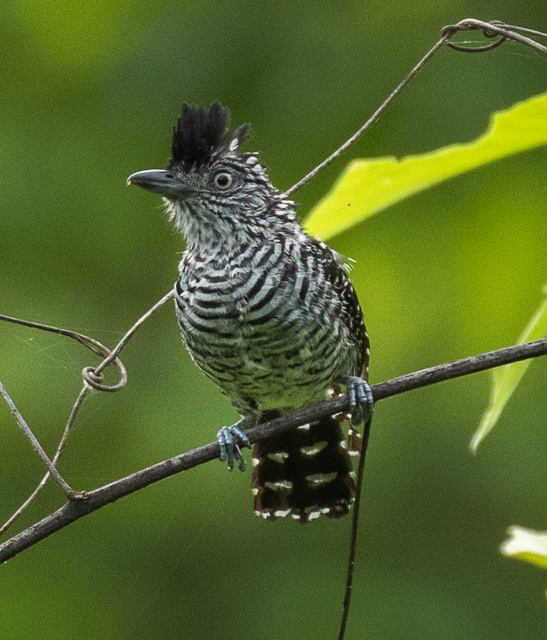 Barred AntshrikeThamnophilus doliatus
-
 Great AntshrikeTaraba major
-
 Black-crowned AntshrikeThamnophilus atrinucha
-
 Ocellated AntbirdPhaenostictus mcleannani
-
 Bicolored AntbirdGymnopithys bicolor
-
 Fasciated AntshrikeCymbilaimus lineatus
-
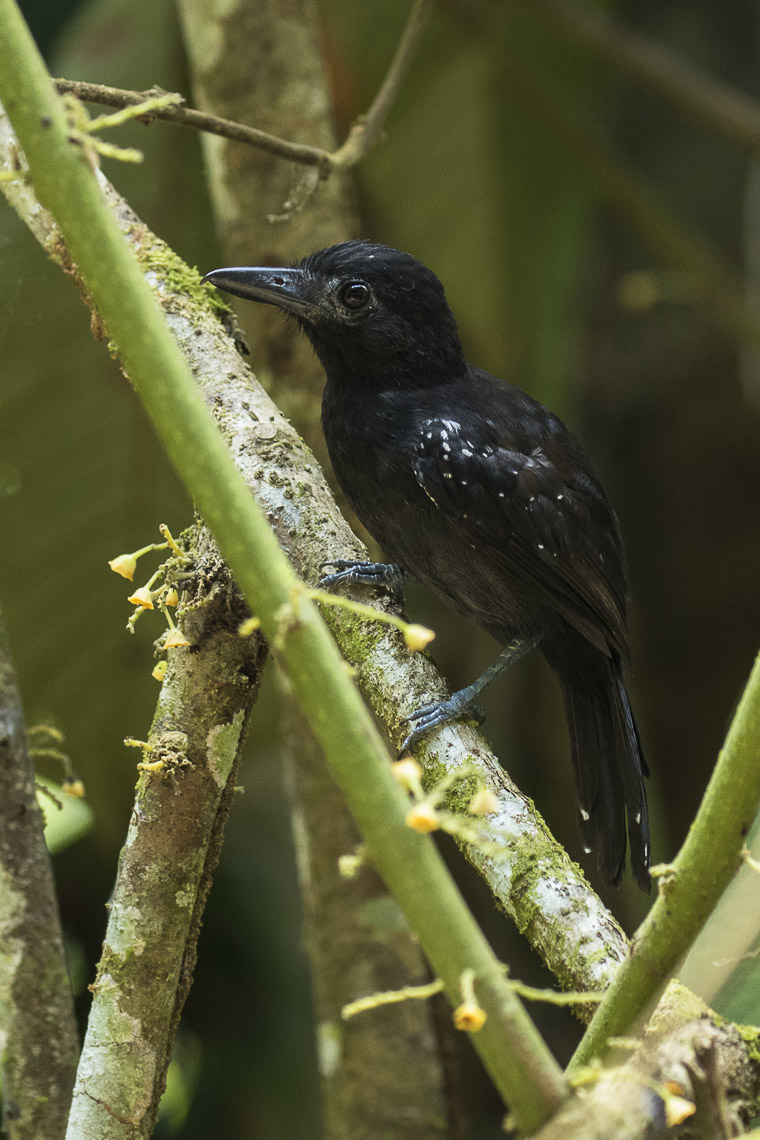 Black-hooded AntshrikeThamnophilus bridgesi
-
 Black-crested AntshrikeSakesphorus canadensis
Compare
Questions and answers
What is the scientific name of the Giant Antshrike?
The scientific name of the Giant Antshrike is Batara cinerea. Written with its author, the full name is Batara cinerea (Vieillot, 1819).
Which family does the Giant Antshrike belong to?
Batara cinerea belongs to the family Thamnophilidae, in the order Passeriformes and the class Aves.
Where is the Giant Antshrike found?
Checklists and occurrence records place Batara cinerea in 4 countries: Brazil, Argentina, Bolivia and Paraguay.
What is the conservation status of the Giant Antshrike?
The IUCN Red List category recorded for Batara cinerea is Least Concern (LC).
What sounds does the Giant Antshrike produce?
Its song begins with a short trill followed by rapidly delivered notes that increase in strength and pitch before leveling out and slowing. It also produces a long, raspy, downward-inflected snarl that is often repeated rapidly, and short, even sequences of abrupt loud notes.[42][43][44]
Where does the nominate subspecies occur?
The nominate subspecies occurs in southeastern Brazil, from southern Espírito Santo and southwestern São Paulo south to central Rio Grande do Sul, and extends into Misiones Province in northeastern Argentina.[45]
Where does B. c. excubitor occur?
It occurs only in western Santa Cruz Department in central Bolivia.[46]
Sources
Passages the profile rests on
- Adults measure 27–35 cm in length. Source passage: “27 to 35 cm (11 to 14 in) long” — English Wikipedia
- Adults weigh between 100 and 155 g. Source passage: “weighing 100 to 155 g (3.5 to 5.5 oz)” — English Wikipedia
- Both sexes have a crest, a very long and wide tail, and a long gray bill with a hooked tip. Source passage: “both sexes have a crest, a very long and wide tail, and a long gray bill with a hook at the end like true shrikes.” — English Wikipedia
- Adult males of the nominate subspecies have a black forehead, crown, and crest. Source passage: “Adult males of the nominate subspecies have a black forehead, crown, and crest.” — English Wikipedia
- Adult males of the nominate subspecies have black-and-white barring on their backs, wings, and tails. Source passage: “Their back, wings, and tail are barred with black and white.” — English Wikipedia
- Adult males of the nominate subspecies have neutral gray faces, napes, throats, and underparts. Source passage: “Their face, nape, throat, and underparts are neutral gray.” — English Wikipedia
- Adult females have a rufous crest with some black feather tips. Source passage: “Adult females have a rufous crest with some black feather tips.” — English Wikipedia
- Adult females have cinnamon-buff and dark-brown barring on their backs, wings, and tails. Source passage: “Their back, wings, and tail are barred with cinnamon-buff and dark brown.” — English Wikipedia
- Adult females have mostly olive-colored faces, napes, throats, and underparts, becoming yellowish around the crissum. Source passage: “Their face, nape, throat, and underparts are mostly olive that becomes yellowish by their crissum.” — English Wikipedia
- The subspecies B. c. argentina is smaller than the nominate subspecies. Source passage: “Subspecies B. c. argentina is smaller than the nominate.” — English Wikipedia
- Male B. c. argentina individuals have fewer wing and tail bars than males of the nominate subspecies. Source passage: “males have fewer bars on their wings and tail” — English Wikipedia
- Female B. c. argentina individuals have less black on their crests and slightly paler upperparts than nominate females. Source passage: “females have less black on their crest, slightly paler upperparts” — English Wikipedia
- Female B. c. argentina individuals have warmer-colored underparts than nominate females. Source passage: “and warmer underparts.” — English Wikipedia
- The subspecies B. c. excubitor is paler overall than B. c. argentina. Source passage: “B. c. excubitor is paler overall than argentina” — English Wikipedia
- The species has a geographically disjunct distribution. Source passage: “The giant antshrike has a disjunct distribution.” — English Wikipedia
- The species generally occupies the understorey to mid-storey of its habitats. Source passage: “in all it favors the understorey to mid-storey.” — English Wikipedia
- In the Atlantic Forest, the species occurs in humid evergreen forest near sea level and in elfin forest at elevations of approximately 2,200 m. Source passage: “In the Atlantic Forest it occurs from humid evergreen forest near sea level up to elfin forest at about 2,200 m (7,200 ft).” — English Wikipedia
- In the Atlantic Forest, the species is almost always associated with large bamboo stands. Source passage: “It almost always is found in or near large stands of bamboo.” — English Wikipedia
- In the Andes, the species inhabits montane forest at elevations reaching 2,600 m. Source passage: “To the west in the Andes it occurs in montane forest as high as 2,600 m (8,500 ft)” — English Wikipedia
- In the Andes, the species primarily occupies dense vegetation along ravines and streams. Source passage: “mostly in dense vegetation along ravines and streams.” — English Wikipedia
- At lower elevations in Argentina, Bolivia, and Paraguay, the species inhabits stunted woodlands of the semi-arid Gran Chaco. Source passage: “At lower elevations in Argentina, Bolivia, and Paraguay it occurs in stunted woodlands of the semi-arid Gran Chaco” — English Wikipedia
- In the Gran Chaco, the species favors dense thorny thickets. Source passage: “where it favors dense thorny thickets.” — English Wikipedia
- The species is presumed to remain in its range throughout the year. Source passage: “The giant antshrike is presumed to be a year-round resident throughout its range” — English Wikipedia
- The species may make local movements in response to bamboo die-off. Source passage: “though local movements in response to bamboo die-off are likely.” — English Wikipedia
- The species usually forages alone or in pairs. Source passage: “It usually forages singly or in pairs” — English Wikipedia
- The species generally forages below approximately 5 m above the ground, although it may forage as high as 15 m. Source passage: “mostly below about 5 m (15 ft) above the ground though as high as 15 m (50 ft).” — English Wikipedia
- The species does not participate in mixed-species feeding flocks. Source passage: “It does not join mixed-species feeding flocks.” — English Wikipedia
- The species searches for prey by hopping and making short flights. Source passage: “It hops and makes short flights to find prey” — English Wikipedia
- The species captures prey by reaching from a perch toward leaves, stems, and branches. Source passage: “which it gleans by reaching from a perch to leaves, stems, and branches.” — English Wikipedia
- The species feeds on a variety of large insects and other arthropods. Source passage: “The giant antshrike feeds on a variety of large insects and other arthropods” — English Wikipedia
- Its diet includes molluscs. Source passage: “its diet also includes molluscs” — English Wikipedia
- Its diet includes small vertebrates such as frogs, lizards, and snakes. Source passage: “small vertebrates like frogs, lizards, and snakes” — English Wikipedia
- Its diet may also include mice, nestling birds, and bird eggs. Source passage: “and possibly mice, nestling birds, and bird eggs.” — English Wikipedia
- The breeding season varies geographically but generally occurs between October and December. Source passage: “The giant antshrike's breeding season appears to vary geographically but is generally within October to December.” — English Wikipedia
- The species builds a large, untidy cup nest from plant fibers and leaves. Source passage: “It makes a large messy cup nest of plant fibers and leaves” — English Wikipedia
- The nest is typically placed in a branch fork among dense vegetation, approximately 1.5–3 m above the ground. Source passage: “typically in a branch fork among dense vegetation about 1.5 to 3 m (5 to 10 ft) above the ground.” — English Wikipedia
- The usual clutch consists of two eggs. Source passage: “The usual clutch is two eggs” — English Wikipedia
- The eggs are whitish and marked with darkish and reddish patterns. Source passage: “which are whitish with darkish and reddish markings.” — English Wikipedia
- The species' population size is unknown and is believed to be decreasing. Source passage: “its population size is not known and is believed to be decreasing.” — English Wikipedia
- No immediate threats to the species have been identified. Source passage: “No immediate threats have been identified.” — English Wikipedia
- The species occurs in several large protected areas. Source passage: “It occurs in several large protected areas.” — English Wikipedia
- The species' song begins with a short trill followed by rapidly delivered notes that increase in strength and pitch before leveling out and slowing. Source passage: “series that starts with a short trill and continues with a fast series of notes that increase in strength and pitch, leveling out and decelerating at the end” — English Wikipedia
- The species produces a long, raspy, downward-inflected snarl that is often repeated rapidly. Source passage: “long, raspy, downward-inflected snarl, often repeated rapidly” — English Wikipedia
- The species also produces short, even sequences of abrupt loud notes. Source passage: “and a short even series of abrupt loud notes” — English Wikipedia
- The nominate subspecies occurs in southeastern Brazil, from southern Espírito Santo and southwestern São Paulo south to central Rio Grande do Sul, and extends into Misiones Province in northeastern Argentina. Source passage: “It is found from southern Espírito Santo and southwestern São Paulo states in southeastern Brazil south to central Rio Grande do Sul and into northeastern Argentina's Misiones Province.” — English Wikipedia
- The subspecies B. c. excubitor occurs only in western Santa Cruz Department in central Bolivia. Source passage: “Subspecies B. c. excubitor is found only in western Santa Cruz Department in central Bolivia.” — English Wikipedia
- The subspecies B. c. argentina occurs in the Bolivian departments of Santa Cruz, Chuquisaca, and Tarija. Source passage: “B. c. argentina is found in southern Bolivia's Santa Cruz, Chuquisaca and Tarija departments” — English Wikipedia
- The subspecies B. c. argentina occurs in the Argentine provinces of Jujuy, Salta, and Tucumán. Source passage: “in northwestern Argentina's Jujuy, Salta, and Tucumán provinces” — English Wikipedia
- The subspecies B. c. argentina occurs in western Paraguay's Boquerón and Presidente Hayes departments. Source passage: “and in western Paraguay's Boquerón and Presidente Hayes departments.” — English Wikipedia
Data
- Catalogue of Life, 2026-10-16 XR cc by
- Global Biodiversity Information Facility CC BY 4.0
- Wikidata CC0
- GeoNames CC BY 4.0
- Wikimedia Commons per image; credit shown with each image
- Within the Catalogue of Life, this name comes from The Integrated Taxonomic Information System cc0
References
- Gill, Frank, & and Minturn Wright. (2006). Birds of the World: Recommended English Names.
This species in other databases
Page built on 27 November 2026. See how the catalog is made and all sources and licences.
Cite this page
ScientificNames.org. (2026). Batara cinerea (Giant Antshrike). Retrieved November 27, 2026, from https://scientificnames.org/species/batara-cinerea
“Batara cinerea (Giant Antshrike).” ScientificNames.org, 2026, scientificnames.org/species/batara-cinerea. Accessed 27 Nov. 2026.
ScientificNames.org. “Batara cinerea (Giant Antshrike).” Accessed November 27, 2026. https://scientificnames.org/species/batara-cinerea.
@misc{scientificnames_batara_cinerea_giant_antshrike,
  author = {{ScientificNames.org}},
  title = {Batara cinerea (Giant Antshrike)},
  year = {2026},
  url = {https://scientificnames.org/species/batara-cinerea},
  note = {Accessed 2026-11-27}
}